

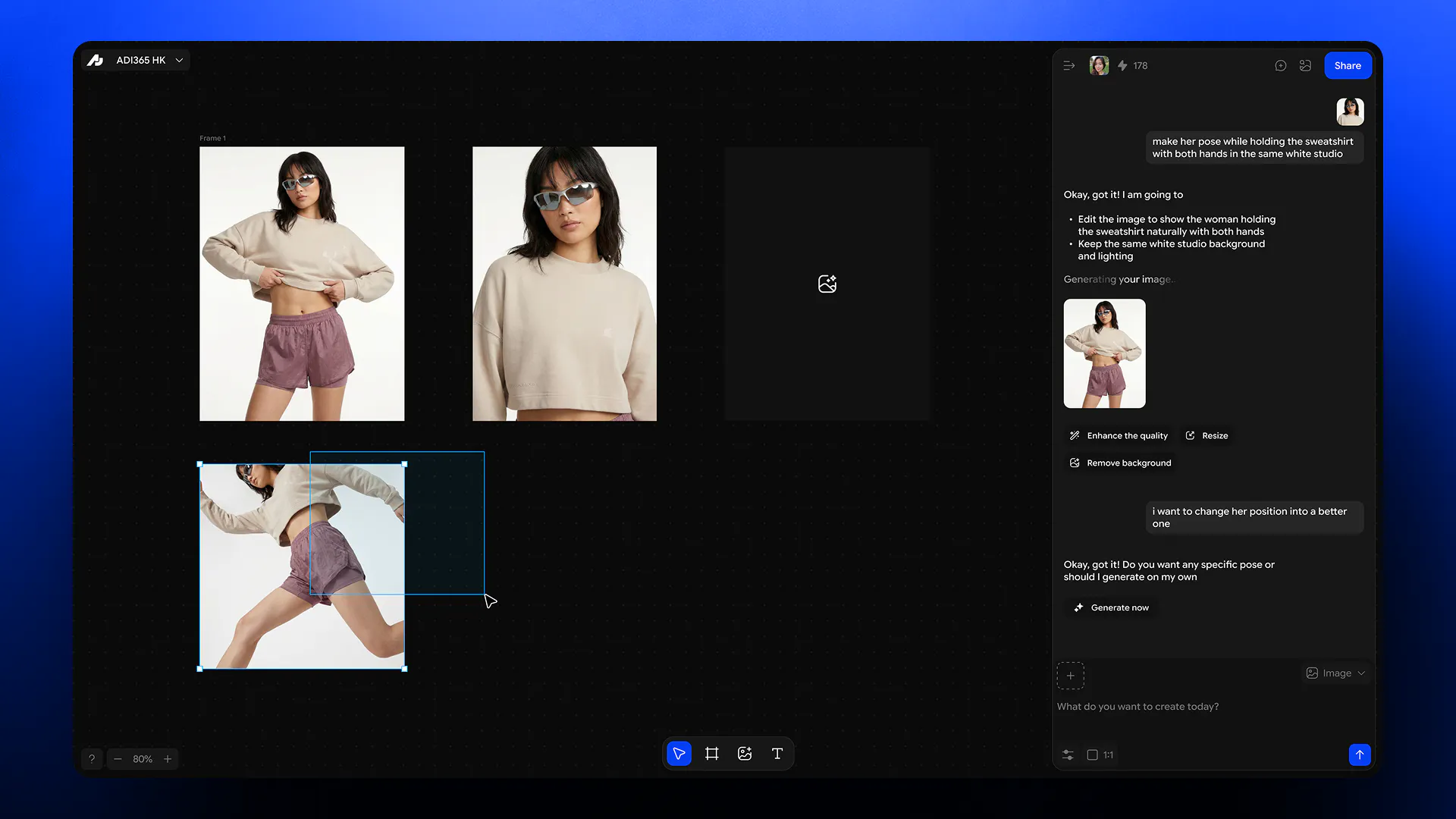
About Adject 2.0
Reviews 14
-
Neal Jacobson 6 months ago
This is really interesting for anyone doing product photography on a budget. I'm building a SaaS and the amount of time (and money) we've spent on product screenshots and marketing visuals is absurd. Question: how does it handle consistency across multiple shots? One of the biggest problems with AI-generated product visuals is that the product looks slightly different in each render — lighting, angle, even color can shift. For a landing page where you need 6 screenshots that look like the same photoshoot, is there a way to lock the style?
-
Korbin Effertz 6 months ago
Didn’t Google release a similar program a few weeks ago for free (unfortunately I don’t remember the name)? For online stores.
-
Rylan Cremin 6 months ago
The idea of keeping all products, models and edits connected in one place sounds like a practical way to maintain creative flow instead of hopping between generate and download. Just wanted to understand if it handles tricky materials like fabric or reflective surfaces well, since those often need subtle lighting and texture detail to feel real.
-
Toni Kutch 6 months ago
Solid execution on a real pain point. We produce a lot of B2B service collateral and one of the consistent headaches is creating professional visuals without the cost of a dedicated design team. The upload once, iterate without starting over workflow is exactly what non-designers need. Curious whether the output quality holds for B2B use cases like software UI screenshots or professional service imagery, or is it primarily tuned for physical product photography?
-
Merl Orn 6 months ago
The interesting thing about hyperrealistic AI product visuals isn't just the static output — it's that the same generation stack pushes "AI-as-content-source" past product photography into narrative-shaped applications: walking tours, location-based stories, scene-building. We've been playing with this on StoryRoute (interactive travel narratives that adapt to where you are in a city), and the bottleneck has shifted from generation quality to *grounding* — making sure the AI doesn't invent a building that isn't actually on that corner. Curious how Adject handles the grounding problem for product context — is there a reference-image pipeline that prevents drift from the real product geometry?
-
Zachariah Hudson 6 months ago
Product fidelity across iterations is the hardest problem in this space. Most AI image tools subtly morph the product after a few edits. How does Adject keep it consistent? Reference image locked in, or something else?
-
Halle Wilkinson 6 months ago
How does it handle brand guidelines? Can you lock certain elements so the AI doesn't drift from them? Congrats on the launch!
-
Maxwell Blanda 6 months ago
This actually looks super useful for ecommerce 😭 Upload once and keep iterating different concepts without reprompting every time. Feels way more practical for brands/content teams than most AI image tools.
-
Monserrate VonRueden 6 months ago
Love the upload once idea. It really solves the annoying problem of doing the same thing again and again.
-
Quincy Medhurst 6 months ago
This is the one worth attention today in my opinion. The generate/download/repeat loop in most AI image tools kills any sense of creative momentum. So, keeping products/models/edits all connected in one place is how creative teams actually think about campaigns. Wonder how you guys handle products with complex textures like fabric or reflective packaging?
-
Rahul Goyette 6 months ago
Hello Product Hunt community! 😸 Bringing Adject v2 to life has been an amazing journey. As the team building the AI infrastructure, our biggest challenge (and most fun task) was setting up the new chatting logic. Getting the agent architectures to communicate perfectly to provide a smooth user experience took a lot of late nights, but we are really proud of the result. Please give it a spin and let us know where we can improve. I'm looking forward to reading your feedback and answering your questions!
-
Johnathan Homenick 6 months ago
Interesting shift from one-off generations to a continuous creative workflow. Keeping assets, edits, and iterations connected inside projects solves a real pain for teams. This could meaningfully streamline how campaigns are built. How you handle consistency across iterations (lighting, textures, brand identity) and how collaborative workflows are managed?
-
Charley Swift 6 months ago
Tried a lot of AI design tools before but most of them feel like one-time prompt generators tbh. You make something nice, then the whole workflow resets again Adject 2.0 feels much smoother. Being able to keep everything in one infinite workspace and continue iterating without constantly re-uploading or restarting honestly makes a huge difference. One of the few AI creative tools that actually feels built for real workflows. Would really love to hear your thoughts and feedback, especially from people interested in the future of creative AI tools.
-
Conner Jacobs 6 months ago
I'm one of the people on the team behind Adject, and we spent a lot of time wrestling with the technical side on this release 😄 Going from 1.5 to 2.0, we didn't really add a feature, we changed the mental model. In v1, every generation started from zero. Prompt, download, start over. It worked, but every campaign meant rebuilding the context all over again. In 2.0, products, models, edits, and assets all live connected to each other. The agent doesn't work inside a single box anymore, it sees the whole workspace. We had to seriously rethink how state and context move through the system. Big thanks to everyone on the team, it was great to ship something like this together. Happy to chat with anyone who has questions about the architecture or the agentic workflow side.