

agentfdr
See why your coding agent looped, drifted, or burned tokens
About agentfdr
Reviews 10
-
Ayden Miller 4 months ago
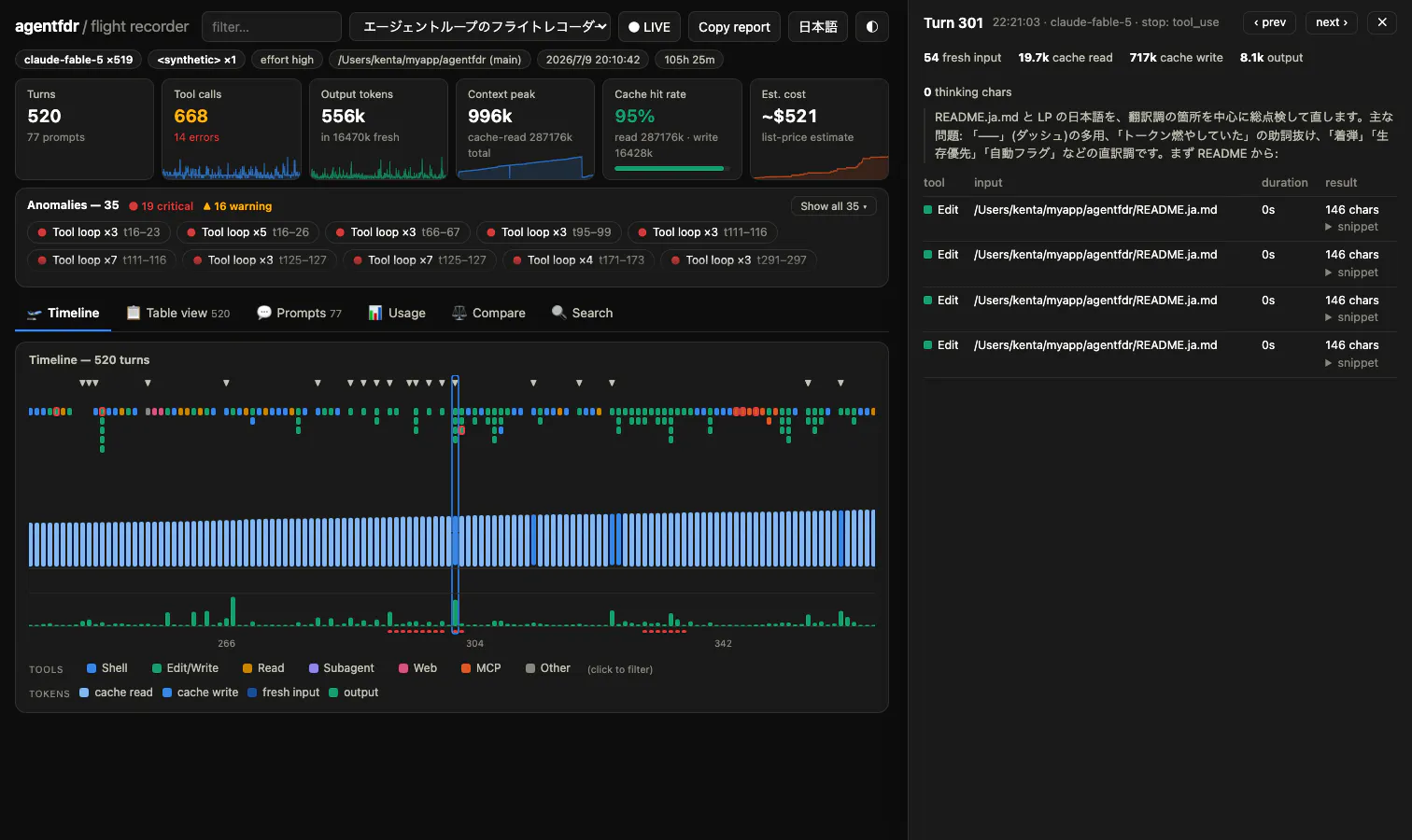
v0.5 — Codex CLI support, full-text search, and a 12-month activity heatmap A lot has shipped since launch day — much of it straight from the feedback in these comments. Thank you! 🤝 OpenAI Codex CLI support (v0.5) — agentfdr is no longer Claude Code-only. Codex rollouts under ~/.codex/sessions/ are auto-discovered next to your Claude projects, and everything works on both: the timeline, anomaly detectors, search, session diff, blame reports, and the CI gate. Same zero setup — if you use both agents, they now share one cockpit. 🔎 Full-text search (v0.4) — agentfdr search "rate limit" scans every prompt, reply, tool call and result across all your sessions and jumps straight to the matching turn. "Which session was that in?" is now one command. 🟩 Activity heatmap — a GitHub-grass view of your daily token burn over the last 12 months, right in the Usage tab. ⚙️ Config file (v0.3) — tune detector thresholds, suppress loops that are legitimate for your workflow (retrying tests, polling builds), and add your own regex rules as first-class anomaly flags. This one came directly from a comment here on launch day. 🎨 UI overhaul — anomalies get their own card with severity badges, the side panel shows a session overview while nothing is selected, and the session filter is a proper quick-open now. Still zero dependencies, still 100% local: npx agentfdr If you tried agentfdr on launch day, npm i -g agentfdr@latest is a very different tool today. And if you use Codex — I'd love to hear how your rollouts parse.
-
Chelsey Gottlieb 4 months ago
A lot shipped since launch day — much of it straight from the feedback in these comments. Thank you! 🔎 Full-text search (`agentfdr search` + a Search tab) — search every prompt, assistant reply, tool call and result across all your sessions, and jump straight to the matching turn. "Which session had that rate-limit error last week?" is now one command. 🟩 Activity heatmap — a GitHub-grass view of your daily token burn over the last 12 months, right in the Usage tab. ⚙️ Config file (v0.3) — tune detector thresholds, suppress loops that are legitimate for your workflow (retrying tests, polling builds), and add your own regex rules as first-class anomaly flags. 🎨 UI overhaul — anomalies get their own card with severity badges, tabs got icons, and the side panel now shows a session overview (top tools, most-edited files) while nothing is selected. Still zero dependencies, still 100% local. `npx agentfdr` If you tried agentfdr on launch day, `npm i -g agentfdr@latest` is worth it.
-
Reilly Thiel 4 months ago
How does this handle Claude Code sessions that span multiple branches or get interrupted mid-turn? Wondering if the timeline stays coherent or if the anomaly detection gets noisy when there's a context reset.
-
Monserrate VonRueden 4 months ago
how does it flag loops in real time without hooking into the actual conversation state
-
Lance Morar 4 months ago
finally something that makes my long claude code sessions actually reviewable, the loop detection caught a stuck tool call i would have missed for sure
-
Derick Koelpin 4 months ago
does the anomaly detection work offline too, or does it need to ping anywhere to flag loops and token burns? curious how it stays 100% local with that kind of analysis.
-
Carter Volkman 4 months ago
Love that you skipped the SDK and just read what Claude Code already writes to disk, zero instrumentation feels like the right call. The per-turn timeline plus automatic loop and token burn flags is exactly what I'd want when something goes sideways mid-session.
-
Daren Bruen 4 months ago
How does it actually surface the anomaly flags in real time during a session, and is there any way to set custom thresholds for things like token burn before it pings you?
-
Joaquin Wisozk 4 months ago
the "assert --no-loops --max-tokens" gate is the part i'd actually want running unattended, not just the timeline after the fact. question on tuning it though: some loops are legitimate, retrying a failing test until it passes, polling a build, re-reading a file after an edit. how does it tell that apart from a genuinely pathological loop before it kills the run? is the anomaly detection just repetition-count based, or does it look at whether the tool calls are converging toward something (diffs shrinking, errors changing) vs just spinning in place
-
Ruben McClure 4 months ago
finally something that surfaces loop patterns in long claude sessions without making me grep through jsonl files, the live watch mode is genuinely useful when a run starts drifting.