

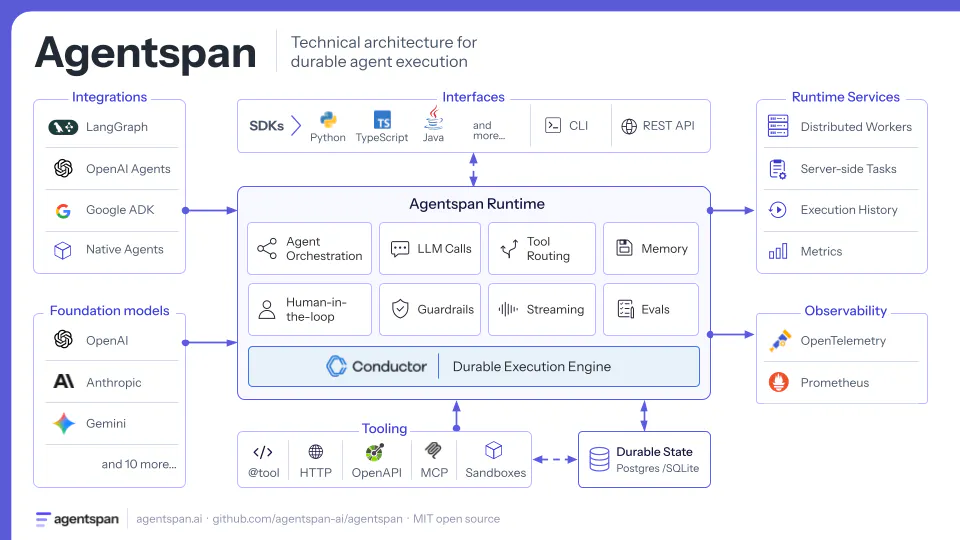
About Agentspan
Reviews 6
-
Chaim Schuppe 6 months ago
Does a failed tool call mid-run restart from the last checkpoint or from the top? Most frameworks (afaik) treat the whole run as atomic, which defeats the point for long-running agents.
-
Rylan Cremin 6 months ago
The durability layer is the piece most agent frameworks skip. We're building AI workflows at RetainSure and the biggest headache isn't the LLM calls, it's what happens when a step fails partway through and the state is gone. Keeping execution state server side while defining agents client side is a clean separation. Does Agentspan support partial retries, or does a failure restart the whole run?
-
Rocio Cormier 6 months ago
Crash recovery for agents is the thing nobody talks about until it breaks in production. We've had workflows silently fail partway through with no state to resume from. Human in the loop approvals are the other piece teams always bolt on last minute. Does Agentspan support branching approvals, where different steps route to different reviewers?
-
Murray Kuhlman 6 months ago
The durable runtime angle is the part I’d look at first. For agent teams, the hard bit is usually not starting a run, it’s resuming state, handling approvals, and seeing exactly what changed after a long task.
-
Buck Yundt 6 months ago
Durable AI agents that survive failures and interruptions is one of the harder infrastructure problems right now. Open-sourcing the runtime is a real commitment to the ecosystem. We've been building in the customer success for developer tool companies space at RetainSure, and Agentspan touches on something we think about a lot: how agent persistence changes what's possible in long-running business workflows. What's your approach to handling state when agents run for hours or days?
-
Korey Hammes 6 months ago
@nickorkes Congrats! Looks amazing, it's super cool for people who want to just focus on the code and don't spend too much time on the infra. QQ, maybe trivial since I didn't check the codebase in detail, but by server, you mean it's still local, right? Not based on any specific cloud provider. It could be amazing to see adapter/connectors/versions on major cloud providers too, and have it super easy to deploy with few line of code (then no need to learn anything major from any provider side).