

Angy
Multi‑agent pipelines w/ AI‑driven scheduling + safety check
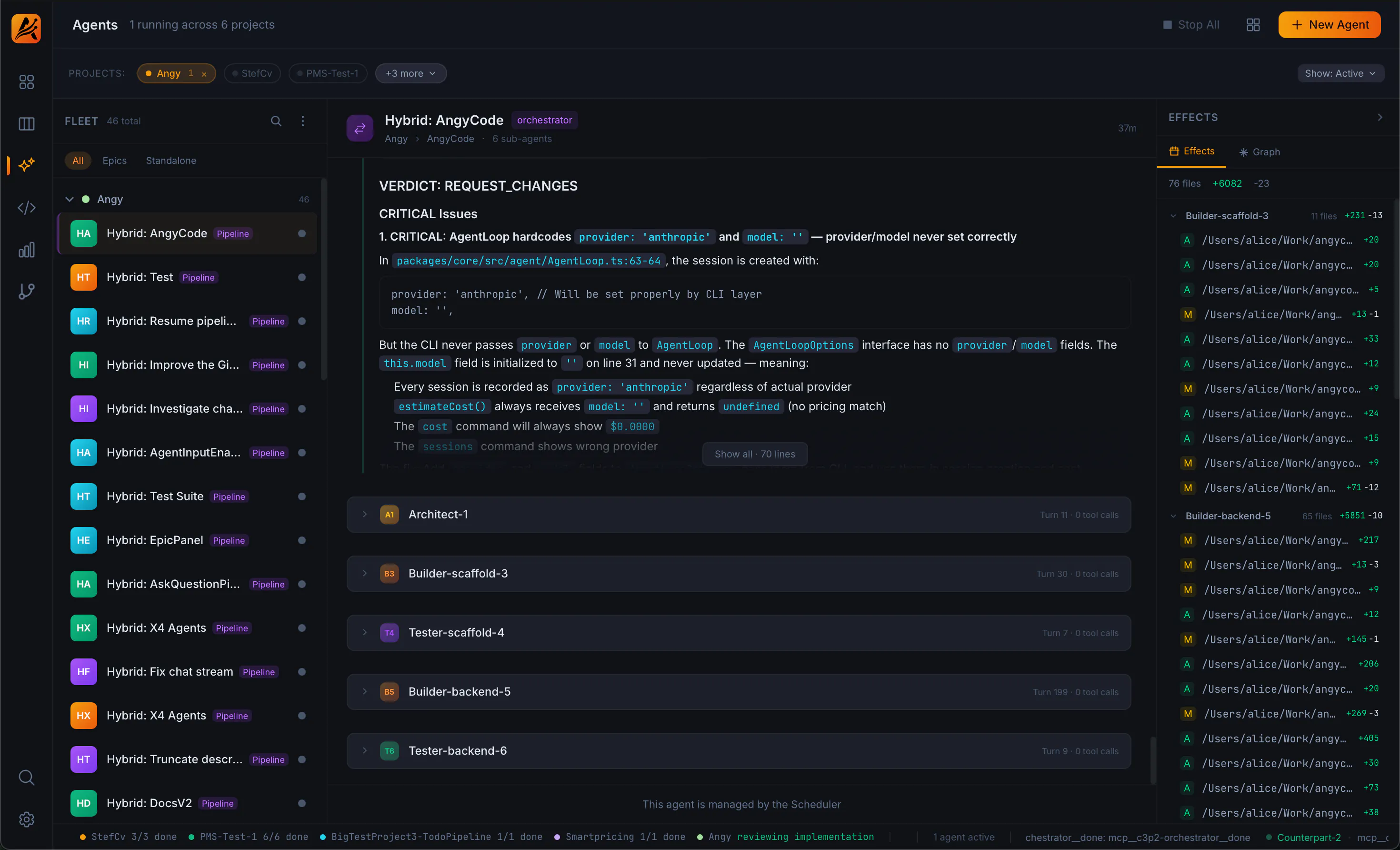
About Angy
Reviews 7
-
Kay Balistreri 6 months ago
Really like this direction. Most coding agent demos still feel optimized around showing autonomy, while this feels optimized around reliability. Having a counterpart that blocks shipping until it's satisfied is a more honest way to build reliability into the pipeline. What I want to know is whether the debate loop scales or just becomes a slower, more expensive way to still miss obvious issues.
-
Daren Bruen 8 months ago
Starting from version 0.4.0 we added our own agentic loop inside Angy, so you can also use Gemini and Anthropic with api keys 🚀
-
Mckenzie Mosciski 8 months ago
How does the adversarial Counterpart agent decide when code is good enough to pass verification? Congrats on the launch!
-
Rahul Goyette 8 months ago
The AI-driven scheduling angle is interesting when you say "safety check," is that checking the agent's output before it acts, or something closer to rate-limiting and permission scoping on what the agent is allowed to call? Curious where in the pipeline that enforcement actually lives.
-
Wiley Lubowitz 8 months ago
@alice_viola_setti I was just yesterday looking for a solution to visualize agent work. And it seems like... I searched in Claude, searched in ChatGPT, and each of them offered their own solution that didn't really satisfy me. So listen, great idea. I think this definitely needs to be tried, especially for overnight runs.
-
Neal Jacobson 8 months ago
Hi guys, congrats on the launch! I love the concept of the product you are building. Could you please tell what are your thoughts on how to compete with bigger developer tools? Wouldn't they ship same features in the next few releases?
-
Mckenzie Mosciski 8 months ago
The adversarial Counterpart agent that strictly verifies code before shipping is the missing piece in most AI coding pipelines — the Architect → Counterpart → Build → Test deterministic loop with a gatekeeper that blocks merges until satisfied should catch the integration failures that single-agent tools routinely miss when generating code in isolation. The fact that Angy bootstrapped its own development after just one day of initial Cursor work is a compelling proof of concept; with the integrated scheduler running epics overnight, how does the Counterpart agent handle ambiguous requirements — does it flag spec gaps back to the user, or does it interpret intent and proceed autonomously?