

About Atlas
Reviews 15
-
Rahul Goyette 4 months ago
i was wondering you say I will own the content graph if I use Atlas what happens if i stop payng the $99 a month do i still own it. It seem to me you own it im just renting
-
Karley Frami 4 months ago
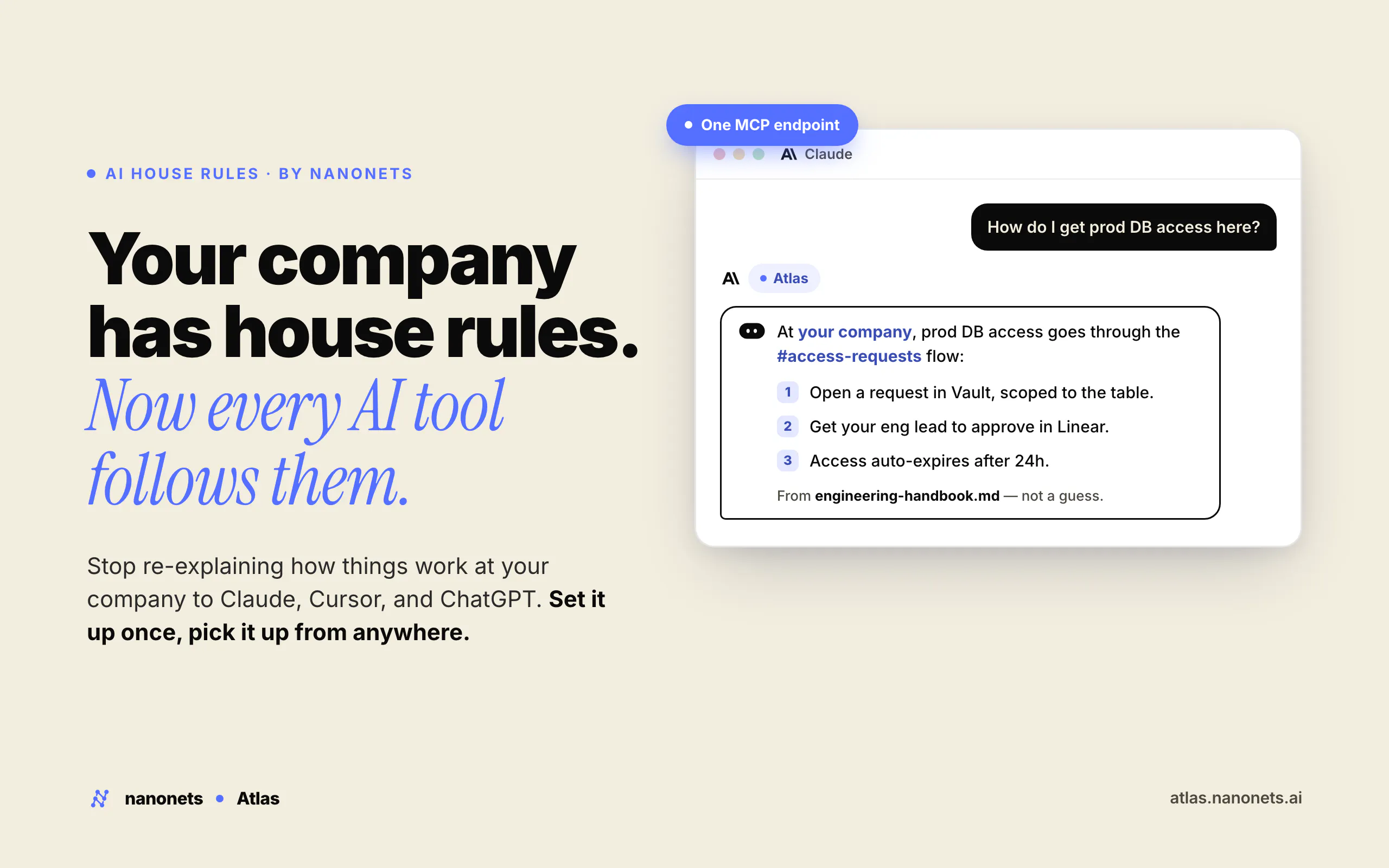
Love that you're going after the shared-context problem instead of building yet another standalone AI tool. The idea that my company's quirks and workflows could just travel with me into whatever tool I'm using is the part I keep thinking about.
-
Derick Koelpin 4 months ago
company context layer is exactly whats missing for agents 🔥 how do you keep it fresh as the company changes?
-
Garnet Stokes 4 months ago
the "you own it" framing is the right hill to die on. every AI tool wants to make itself the context, then re-render your work for someone else. owning the graph that plugs into them is the only model that survives the next 3 LLM cycles. i'd take the white-glove setup. small team, we've been re-explaining our voice + customer segments + competitor positioning to every new tool we adopt for the last year. 4 different vendor onboardings, same hour-long context dump every time. it's the dumbest time tax in our stack. reach out, happy to be one of the founding 200 and give blunt feedback.
-
Charley Swift 4 months ago
Nice launch. I’d separate context from authority: a company graph can tell an agent how the business works, but it also needs to say which actions are allowed, when a source is stale, and what proof survives after acting. Do you version the graph or rules per run?
-
Conner Gislason 4 months ago
How does this compare to what Glean is doing? Both are essentially trying to give AI tools a shared layer of company context -- but Glean approaches it through search and retrieval while this looks more like a ruleset. Curious if there's a meaningful difference in how the rules actually get enforced across different AI tools, or whether it depends on each tool's API supporting it.
-
Blaze Koepp 4 months ago
Planned company level sources for automatic updating contact? Ex. Notion mapping so any updates in key sections that cover policies are updated through Atlas to the company context layer automatically? Company context also changes regularly obviously, it’s becoming a hassle to manually upload new context documents to different context systems across multiple ai tooling systems.
-
Esteban Hilpert 4 months ago
Fun idea WRT context sharing! Excited to see where the product goes, congrats team
-
Jake Blanda 4 months ago
Context is everything. Not having to rebuild your entity voice, brand, rules, etc.. on each model/platform is elegant, and correct.
-
Jackson Fisher 4 months ago
The context loss between tools is something a lot of small business owners feel but can't quite name. You spend 20 minutes explaining your company structure in one AI session, then open a different tool and start from zero. I work adjacent to supplier onboarding, where small vendors have to describe the same business details repeatedly across procurement portals, compliance forms, and vendor packets. A portable context layer that travels with you across tools could be genuinely useful in that world. Curious whether Atlas is designed mainly for brand and marketing context, or whether you see it handling more operational data too, like business certifications, entity types, or compliance documentation?
-
Esteban Hilpert 4 months ago
the "house rules every AI tool follows" framing is the real unlock — context that lives once instead of re-explaining it to Claude, Cursor, and ChatGPT separately. how do you keep it permission-scoped so a given user or tool only pulls what it should, not the whole company brain?
-
Adam Zemlak 4 months ago
The insight that company context should live outside individual AI tools rather than being re-input in each system prompt is sound. Most teams end up maintaining duplicate context blobs in Cursor, Claude, and internal tools that drift out of sync. How does Atlas push updates to connected tools when company guidelines change? Is it pull-based querying or active propagation to each integration?
-
Floyd Botsford 4 months ago
document processing is one of those problems that sounds solved until you actually try to automate it with messy real world inputs. scanned PDFs at weird angles, handwritten notes mixed with printed text, tables that don't follow any consistent format. how does nanonets handle the edge cases where OCR confidence is low? does it flag those for human review or just best-guess its way through?
-
Constantin Leuschke 4 months ago
What's the best way to get started for a company?
-
Eino Klein 4 months ago
The premise is right. The failure mode with most AI tools isn't the model, it's that every session starts cold and you end up re-explaining your positioning, your audience, your tone, your internal terminology, over and over across a dozen different tools. What I'm curious about is how Atlas actually propagates that context. Is there a central knowledge layer that each connected tool reads from, or are you syncing context into each tool's own memory or system prompt? And when your company context changes, say you rebrand or shift positioning, how does that update flow through to the tools that already have the old version baked in?