

AVTR-1 Real-Time Open Weights Model
Generating uncanny AI avatars is now open source
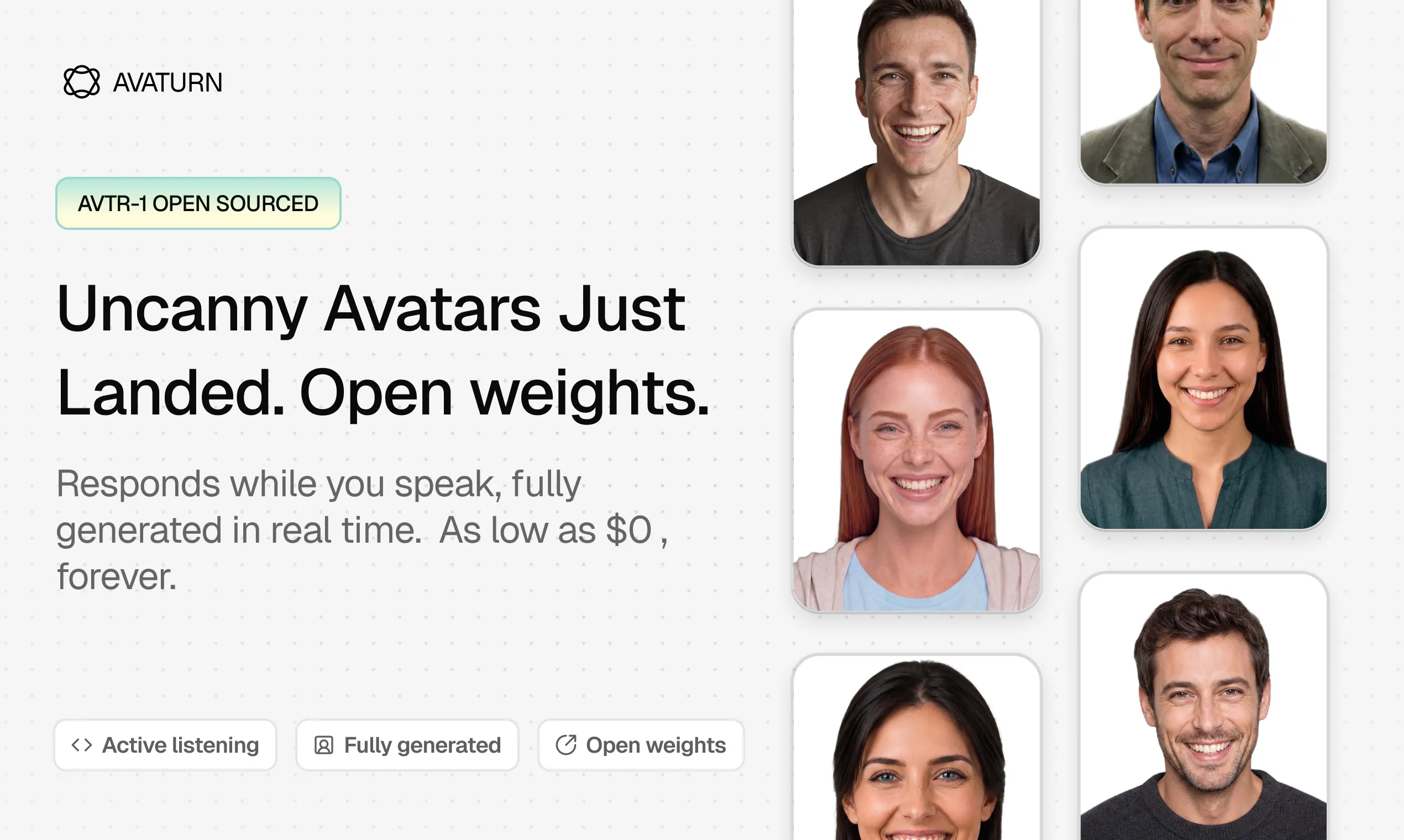
About AVTR-1 Real-Time Open Weights Model
Reviews 13
Thanks! Your review is posted.
Sign in to rate and review AVTR-1 Real-Time Open Weights Model.
-
just now
-
Jackson Fisher 5 months ago
Full-duplex with "minimal latency" and every-frame-generated is the hard combo — what's the actual end-to-end latency, and on what GPU? Open weights only matter if a small team can self-host without a rack of H100s, so the number that decides adoption is "real-time on a single 4090" versus "real-time only on datacenter silicon." Which is it today?
-
Makenna Eichmann 5 months ago
Congrats on this amazing release! I’ve been in the real time Avatar business for the past 20 years. My first real time Avatar engine, a desktop windows app called Virtual Assistant Denise was released in 2008, and finding out you’re open sourcing your framework is just a unbelievable good news taking in consideration the high quality and competitiveness of your engine. You may be right now disrupting a very competitive market, where most big players will have to review their pricing. I have great respect for all those current Avatar companies as I’ve worked with most of them and know their very skilled people and their effort to stay competitive, and I do understand their efforts and investments to stay alive. But on the other hand, they need to go back in time and observe what companies like Unreal did to survive when Unity came up and disrupted the game market. Thanks to that, today we have small group of people releasing amazing games! Congrats again on this intrepid move, as developers can now focus on the creation of the final product, and not on finding ways to pay for subscriptions. TTS, STT, LLMs, memory and database frameworks were until a few time ago in the hands of a few companies and today they became commodities. Your decision to open source this engine is one big step to democratize this important piece of software to build human machine interactive product possible for everyone.
-
Wiley Lubowitz 5 months ago
Open-sourcing the weights for a real-time avatar model is a much bigger deal than the headline suggests. The closed-stack incumbents in this space charge per-minute and effectively gate experimentation to whoever can afford to burn API credits playing with use cases. I make finance educational content on Mod3Loop (YouTube) and the choice between "talking head on camera" and "avatar reading a script" has been completely blocked on per-minute cost economics for indie creators — free weights changes that math entirely. Full-duplex listening while speaking is the unsexy part that actually makes these feel like presence rather than playback.
-
Adam Zemlak 5 months ago
Really great to see truly open models for realtime video (and a nice technical overview post). Congratulations on the launch, team!
-
Kenneth Corwin 5 months ago
Love this! I am working on a project to enable voice as primary interface for agents doing real work would love to integrate with AVATURN! Tried using with Tavus before but too pricey, how can we scale this to multiple users any tips on the same? Love the project and initiative, congrats on the launch!
-
Conner Jacobs 5 months ago
Tried the demo, looks impressive. Why have you decided to open source your model?
-
Randi Prohaska 5 months ago
What GPU is needed?
-
Rylan Cremin 5 months ago
How is it different from Tavus or HeyGen?
-
Uriah Mayer 5 months ago
the 9x faster claim is interesting but faster than what exactly. the baseline matters a lot here. sub-300ms felt like magic two years ago and now it's table stakes for anything calling itself real-time. curious what the actual latency numbers look like end to end, not just the generation side
-
Jaylon Deckow 5 months ago
the active listening part is what separates this from every other avatar tool. current ones just talk at you with dead eyes while you wait. if the expression matching actually works in real time this changes how you build AI sales and onboarding flows
-
Duncan Effertz 5 months ago
Hey guys! We are so excited to show you our new model: avatars became even more realistic and reactive. The awesome thing is that active listening is now at another level: avatars are reacting to your speech like a real person. If you are not a technical person like me, you can simply go to our website and talk to our avatars to see how cool that is! If you are a developer yourself, check out our github: we opened our model!
-
Alford Marvin 5 months ago
Tried the demo before launch — the lip sync is noticeably better than what I’ve seen with other generative avatars. But @sergei_sherman walked me through something deeper: active listening coupled with empathetic response. You know how you can kind of say anything to most AI avatars (e.g. “my mom died”, or "omg there's a murderer outside my window!") and they'll just blink, cycle their idle loop, nod and say something like “oh, that’s nice to hear.” These bots are just mouths on a timer with zero semantic read. AVTR-1 generates every pixel of the face in real time, frame by frame. When meaning shifts in what you’re saying, the expression shifts to match — e.g. brow lifting at word three because the content warranted it, not just because the sentence ended. For developers: there’s no Pipecat equivalent for video agents right now. @Avaturn Live is shipping the full stack — model weights, streamer, sync layer, reference avatars. Bring your own GPU, and you're ready in 15 minutes. Open weights is a big deal, and it's all free if your business is under $10M ARR.
-
Zachariah Hudson 5 months ago
Hey Product Hunt 👋 I'm Sergei Sherman, CEO of @Avaturn. Today we're releasing AVTR-1 — an open-weights real-time AI avatar model that sets a new state of the art on key benchmarks. If you're building anything with real-time AI avatars, AVTR-1 is for you. ✍️ Here's what makes AVTR-1 different: The whole face is generated. Not just the lips swapped onto a pre-recorded clip. Every pixel of the avatar's face, top of the head to the chin, is generated in real time, frame by frame. Native duplex — the avatar actively listens. The model is generating all the time, whether the avatar is speaking or listening. Just like a human on a call, the avatar's face responds to your words and your tone in real time. The brow lifts at word three because you sounded surprised at word three, not after the sentence ends. For three years, "real-time avatars" have meant pre-recorded video with a generated mouth pasted on top. We threw out the recording. 🎯 Why you want AVTR-1: Open weights. Free for personal, research, and any commercial use under $10M in annual revenue. Commercial licensing above that, through us. Sub-200ms end-to-end on one A100 or 4060. Runs on youd device in a data center, in the cloud. Avaturn Streamer included — the open infrastructure layer for real-time avatars. Accepts AVTR-1 or any other open-weight real-time video model as a drop-in. Plug in your video model on one side, your conversation backend on the other. Reference avatars out of the box. Model cards, license-cleared, deployable today. Launch-partner examples in the repo with Cartesia and Pipecat on day one. 🏗️ One thing we're explicitly NOT launching — and want the industry to build with us: A public, vendor-neutral leaderboard for real-time AI avatars. The category needs a transparent scoreboard, one the ecosystem runs together. Clear, public competition is the only way improvement happens fast. We're inviting every other vendor, every open-source contributor, every researcher to help us build it. 🎉 Everything is live today: Code, inference, evaluation: github.com/avaturn-live/avtr-1 Download Model Weights huggingface.co/avaturn-live/avtr-1 Technical report, full paper, reproducible benchmarks: avtr-1.avaturn.live Hosted demo: avaturn.live Real-time generated video is the next frontier. Every previous wave — text, then real-time audio — produced an open layer the category built on. We're shipping that layer today: model and orchestration both. Drop questions, feedback, or what you're building below — I'll be here all day 🚀 — Sergei