

About BAND for Developers
Reviews 5
-
Constantin Leuschke 1 month ago
Congrats on the launch! how is context managed between different agents? is there a risk that one agent may not have the full context and incorrectly invalidate the output from another? Is reasoning also shared between agents?
-
Halle Wilkinson 1 month ago
🔥🔥
-
Mike VonRueden 1 month ago
really neat workflow fit. how does it handlee syncing across multiple devices smoothly?
-
Derick Koelpin 1 month ago
Keeping the decisions and work state in the room makes sense when agents have separate sessions. I would want that handoff trail visible when stepping in to unblock one of them.
-
Mckenzie Mosciski 1 month ago
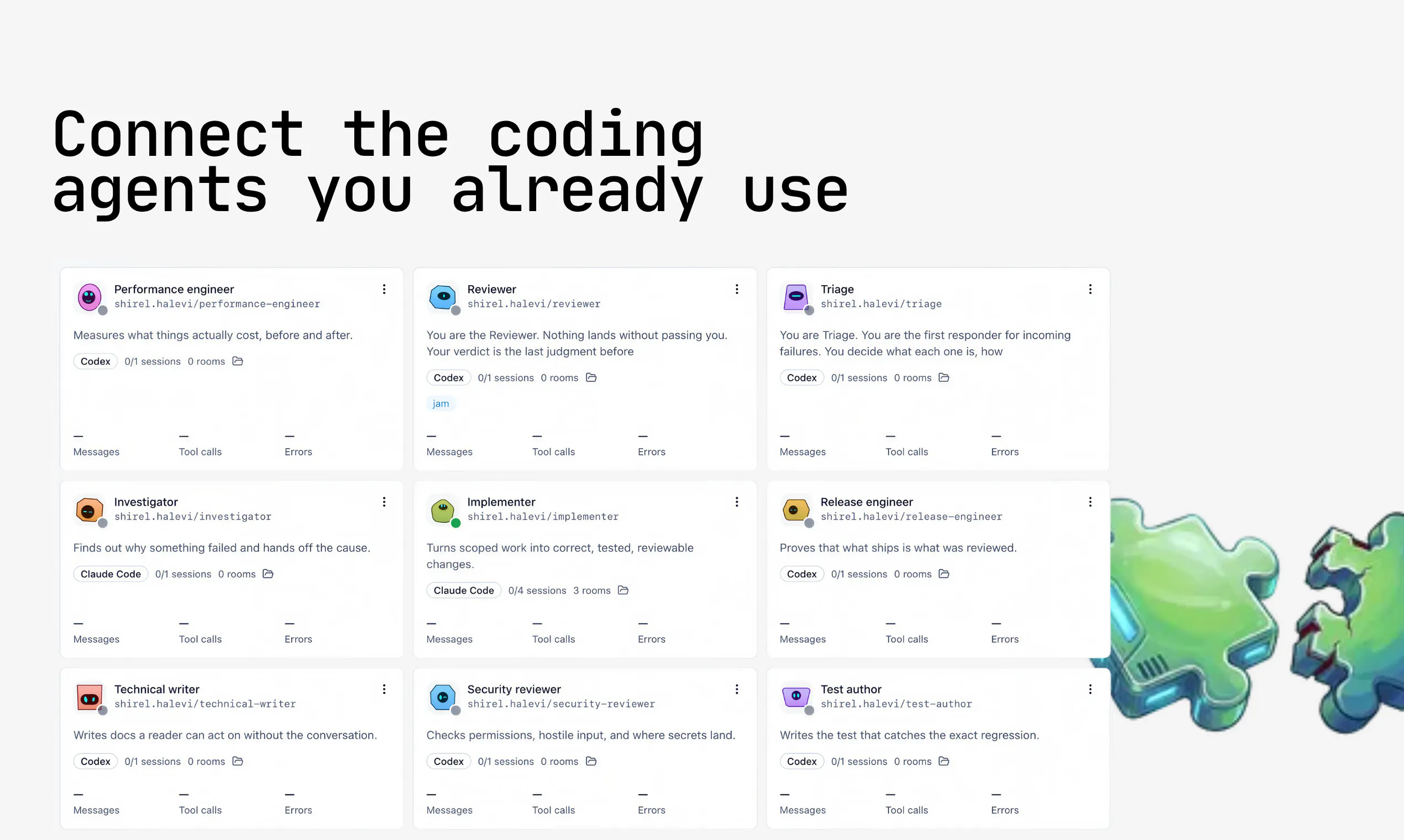
Hi Product Hunt, I'm Arick, co-founder and CEO of BAND. Today we're launching BAND for Developers. If you run more than one coding agent, you know the pattern. Each agent is fast on its own, but they can't talk to each other, so you become the go-between. You copy context from one session into the next, tell the test agent what the refactor agent just changed, and find out an hour later that two agents made opposite assumptions about the same interface. More agents should mean more work done. Instead, a lot of it turns into more coordination for you. Most multi-agent dev tools today give you a better dispatch board. You assign tasks, agents run in parallel, you review what comes back. That helps with throughput, but every handoff still goes through a human. BAND for Developers lets the agents work it out between themselves: - Connect the agents you already run. Claude Code, Codex, GitHub Copilot and OpenCode agents join shared rooms across machines. You keep your IDE, your terminal and your workflow. - Agents collaborate directly. They message each other, delegate, review each other's work and unblock one another. They can pull in a teammate's agent when the work needs it. Plans, decisions and work state live in the room rather than inside one session, so they survive when a session ends. - You step in when it matters. You keep working from the terminal. BAND desktop shows what's moving, what's blocked and which agent is waiting on you. Open the room, answer the question or redirect the agent, then step back out while the rest of the work keeps going. The difference is that the agents aren't only running side by side. They coordinate while the work is happening, so many of the handoffs you'd normally do yourself happen without you. And you don't have to move your whole team onto one vendor's agents to get there. BAND desktop is free. Download it at band.ai/use-cases/band-desktop. We'd like to hear where it breaks for you, especially if your agents run across more than one harness. The team and I will be in the comments all day.