

Basedash Audit Logs
Every action in your BI tool, on the record.
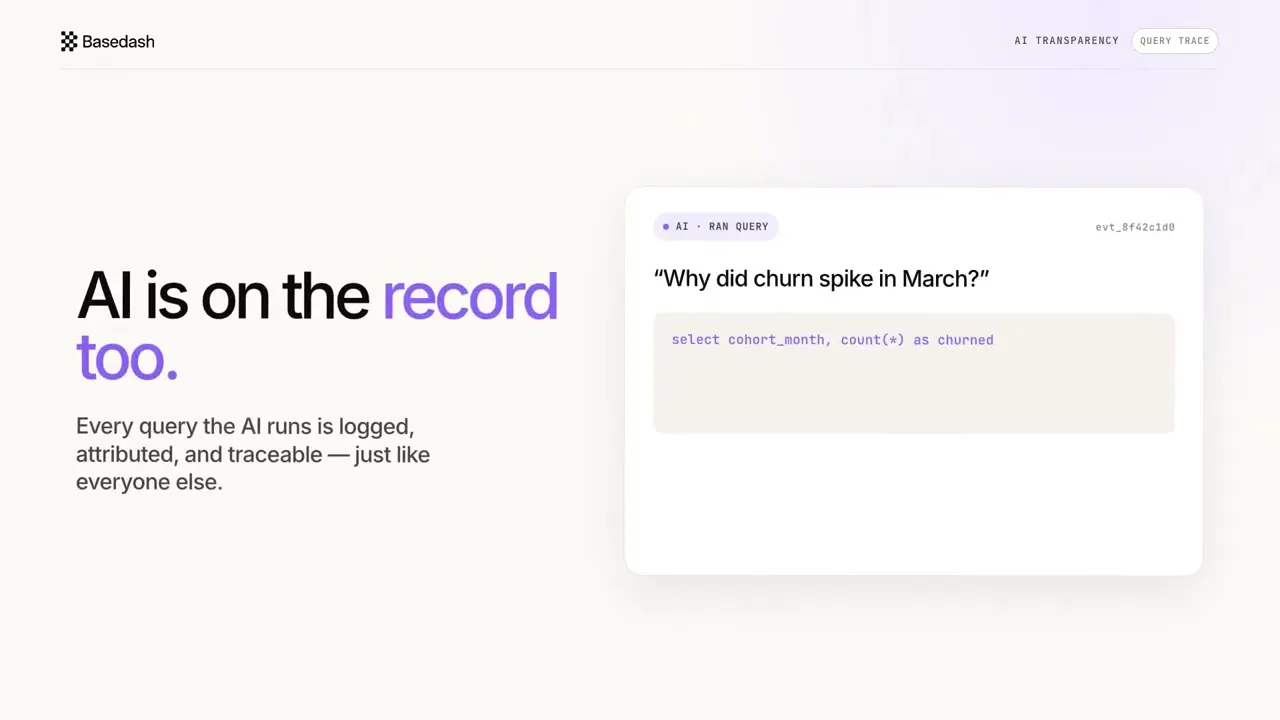
About Basedash Audit Logs
Reviews 4
-
Blaze Koepp 3 months ago
The AI query attribution is the part that would actually unblock us. When someone on our team asks why a dashboard number changed, being able to pull the exact query the AI ran at a specific time is very different from guessing from logs. One thing before I connect a production workspace: does the audit log store the full query text, or just metadata like a hash or query ID? For a SIEM export use case, having the raw SQL attached to the log entry makes the difference.
-
Jedidiah Farrell 3 months ago
The retention-follows-your-policy part is what I'd want to dig into before rolling this out on anything financial. Compliance usually forces a retention minimum, but a log full of query text can end up holding customer PII well past when a deletion request should have wiped it. Is retention global, or can specific fields get redacted before the entry is even written?
-
Johnathan Homenick 3 months ago
Very excited about this launch! We’ve been getting more requests for audit ability, which is a big reason why companies choose Basedash in the first place. Happy to answer any questions.
-
Monserrate VonRueden 3 months ago
Logging the SQL the AI ran is the necessary half. The half I'd push on is whether you store the answer it gave in words right next to the query, because a correct query with a wrong summary on top is the failure that actually reaches a decision, and nobody goes back and re-reads the SQL to catch it. Six months later the artefact a review needs is the sentence someone acted on, not just the statement that produced it.