

Basedash Skills
Reusable AI instructions for every Basedash surface.
About Basedash Skills
Reviews 4
-
Hobart Glover 6 months ago
Natural language to chart is a familiar idea, but curious how Basedash handles ambiguous questions - like when 'active user' could mean three different things depending on the team?
-
Merl Orn 6 months ago
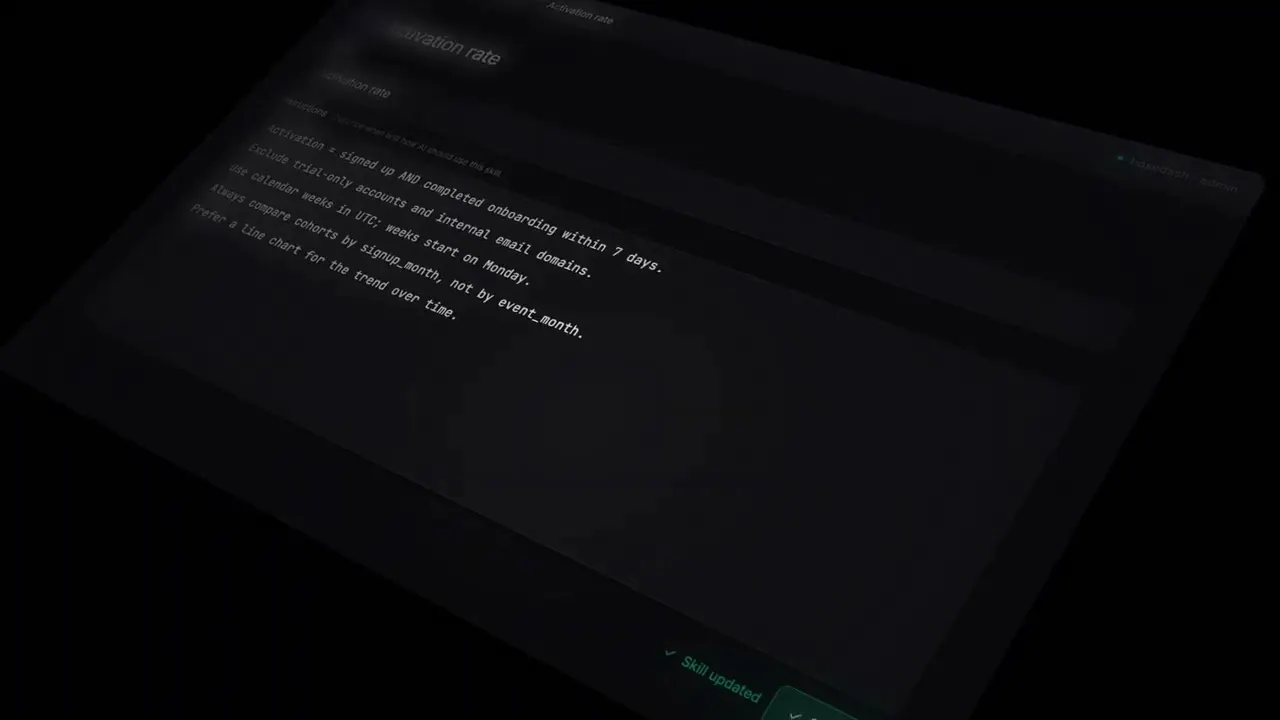
The origin of this was pretty unglamorous. We kept watching people paste the same definition of activation or churn into chat, then into a chart prompt, then into an automation, and every time they'd phrase it slightly differently and get slightly different numbers. The model was doing exactly what we asked but we were just asking five versions of the same question lol. Skills came out of fixing that for ourselves. You write the definition down once, in plain language, and from then on any agent in the workspace reaches for it when the topic comes up. A new person can ask "how's activation trending" on day one and get the same answer the rest of the team would get, because the agent is reading the same playbook everyone else's agent reads. If you've got a metric that means something specific at your company and you're tired of explaining it to the AI every single time, give it a try and tell us where it falls short!
-
Johnathan Homenick 6 months ago
Moving definitions out of one-off prompts and into shared durable context is exactly the lightweight semantic layer most teams skip until they're already drowning in inconsistent metric defs. How do you handle drift when someone updates a Skill that's been silently feeding 12 different surfaces — version pin, broadcast, or both?
-
Korey Hammes 6 months ago
this is a very handy tool for founders, but I have a question on how are you handling large dataset like clickstream locally and does the data site locally even after ETL?