

About BaseRT
Reviews 15
-
Derick Koelpin 4 months ago
Hello Lukas Is it possible to use it via LM Studio ?
-
Kyleigh Luettgen 4 months ago
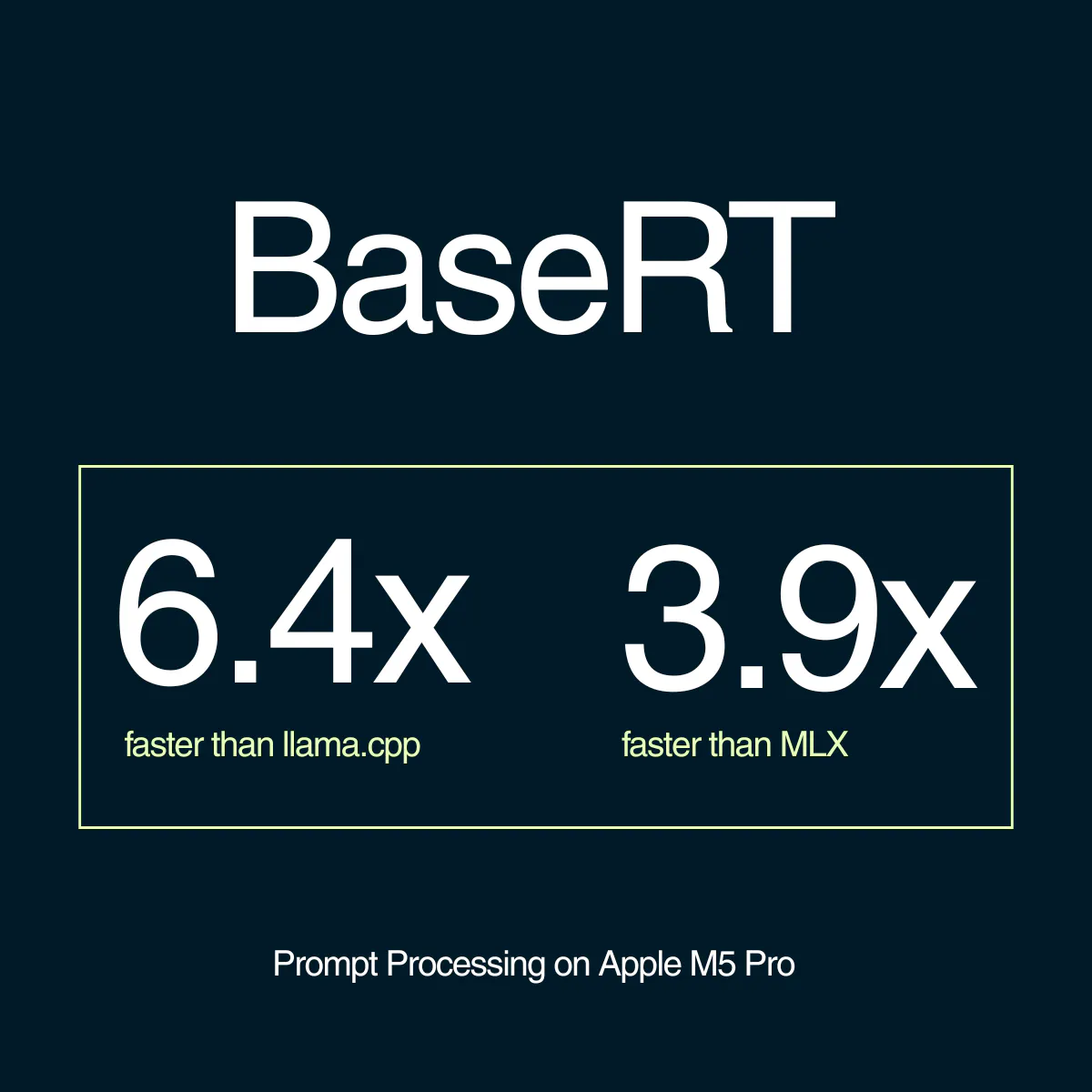
The 3.9x over MLX claim caught my eye — is that mostly custom Metal kernels or smarter KV-cache handling? And does the speedup hold for long-context prompt processing, or mainly decode? Running models locally is fast becoming my default for anything privacy-sensitive, so this is timely.
-
Zachariah Hudson 4 months ago
The speed numbers are impressive, especially on Apple hardware. For teams deciding between llama.cpp, MLX, and BaseRT, what is the tradeoff in model coverage or quantization support? I would love to know where you see BaseRT fitting in a production local-inference stack.
-
Quincy Medhurst 4 months ago
the Metal 4 tensor core optimization is the interesting part here. most local inference tools treat Apple Silicon as a nice-to-have but you're actually building for it as the primary target. curious how the performance scales with context length — prefill speed is great but does it hold up at 32k+ tokens?
-
Merl Orn 4 months ago
The discussion's focused heavily on prefill vs. decode, but there's a third axis worth thinking about for Apple Silicon specifically: unified memory's effect on how many models you can keep resident simultaneously. llama.cpp and MLX both require fairly explicit load/unload, and on a machine where you might want a small coding model, a larger reasoning model, and an embedding model all warm at once, the round-trip cost of loading from disk breaks the local-first experience more than raw token throughput does. Is BaseRT doing anything with model-weight sharing or partial preloading, or is that a separate problem from what you've optimized?
-
Merl Orn 4 months ago
On-device inference is exactly the direction I keep hoping more indie apps can go — no per-token bill and privacy by default is a big deal. Is BaseRT meant to be embedded inside a shipping Mac/iOS app, or is it more of a dev/CLI runtime for now? That'd decide whether I could actually bundle it into my own app.
-
Murray Kuhlman 4 months ago
Is it also on huggingface? I don't want to install it via bash command.
-
Orrin Batz 4 months ago
6.4x over llama.cpp is a big claim for a field this optimized — where does the speedup actually come from? Custom Metal kernels, better KV-cache layout, speculative decoding, or quantization formats? And does the gap hold at batch-1 decode on long contexts, or is it mostly a prefill win? Genuinely curious — we run local models for dev work and llama.cpp has been the default for so long that a 6x claim deserves a look.
-
Merl Orn 4 months ago
6.4x faster than llama.cpp is a big claim — what's the tradeoff? Curious whether it's fast enough to run a real-time voice pipeline on-device (where every 100ms of latency is felt), or if the win is mainly on batch/throughput. Running local with no token cost + full privacy is a huge deal for small-business use cases. Following.
-
Joany Hansen 4 months ago
Very interesting work. It feels like we're finally seeing software catch up to what Apple Silicon has been capable of for a while. One thing I'm curious about: if an application needs to switch between different models depending on latency or quality requirements, does BaseRT help manage that orchestration, or is that intentionally left to the application layer?
-
Tyrique Lind 4 months ago
the no-per-token part matters as much as the speed imo, it's what makes always-on background agents affordable to run. is that the direction you're headed?
-
Toni Kutch 4 months ago
the prefill numbers are impressive, but prefill isn't usually where I feel the wait on a laptop - it's token-by-token decode speed during a long generation. is the decode-side speedup in the same range as prefill, or is that gap smaller since decode is more memory-bandwidth bound than compute bound?
-
Mckenzie Mosciski 4 months ago
@lukas_base Benchmarks you posted seems to be prefill numbers. do you have decode or token generation throughput comparisons against llama.cpp and MLX too, or is most of the gain concentrated in prompt processing rather than generation speed? Thanks!
-
Haleigh Bartoletti 4 months ago
Tuning specifically for the M5's new tensor cores through the Metal 4 API, instead of just optimizing existing kernels, is a genuinely sharp bet given how far the hardware has pulled ahead of the software stack. Your published numbers highlight prefill speed specifically, so how much does decode/token-generation throughput improve on M5 versus llama.cpp and MLX, since that's usually the bottleneck for longer, more conversational or agentic workloads?
-
Mckenzie Mosciski 4 months ago
@lukas_base Just a quick question how does it compare to LiteRT? It is no secret that MLX and llama.cpp are falling behind but we already have a great architecture from Google.