

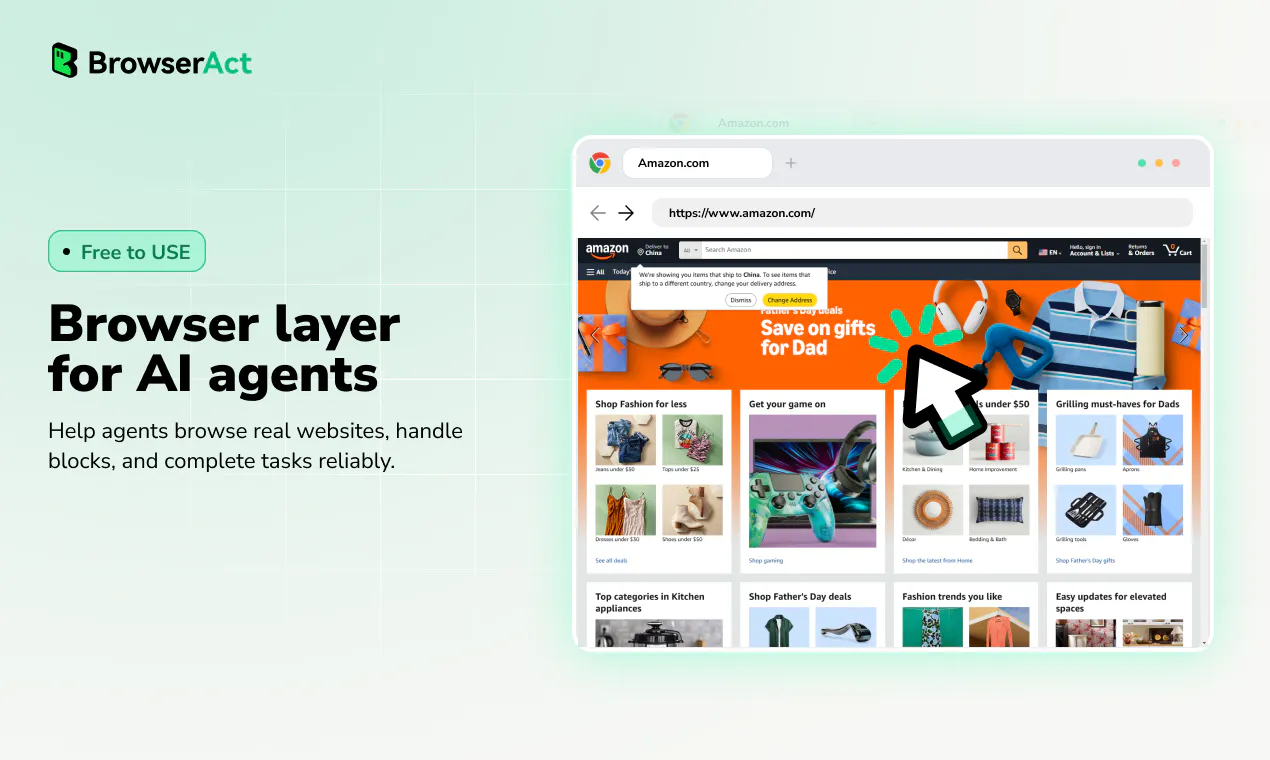
About BrowserAct
Reviews 15
-
Malachi Armstrong 4 months ago
Browser automation seems to be evolving into infrastructure for AI rather than just another productivity feature. Curious—what's the most unexpected workflow developers have built with BrowserAct that you didn't originally anticipate?
-
Jarrell Homenick 4 months ago
The 'continue from the same browser state after a human handoff' part is what usually breaks other tools — most drop the session the moment a person steps in. Concretely: when BrowserAct pauses for manual verification, does the browser session run on my own machine or in your hosted environment, and does the agent block waiting or get a callback when the human finishes? And for slotting it into an existing agent, is it driven purely by the CLI, or is there a programmatic API my orchestration can call?
-
Ayden Miller 4 months ago
The browser task that still breaks agents for me is not just the click path. It is proving what happened after a login, upload, or verification handoff. For agent workflows I would want BrowserAct to return a small run receipt: final URL, key actions taken, files uploaded, form fields changed, and the exact point where a human stepped in. That makes it easier to reuse safely instead of treating each browser run as a black box.
-
Kyleigh Luettgen 4 months ago
Browser automation always looks easy in demos, then dynamic pages and CAPTCHAs make it messy. Curious if BrowserAct exposes failure reasons clearly enough for an agent to decide retry vs ask a human, instead of just timing out.
-
Mike VonRueden 4 months ago
How does BrowserAct handle dynamic websites and anti-bot protections while ensuring agents can reliably complete tasks without frequent manual intervention?
-
Franz Bauch 4 months ago
Prevention is the right first line. The part I keep getting stuck on is the residual: even with good stealth, some fraction still gets quietly degraded, and at that point the session looks healthy so nothing in the browser state tells the agent the content is junk. The only thing that worked for us was a content-level canary, asserting some value we know a real logged-in response should carry. Does BrowserAct expose anything at that layer, or is the bet that prevention keeps the residual small enough to ignore?
-
Toni Kutch 4 months ago
Silent soft-blocks are the failure mode I'd push on here. Hard blocks (a CAPTCHA, a 403) are easy to catch and hand off. The mean ones are when a site decides you're a bot and quietly serves degraded or stale content instead of erroring, so the agent reasons over garbage and never trips the handoff. Driving real browser sessions for our own tooling, that's the case that burned us most: every signal said success, the data was subtly wrong. Does BrowserAct flag content-level blocks, or only HTTP-level failures?
-
Daren Bruen 4 months ago
As someone focused on building physical interfaces to trigger agentic workflows, I know that the hardware trigger is only as good as the execution layer behind it. The web is messy, and broken workflows or verification blocks completely ruin the seamless experience users expect. Love the focus on giving agents a secure browser layer. I'm curious—how does BrowserAct handle unexpected UI changes or random pop-ups on a site to ensure the agent doesn't get stuck in a loop during a repeatable workflow? Brilliant utility, congrats on the launch!
-
Esteban Kilback 4 months ago
@wendyba This is so cool! Congrats on the launch
-
Nikunj 4 months ago
The handoff-to-human piece is what makes this actually usable in production. Most browser automation breaks the moment it hits a CAPTCHA or an unusual login flow, and then you're just stuck. Letting the agent pass control back cleanly and pick up from the same state is genuinely different from what's out there. Congrats on the #1 yesterday.
-
Jaiden Runolfsson 4 months ago
#1 well deserved 🥇 browser layer is exactly the bottleneck rn
-
Carter Volkman 4 months ago
hey! Browser automation for agents is genuinely exciting, the fact that it handles blocked pages and session isolation means agents can finally work on the real web, not just clean APIs. One thing I'm curious about though, how does BrowserAct handle sites that fingerprint browser behaviour to detect bots? Because the hardest part of real-web automation isn't blocked pages, it's sites that let you in but silently serve you degraded or misleading data once they detect non-human patterns. Is there any layer that makes the agent's browsing behaviour look more human at the request level?
-
Alford Marvin 4 months ago
The stale-position issue David raised is the thing I hit most. I do browser automation and every element ref I grab dies the moment the page navigates. I just re-find everything before each click, but it adds a round trip every time. Does BrowserAct batch that re-anchoring under the hood, or does the agent still need to request a fresh page state manually?
-
Randi Prohaska 4 months ago
BrowserAct is one of those things I kept wishing existed, so happy to see it. The part that grabs me is letting agents actually drive a real browser instead of fighting with brittle scrapers or half-baked APIs. Curious about reliability though, when a site changes its layout, does the agent recover on its own, or do you end up babysitting the flows? Either way, nice work.
-
Hazel Altenwerth 4 months ago
Congrats on the launch. I currently use agent-browser, which is also OSS and agent first. Why should I think about switching to this?