

About Bruin
Reviews 10
-
Demetrius Gulgowski 6 months ago
The reverse-ETL trigger for a specific client ID is the detail that makes this actually agentic rather than just a fancy SQL chatbot-that's a write action with real downstream consequences. So I had a ques- what's the permission model? Like if a sales rep asks Bruin in a shared channel to backfill missing data for a client, can it just do that, or does it check whether that person has the rights to trigger that pipeline? Curious whether authorization is inherited from the user asking or from whoever connected the warehouse.
-
Carter Volkman 6 months ago
Since the agent relies on an existing semantic layer like dbt or LookML to provide context, how does it handle schema drift when underlying table structures change? I am curious if the agent can autonomously suggest updates to the semantic mapping when it detects a mismatch, or if it requires a manual re-sync to maintain a deterministic link between natural language queries and the warehouse data.
-
Hillard Halvorson 6 months ago
What got me was the lineage screen , seeing how all the data flows from raw to reports visually, and then having an agent sitting on top of that. Most of my experience with data tools is that by the time an insight reaches a business team, nobody remembers where it came from. My question is simpler though , if two different teams ask Bruin the same question but their data is set up slightly differently, does it give them different answers? And if yes, does anyone get notified, or does the inconsistency just quietly exist?
-
Malachi Armstrong 6 months ago
What I found interesting here was the idea of analytics becoming part of the team’s day-to-day conversations instead of something people only check separately through dashboards and reports. It makes the workflow feel much more interactive and accessible for non-technical teams as well. I did wonder about one thing though — in larger organizations, different teams often interpret or calculate KPIs slightly differently depending on their workflows. How does Bruin handle those differences while still keeping the AI’s analysis and recommendations contextually accurate?
-
Rylan Hyatt 6 months ago
The PR-generation flow is most interesting part here. Reviewing the Agent generated changes feels different from reviewing normal Human PRs because you're also validating the automation boundaries themselves. whether this reduced or increased review overhead internally.
-
Roberto Smith 6 months ago
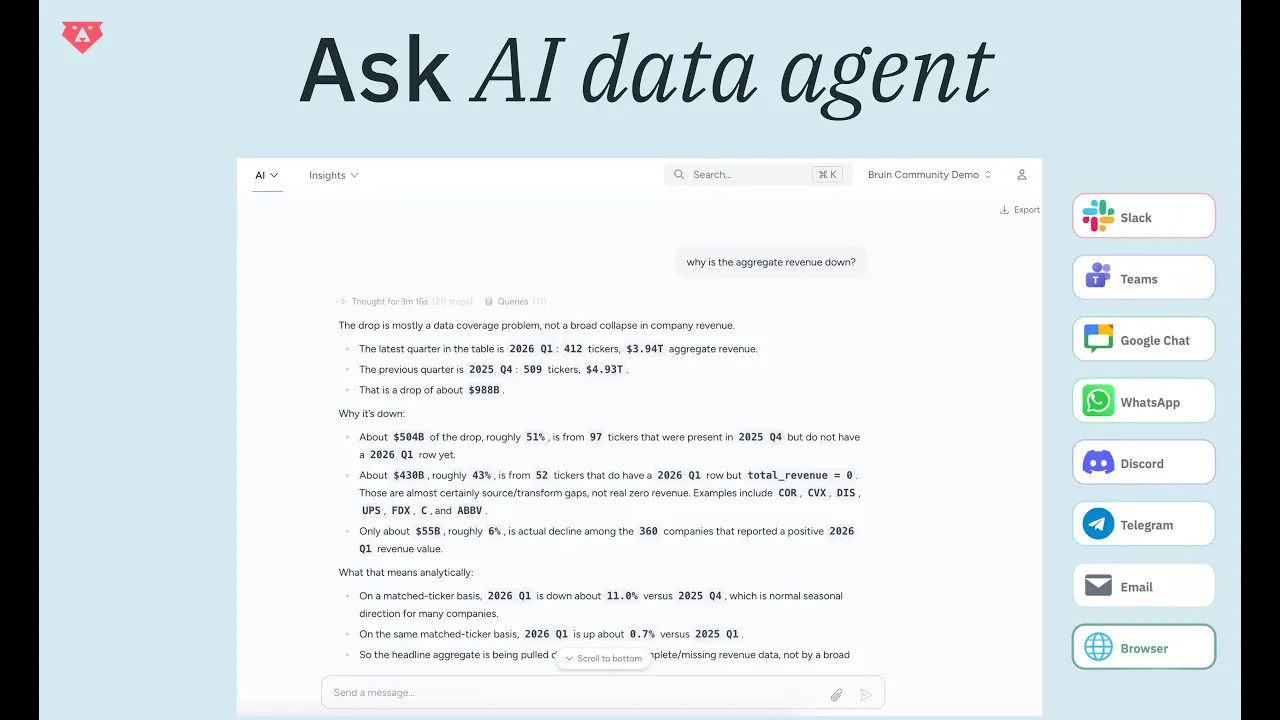
@burakkarakan What I like here is that the agent lives inside Slack where decisions actually happen, instead of being a separate dashboard nobody opens. Curious whether Bruin can ask clarifying questions back when a request is ambiguous — that's usually where data agents hallucinate instead of admitting uncertainty.
-
Gaylord Buckridge 6 months ago
Interesting approach combining semantic layers with conversational workflows instead of building another standalone AI dashboard. The Slack/Teams integration feels practical for real analyst collaboration. Curious how you handle metric consistency and hallucination risks when multiple teams query the same data differently.
-
Godfrey Donnelly 6 months ago
Embedding a data agent directly into team conversations is interesting. how are you handling query validation and permission boundaries across shared data environments?
-
Elmer Schoen 6 months ago
"Collaborates with your team" is the part most data agents undersell. Curious whether your collab surface is synchronous (live chat in-context) or async (PR-style review). Different products entirely.
-
Buck Yundt 6 months ago
Can Bruin ask follow up questions when a request is not clear?