

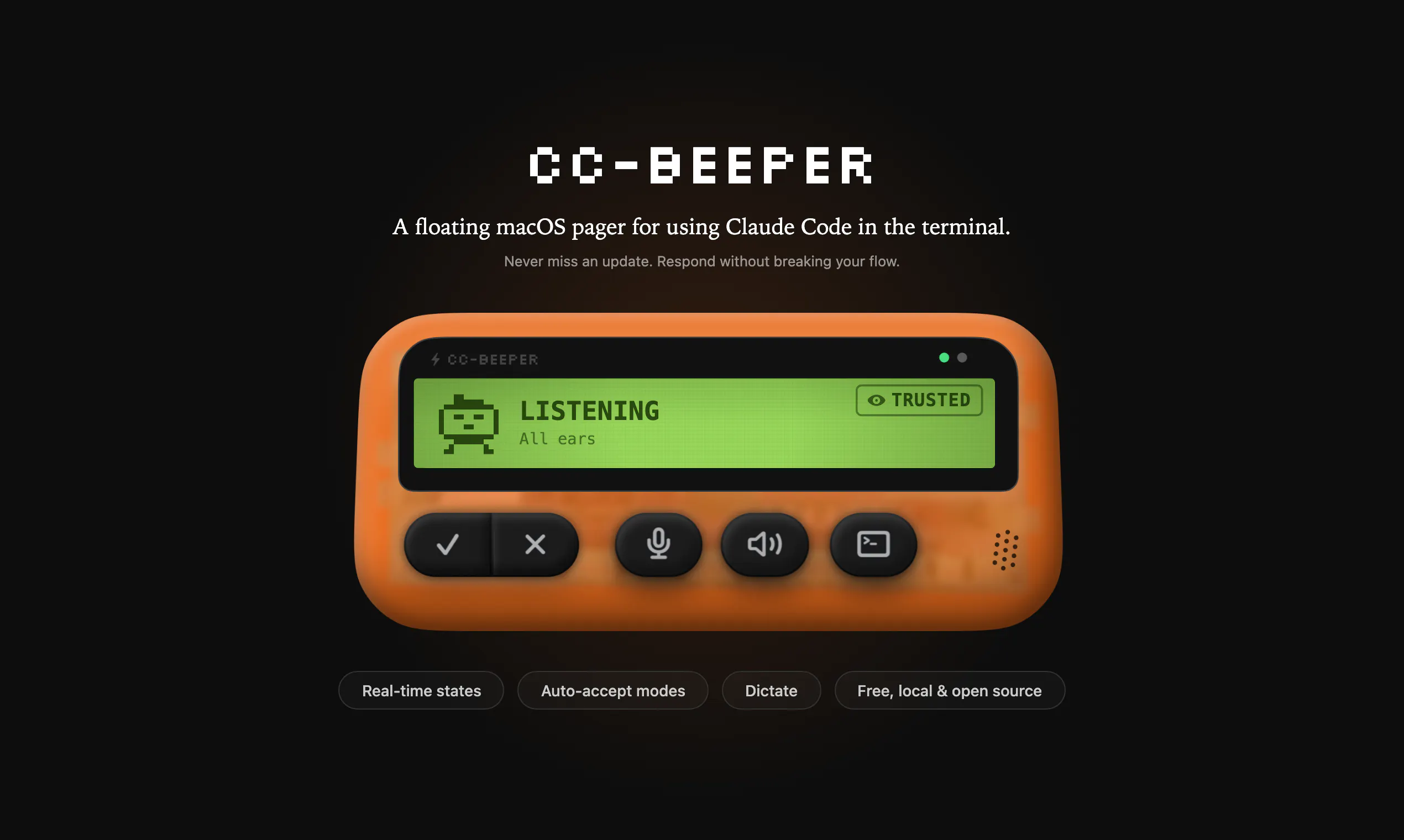
About CC-BEEPER
Reviews 14
-
Dejon Bergstrom 7 months ago
The four auto-accept modes are the interesting design decision here. YOLO mode — does that mean Claude can execute shell commands, write files, make network requests without any prompt? Trying to understand where the trust boundary actually sits, because "auto-accept everything" in an agentic coding context is either brilliant or terrifying depending on what Claude decides to do at 2am.
-
Ruben McClure 7 months ago
I’ve run into this myself—I often assume Claude would’ve completed the task by now, but when I check, it’s usually stuck on some permission issue. Love the idea—how do you detect when Claude needs permission? Do you poll for it continuously?
-
Ulises Ankunding 7 months ago
Having a beeper UI on my desktop in 2026 was not on my bingo card for the year.
-
Monserrate VonRueden 7 months ago
This fills a real gap - I've caught myself staring at the terminal waiting for Claude to finish way too many times. The four auto-accept modes are the right call, YOLO mode for scaffolding and Strict for anything touching prod. One question: does the LCD status show which tool Claude is currently using (file read vs bash vs edit)? That granularity would be genuinely useful for knowing when to intervene.
-
Joany Hansen 7 months ago
Love the retro pager concept. It makes something pretty technical feel way more approachable. How did you decide what states and signals were most important to show in real time?
-
Mike VonRueden 7 months ago
This is super cool. One suggestion: you could consider color-coding the statuses based on whether there's input needed from the user. (eg. "done" -> green, "error" -> red, "needs input" -> yellow).
-
Garland Grady 7 months ago
As a Claude Code user- this is clever. Does it work with the new agent/skill features too?
-
Korey Hammes 7 months ago
naming the top trust level "yolo" is the most honest ux decision i've seen in a dev tool. been running claude code for months — you always end up at two extremes: approve everything manually or just run --dangerouslySkipPermissions and hope. strict to yolo as an actual dial makes trust a real decision.
-
Randi Prohaska 7 months ago
Can you walk through how the blocking PermissionRequest hook handling works end-to-end (especially holding a TCP connection open) and what reliability/edge cases you had to solve—multiple concurrent sessions, crashes, sleep/wake, terminal restarts, or Claude updates?
-
Santa Cassin 7 months ago
This is so fun. Did you ever think about trying to connect this with a real beeper? I also can't believe this is your first open source project. I'm definitely looking forward to seeing what you're building. This was great. Well done @vecartier!
-
Reilly Thiel 7 months ago
This looks really great. I hope we have something similar for Windows Laptop too, sooner. Just in case, if there are multiple Claude sessions going on, how it will react, I am curious to know that.
-
Zachariah Hudson 7 months ago
Seriously, the state that attracted me the most was the error: “Something went wrong.” A lot of times, I only see a summary at the very end of the run, and I end up getting lost in what actually happened during the execution flow. The real issue is that when there are multiple errors and the claude tries to handle them on its own, it becomes painful on my side. It affects the whole workflow. Instead of finding out only at the end, I’d rather get real-time signals about errors as they happen, so I can step in immediately and help, rather than reacting after everything is already done. COOL!
-
Jackson Fisher 7 months ago
When you have multiple Claude sessions running at a time, do we get multiple pages, or does the page screen get increased with each Claude session?
-
Halle Wilkinson 7 months ago
Looks very cool! Will give it a try!