

About Checksum AI
Reviews 10
-
Elmer Schoen 2 weeks ago
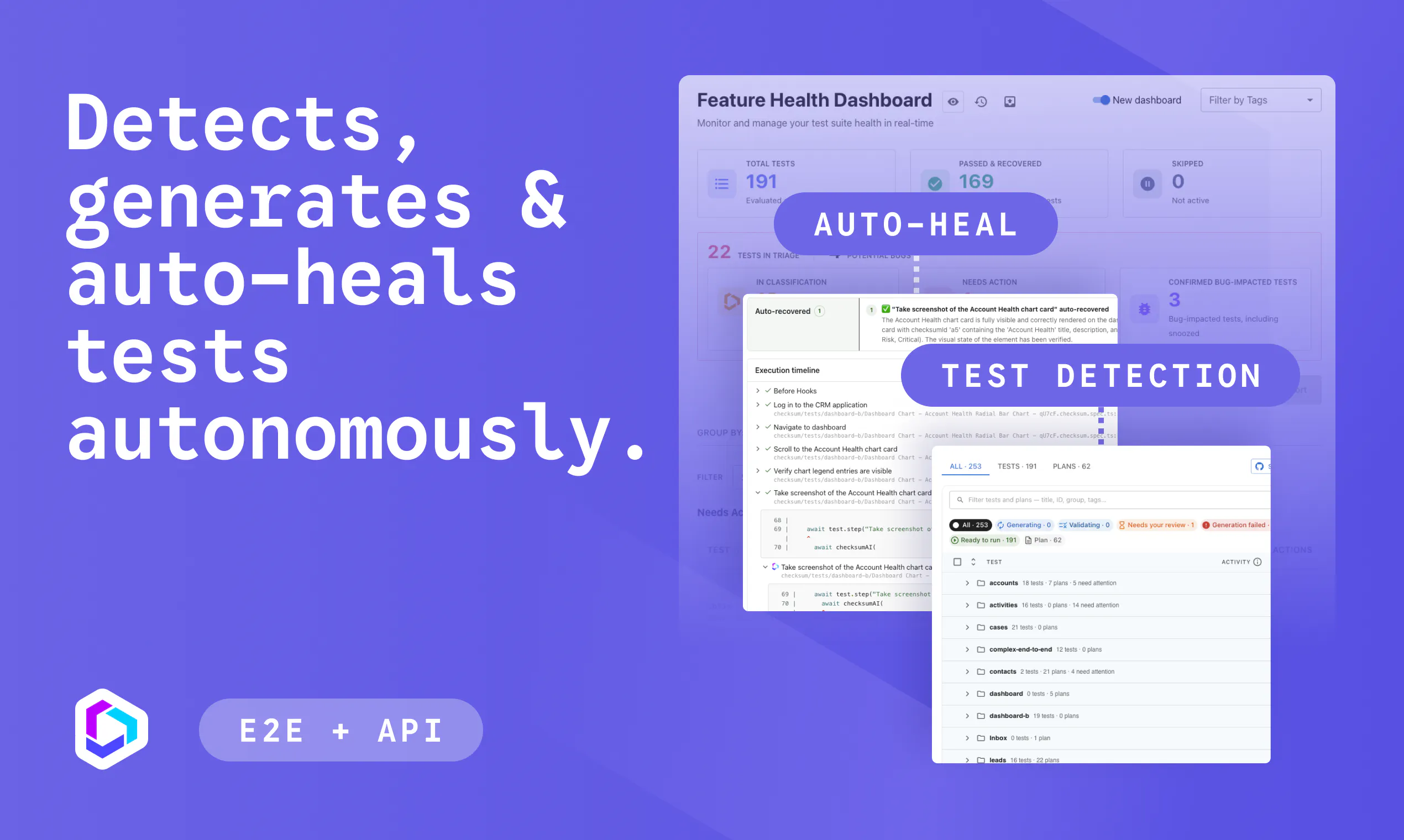
Congrats on the launch!! 🚀🚀🚀 what i'm unsure bout is where the 'intent signal' comes from. if i renamed that btn on purpose the PR diff already says so, and if the heal is only looking at the running app then a regression that happens to look like a rename gets absorbed quietly. flaky tests at least annoy you into looking, this one wouldnt. Does the heal read the code change when it decides or just the app?
-
Elmer Schoen 3 months ago
This is a really interesting take on keeping AI-generated code testable. Auto-healing stale tests sounds especially useful as coding agents get faster.
-
Randi Prohaska 3 months ago
This is one of those problems that becomes more important as AI-assisted development becomes the norm. More generated code means more surface area to validate. Excited to see how Checksum AI evolves!
-
Haleigh Bartoletti 3 months ago
Congratulations! Checksum tackling the verification gap is huge—AI sped up code generation, but trust in what ships is still the bottleneck. Curious, how do teams usually measure the ROI of automated test triage once they adopt your loop?
-
Esteban Hilpert 3 months ago
I work at checksum so grain of salt, but my take: What surprised me: I came in assuming the hard problem was generating tests. It isn't — models will write plausible-looking tests all day. The hard problem is that "plausible" and "green" are both terrible proxies for "actually proves the feature works." A big part of my job turned out to be making the system distrust its own passing tests. The moment that sold me: a test broke after a routine frontend change, and the obvious move — the one every human on every team makes ten times a week — was to update the assertion to match the new behavior and get back to green. The agent refused. It walked the diff, decided the new behavior wasn't an intentional change but a regression, and filed it as a product bug instead of "fixing" the test. It was right. A human reviewer would have rubber-stamped the assertion update, the suite would have gone green, and the bug would have shipped with a passing test standing guard over it. Why verification is the unglamorous problem: when it works, nothing visible happens. There's no demo moment for "this green check is real." So everyone builds the flashy generation demo and quietly ships suites that decay into checkmarks nobody trusts. But an untrusted suite is worse than no suite — you keep paying the maintenance cost and get none of the confidence. Solving that is the actual product, and it's the part nobody wants to put on stage.
-
Mckenzie Mosciski 3 months ago
Would you suggest using this for more elaborate claude code projects (full stack, hosted)? I'm the owner of a few of our internal tools and I'm trying to figure out where I can/should fit something like Checksum into the stack. I'm frequently worried about random bugs and keeping the tools running as smoothly as possible.
-
Kay Balistreri 3 months ago
As a marketer, I'm just here to say that I love your tagline ☺️ it makes a pretty intimidating category feel approachable. Congrats on the launch!
-
Ruben McClure 3 months ago
Auto-healing Playwright tests for coding agents is a brilliant fix for test suite maintenance. Huge congrats on the launch!
-
Johnathan Homenick 3 months ago
Shipping the generated tests as standard Playwright in the team’s own repo is a really strong call. Makes it feel like part of the engineering workflow, not some vendor-owned test layer. Also love the real bug vs stale test distinction, that’s exactly where a lot of CI pain comes from. Congrats on the launch!
-
Zachariah Hudson 3 months ago
How do teams build confidence in auto healed tests without manually reviewing every change?