

About Clark
Reviews 15
-
Rylan Hyatt 4 months ago
🎯 Clark An AI coworker with its own cloud computer is ambitious. What's the first workflow where users completely stop supervising it and simply expect the work to be finished? That seems like an important milestone.
-
Gaylord Buckridge 4 months ago
Congrats on the launch. The own-cloud-computer model is compelling, especially the inspectable files, screenshots, sources, and logs. Before trusting it with repository changes or form submissions, can users define approval gates for sensitive actions and scope them to a specific operation, account, repository, and time window? Also, after a partial failure, do the logs show what completed and whether a retry is safe?
-
Zachariah Hudson 4 months ago
I'd be curious to know things with which this would help me out that a Claude Scheduler with cowork cannot. P.S. - really like the innovation with AI agents that's currently happening
-
Ayden Miller 4 months ago
We stress-tested Clark on original mathematics research — specifically, an open gap in our Riemann Hypothesis program at MathLab (mathlab.quantiterate.com), a proof verification platform with an adversarial War Room. We gave Clark a five-step forward path and told him to implement it. He produced two compilable LaTeX files: an unconditional lemma with correct proofs and a conditional strip theorem with five named hypotheses. When we critiqued structural defects in v1.0, he absorbed every point and produced a tighter v1.1 with a changelog. Rating: 7–8/10. Your three questions: 1. First task: we went straight to the hardest thing we could think of. Most honest test. 2. "Own cloud computer" comes through — getting back compilable LaTeX with correct theorem numbering and cross-references is qualitatively different from chat. 3. Where we'd hesitate: autonomous long-horizon work. Clark is an excellent decomposer — he factors hard problems into clean sub-problems. But when the difficulty is a tension that doesn't decompose further, he'll keep refining the scaffold without resolving it. The human critique loop is what made him improve. Infrastructure, not engine. We'll use him again.
-
Lance Morar 4 months ago
giving the agent its own cloud computer is the right bet imo 👏 the async close-the-tab flow is nice. hows reliability on longer tasks?
-
Karley Frami 4 months ago
Clark caught my eye today. Wishing the whole team an amazing launch! 🎉🚀
-
Enrico Wiza 4 months ago
Congrats on the launch — #2 on the day is well earned. The under-discussed part IMO is the OpenAI-compatible API: an embeddable agent means other agents can delegate to Clark, and agent-to-agent work is where a lot of this space is heading. How does the API handle long-running tasks — does a caller get a job handle to poll, streamed progress, or a webhook when the artifact is ready?
-
Monserrate VonRueden 4 months ago
the async model is the right call. most AI tools force you to babysit the process in real-time which defeats the purpose. curious how you handle the verification step though — when Clark finishes a research task, how does the user know the sources are solid without re-doing the work themselves?
-
Lamont Strosin 4 months ago
This looks cool! Was wondering what the difference is between this and /loop on claude code? Can't cc agents run autonomously already?
-
Neal Jacobson 4 months ago
Love that it actually hands you back evidence with the work, not just a wall of text. Closing the tab and coming back to a finished spreadsheet feels like cheating.
-
Adam Zemlak 4 months ago
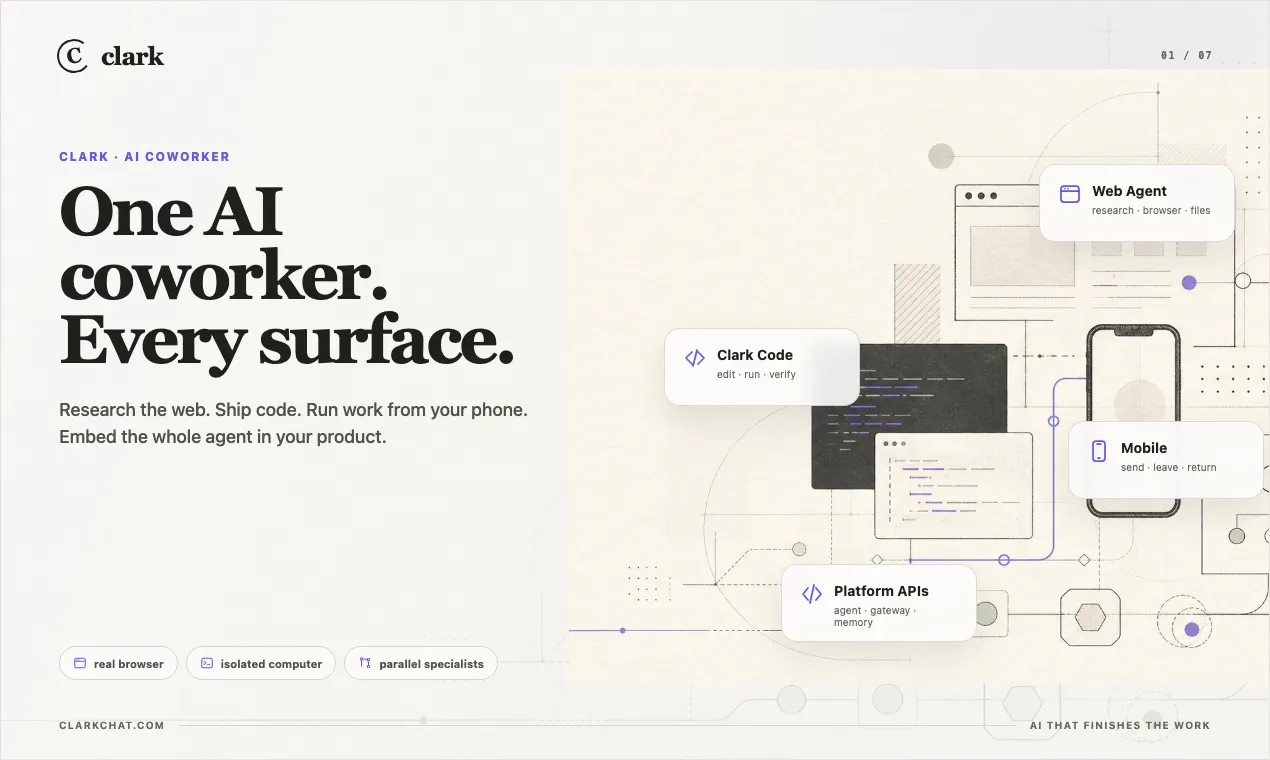
Love that Clark can fan work out to parallel specialists and hand back artifacts with sources. One thing I'd love is a simple "trust but verify" mode where I can quickly diff what Clark did against my own expectations before it writes to a repo or ships a spreadsheet, so I can catch small errors without babysitting the run.
-
Gaylord Buckridge 4 months ago
the scheduled monitor use case is the one I'd want most out of this. when it re-runs on a timer, does it diff against the last artifact and surface only what changed, or hand back a fresh full artifact every time and leave the comparison to you?
-
Neal Jacobson 4 months ago
the scheduled monitoring runs are the part I'd worry about most - if a recurring job silently starts failing (site changed, credentials expired) does it flag that as a failure or just quietly hand back a stale/empty artifact next run?
-
Wiley Lubowitz 4 months ago
the scheduled monitoring use case is the interesting one - when a monitor job runs repeatedly, does it diff against the last run so you only get pinged on what changed, or does it hand back the full state fresh each time and you compare yourself?
-
Fidel Davis 4 months ago
How does the fan out to parallel specialists actually work, does Clark decide on its own how to split a task or do you have to define the sub agents ahead of time?