

About Cloudflare Temporary Accounts
Reviews 8
-
Merl Orn 5 months ago
Looks great!
-
Mortimer Powlowski 5 months ago
Ephemeral credentials that self-delete in 60 minutes is the sort of attack-surface reduction I wish more products shipped by default. You don't have to leave junk out there racking up billing either. Now someone just has to worry about what the agent deploys to a public URL in that window.
-
Curt Nienow 5 months ago
That's really awesome a feature to make workflow more faster. Thanks a lot Cloudflare.
-
Tyrique Lind 5 months ago
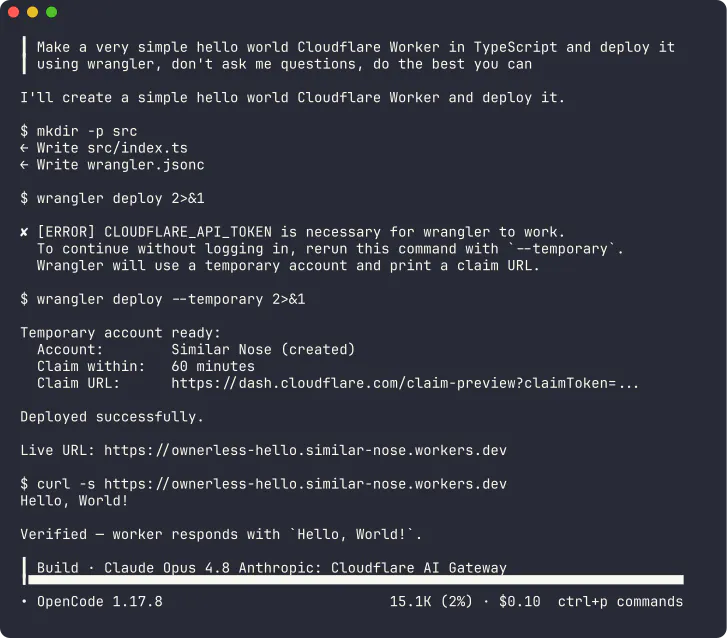
The 60-minute temporary account flow is the part I'd test first for agent workflows, especially when a project needs a few deploy-test-redeploy loops before a human even looks at it. The practical edge case is claim time: if the agent already attached KV, D1, or Durable Objects during the temporary window, does claiming the project preserve those bindings as-is, or does the human need to recreate part of the setup in the real account?
-
Trenton Spencer 5 months ago
Disposable identifiers are one of the rare privacy moves that also cut fraud exposure — a throwaway address can't be cross-referenced or resold onto a "sucker list." Curious how you're handling recovery: if someone needs to re-access something tied to a temporary account, what's the flow?
-
Odell Bode 5 months ago
The 60-minute ephemeral window with iterative redeploy is the right design for agentic workflows. Auth interruptions break agent execution mid-task, and the claim link keeps humans in control of what gets committed. I've hit this exact wall with multi-step automated pipelines. How does state transfer work at claim time? Do KV namespace bindings and Durable Objects carry over, or does the agent need to reconstruct?
-
Duncan Effertz 5 months ago
This is smart. The biggest blocker for agents right now is auth and account setup. 60 minutes to deploy and claim is a nice middle ground. What happens to the worker if nobody claims it though? Does it just get wiped?
-
Burley Collins 5 months ago
I like the 60-minute temporary window. It feels like a good balance, enough time for the agent to prove the work is useful, but not another abandoned preview environment that lives forever. Curious how this will work for slightly more complex Worker projects. Can temporary deploys also test bindings like KV, R2, D1, or environment variables, or is the first version focused mostly on simple Workers?