

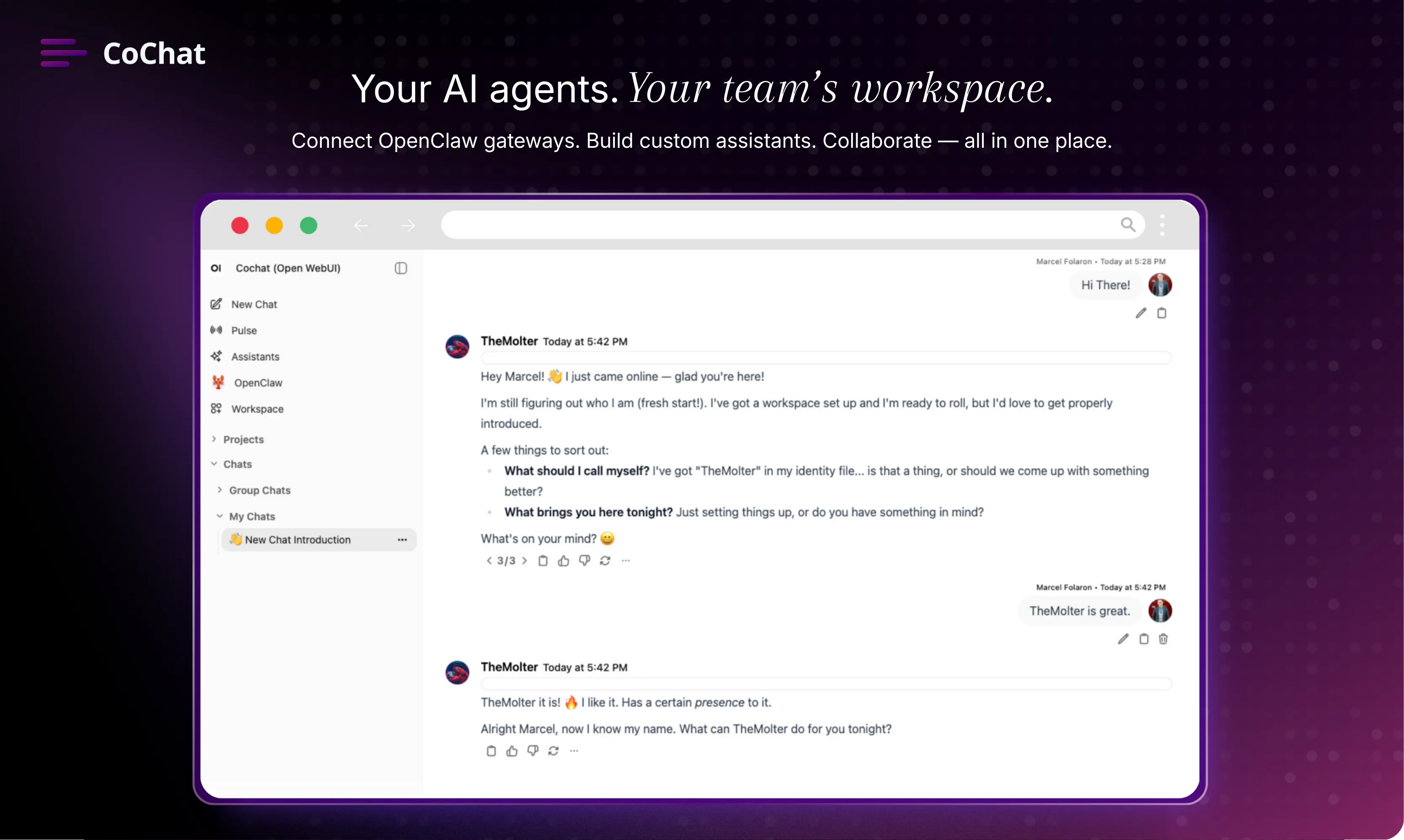
About CoChat
Reviews 13
-
Blaze Koepp 8 months ago
Congratulations on your launch, and interesting concept! Caught my eye because recently our org completely banned OpenClaw due to IP/data leakage risks, even if running locally. I understand that having logs and approvals for sensitive steps is a great way forward, but can you really claim that's all it takes to make it "secure"? Also, what about data retention since agents have memory? Curious how you tackle data retention and leakage risks.
-
Paul Kshlerin 8 months ago
Question: Is the "CoChat" name hinting at a real-time collaborative layer over existing chatbots, or is this building something from scratch? The minimalist landing page has me intrigued but also wondering if I'm looking at a wrapper around ChatGPT's API or a completely new conversational architecture.
-
Enrico Wiza 8 months ago
the memory and personality per agent is the right call. most team AI tools feel stateless, like starting over every session. curious about the cold start for new team members though. agents build context over time, but what about day one? been using northr identity for that exact gap, portable user identity that loads into any AI session instantly. combined with cochat's memory layer that could be pretty powerful.
-
Korey Hammes 8 months ago
This looks super useful for marketers. Real-time insights from actual consumers can make a huge difference in understanding brand performance. Congrats on the launch!
-
Monserrate VonRueden 8 months ago
The “agents as teammates” framing is really interesting. One thing I’m curious about: when a new team first opens CoChat, what’s the main starting workflow you expect them to try first? With platforms that combine agents, automation and collaboration, sometimes the hardest part is helping users understand the first simple use case.
-
Scotty Feest 8 months ago
The 'one thread where humans and agents collaborate' framing is the right bet — most team AI tools fail because they treat AI as a separate workflow instead of an integrated participant, so people revert to old habits. Curious how you handle the trust layer when a new team member joins: do they inherit existing agent memory and approvals, or start fresh? The security audit on every connection is a smart default that removes the 'who approved this?' conversation that kills adoption in ops-heavy teams. The scheduled tasks plus memory combo is where I'd expect the stickiest use cases to emerge — that's the shift from 'tool you use' to 'system that works for you.'
-
Rupert Emmerich 8 months ago
Interesting direction as moving AI agents from isolated chatbots into a shared team workspace feels like a natural next step for collaboration. Curious how teams will balance agent autonomy, memory, and security as these systems start handling real responsibilities.
-
Rylan Cremin 8 months ago
Saw CoChat's PH launch and 249 upvotes is solid validation for collaborative AI tooling.. What caught my attention: you're leading with 'autonomous' + 'secure' which typically conflict in enterprise buying committees I work with.. Quick question: how are you positioning the autonomous capabilities to InfoSec teams who usually flag agent-based tools as data exfiltration risks? From a marketing lens, I'm seeing B2B AI tools struggle with attribution when selling 'collaboration' as the buying committee is fragmented and CAC spikes without clear product led funnels. If you're exploring paid acquisition for MENA markets (where data residency is make or break), I'd be interested in exchanging notes on how AI collaboration tools are approaching regional compliance in ad messaging. Congrats on the launch.
-
Rupert Emmerich 8 months ago
Oh this is cool — I love that agents here actually have memory and personality instead of being "ask and forget" chatbots. Since you asked for feedback: 1. On security — honestly, the biggest thing for me is visibility. I want to see exactly what each agent has access to and what it did. Audit logs are a must. I build iOS apps and I route all my AI API calls through a proxy just to keep keys off the device, so I really appreciate that you're thinking about this at the infra level. The 225+ CVE auto-scan is a nice touch. 2. Scheduled tasks — 100% yes. Off the top of my head: weekly monitoring of competitor reviews on the App Store, auto-summarizing GitHub commits into changelogs, daily crash report digests. Basically anything that's "go check this thing regularly and yell at me if something's off." Also the no-SSH approach is such a relief. Setting up tunnels to self-host AI tools has always been the part where I lose motivation lol. Great work on this!
-
Nils Auer 8 months ago
Curious how you deal with gateways going down or getting corrupted after something like an openclaw update? Asking because I ran into this specifically today.
-
Maxwell Blanda 8 months ago
Cool concept! How do you think about managing agent permissions / preventing agents from taking risky actions?
-
Jackson Fisher 8 months ago
I’m the founder of cochat.io and you’ve been copy and pasting my ideas. You were originally an AI platform where people can use different AI models all in one place. Now you transitioned to “LinkedIn for AI”. My idea is based on having AI in your portfolio. Your name is completely identical except for the domain type. When I changed the hero of my landing page, I noticed one week afterwards your page had the same dynamic chat component. You’ve been ignoring my attempts to reach out, I’m kindly asking you and your cofounder to respond to my messages so we can reach a resolution.
-
Odell Bode 8 months ago
The "agents as teammates" framing really resonates. We've been dealing with the exact same problem on our team where everyone has their own AI setup but there's zero shared context between them. The gateway security audit feature caught my eye too, how granular are the permission controls per agent?