

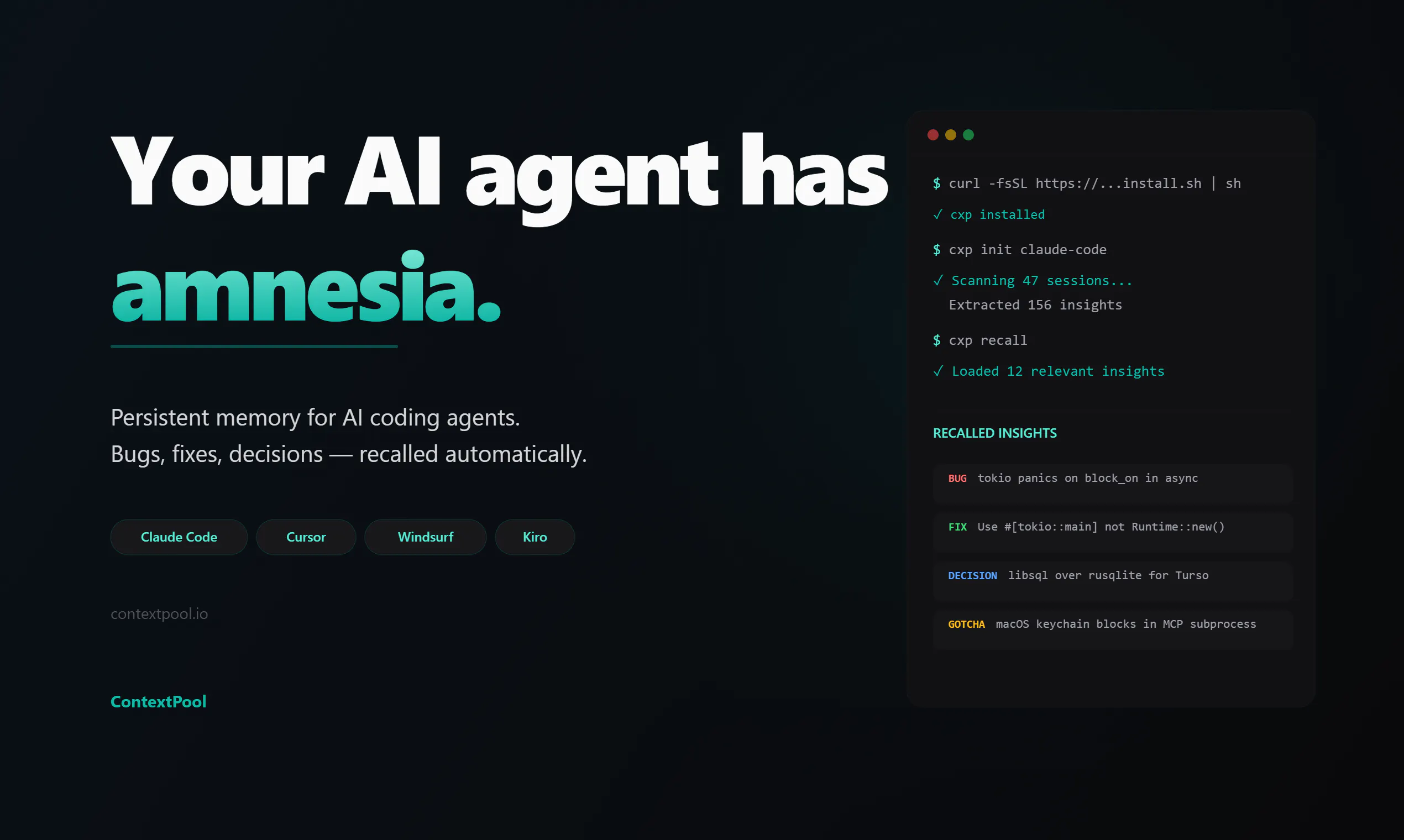
About ContextPool
Reviews 12
-
Makenna Eichmann 5 months ago
Persistent memory helps, but the hard failure mode in coding-agent workflows is memory outranking fresh evidence. I'd want a clear boundary between approved long-lived context and run-local receipts: what changed, what failed, why another retry is justified, and what should expire automatically after the run. How do you decide what becomes durable memory versus what stays ephemeral session state?
-
Rocio Cormier 6 months ago
@majidyusufi The 'brilliant colleague with amnesia' problem is real — I've watched developers re-explain the same architectural decisions every single session. What ContextPool gets right is that it captures why decisions were made, not just what they were. That's the thing most memory tools miss. Curious how it handles insight staleness when a decision gets reversed — does old context get superseded automatically or does it require manual cleanup?
-
Hobart Glover 7 months ago
And what if I had multiple projects in Claude Code? How do you handle that?
-
Godfrey Donnelly 7 months ago
What I've used so far that works very well for me is the compound part of Compound Engineering. The problem I see to CE is that it's per repo, ContextPool looks amazing since all my repos can share these eng learnings! Great work!
-
Mckenzie Mosciski 7 months ago
This solves a genuine pain point. I run a small agency and every time I spin up a Claude Code session on a client project, I spend the first 10 minutes re-explaining the stack, the deployment quirks, and why we made certain architectural choices. The idea of capturing that as structured, searchable memory rather than just dumping everything into CLAUDE.md is a much cleaner approach. Curious about one thing: for the team sync at $7.99/mo, is there a way to scope shared memory per project or repo? In an agency setting, you definitely don't want client A's context leaking into client B's sessions.
-
Kenneth Corwin 7 months ago
Interesting concept, but “exhaustive scanning” sounds expensive at scale. Curious how it performs with large document sets in real production use.
-
Esteban Hilpert 7 months ago
Built something similar for a different layer persistent memory across business workflows, not just coding sessions. The "docs graveyard" concern from the comments is real. What helped us was making memory write-on-use, not write-on-save. If an agent references a piece of context during a task, that context gets reinforced. If nothing ever pulls it, it decays. Curious how you handle relevance scoring when the pool grows past a few thousand entries.
-
Blaze Koepp 7 months ago
Vibe-coder here. I maintain a claude.md file and update it manually at the end of every session. It's manual, but it works. For a solo builder (no team) what does ContextPool give me that a well-maintained claude.md doesn't?
-
Gaylord Buckridge 7 months ago
This is really cool. Does the agent have persistent memory on only your work or also the work your team is working on?
-
Conner Jacobs 7 months ago
This is solving a real problem. I've been building a full SaaS in Claude Code for the past year: 13 AI agents, FastAPI backend, Next.js frontend — and the context loss between sessions is genuinely the biggest friction point. The thing I keep re-explaining: project architecture decisions. Why certain agents are split the way they are, why the credit system works a specific way, which database tables relate to what. Every new session I'm pasting the same CLAUDE.md context block to get the agent back up to speed. Curious about one thing, how does it handle multi-stack projects? My repo has TypeScript frontend and Python backend with very different patterns and gotchas in each. Does it extract insights per-language/per-directory, or is it all one pool? Going to try this today.
-
Marcelo Prohaska 7 months ago
I don’t quite understand how you handle control and cleanup of memory from bad, incorrect, or outdated solutions. I often reset the context on purpose so the agent forgets everything and we can start from a clean slate — otherwise past mistakes can compound into even worse decisions over time. I’m really curious how this is managed in your approach.
-
Uriah Mayer 7 months ago
Really cool! Btw how does Contextpool handles codebase evolution like when old decisions become invalid? Also how are you structuring extracted insights, are these embeddings, structured schemas,or something hybrid? And is all of it stored locally?