

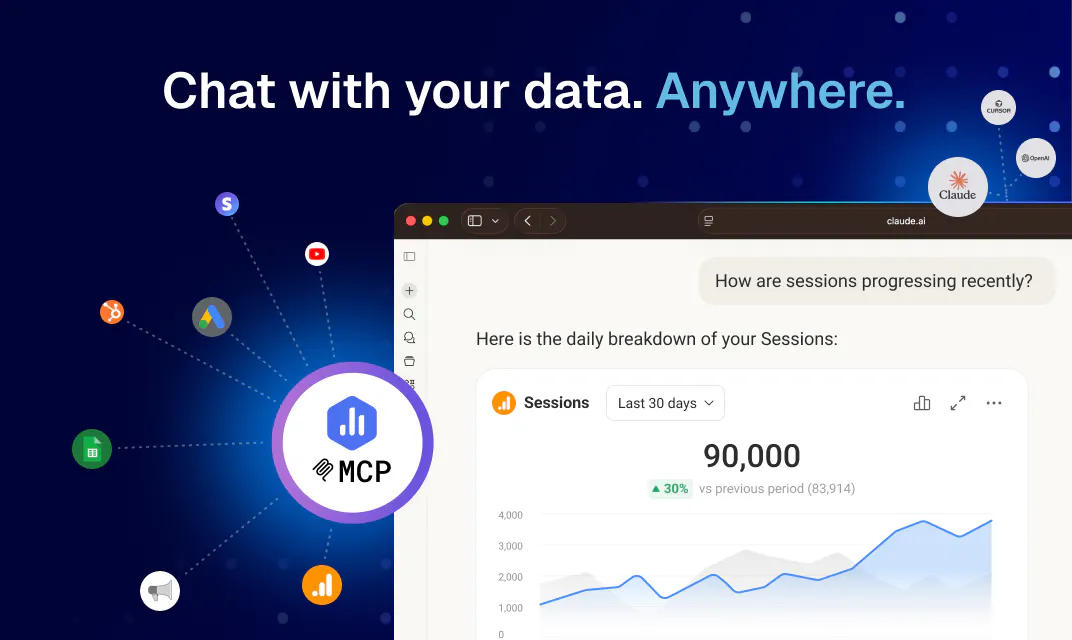
About Databox MCP
Reviews 15
-
Rylan Cremin 5 months ago
This is exactly what I've been missing. I use Claude constantly for business decisions but I'm always manually copying data in to give it context. Having Databox feed that context directly would change how I work with it completely.
-
Neal Jacobson 5 months ago
Databox is known for aggregating data from dozens of different platforms (Stripe, HubSpot, Google Analytics). When querying it via Claude or ChatGPT using MCP, how well does the LLM handle complex, cross-platform questions that require joining data from two completely separate silos?
-
Daren Bruen 5 months ago
Love that this cuts out the manual copy-pasting into ChatGPT. Since LLMs are notoriously finicky with raw math, how much of the actual heavy lifting/calculation is done by Databox's engine versus the LLM itself? If I ask for a complex calculation, how do you ensure the AI doesn't hallucinate the final metric output?
-
Roy Kris 5 months ago
The shift from open the dashboard to ask the question is the right framing, and grounding answers in real metric definitions is the part that keeps it from being a confident guess. That is also where I would push. When someone asks “how did CAC do last week,” the answer depends entirely on whose definition of CAC is canonical, and the failure mode for an LLM is inventing a plausible formula when the metric is not in the catalog. Does the MCP server refuse and say the metric is undefined, or does it fall back to a best guess? And when two teams define the same metric differently, does the answer carry which definition it used, so the number stays auditable later?
-
Jackson Fisher 5 months ago
This is exactly the direction BI is heading. One question — for users with messy, inconsistent data sources, how does Databox handle schema drift or late-arriving data before it hits the LLM context? That's the hard part most tools skip. As a data engineer who's dealt with this on Databricks + Delta Lake, I'd love to know your approach
-
Scotty Feest 5 months ago
I'm loving the Databox MCP and honestly, the one thing I didn't anticipate was how useful this could be for upskilling junior team members in the marketing agencies I work with. I sit at the intersection of ops, strategy, delivery, and client services for agency teams, and the hardest part to scale has always been the month-end report analysis. We've always needed to pair every account with a dedicated senior strategist to look at the work, the numbers, the objectives, and then tell a strong, client-facing story about what's going on and what to do about it. It takes YEARS to build that kind of instinct, and it's not practical to assume your more junior folks can step in and handle it. With the Databox MCP, you've just fast-forwarded years of experience. An AM or coordinator can ask why a number moved, get a real answer pulled from the actual metrics, provide context around the program and goals, collaboratively hypothesize around what's happening, then show up to the client call with a proactive point of view instead of a dashboard and a promise to "have the team look into it". Game changer. Stoked for this new evolution of the Databox platform!
-
Garland Grady 5 months ago
The MCP angle makes sense for analytics because the useful part is not just querying charts, it is keeping answers tied to the same metric definitions the team already trusts. I’d be curious how you handle permissions when Claude or Cursor asks for data across multiple teams.
-
Santa Cassin 5 months ago
One more thing worth sharing. The most fun part of the soft launch has been watching what partners built on top of the Databox MCP, then gave away for free. A few you can grab or look at right now: László Fazakas open-sourced Arcanian OS, a system for managing complex, multi-market client campaigns that uses the Databox MCP to run automated in-depth analysis and inform daily decisions. The whole thing is on GitHub: https://github.com/arcanianHQ/arcanian-os Max Traylor built Mantis, an AI-powered agency account management system that automates reporting, protects retention, and surfaces upsells. Here's how it works: https://claude.ai/public/artifacts/7b5265c8-2b0c-47d9-ae69-bbdbb86ab113 Jovan Miljevic built an n8n workflow that monitors SEO cannibalization across Databox, Google Search Console, and Slack, running on its own on a schedule. It's published here: https://n8n.io/workflows/15691-ai-powered-seo-cannibalization-monitor-databox-google-search-console-and-slack/ Rick Kranz gave away three Claude skills that use the MCP to analyze different parts of a sales and marketing funnel automatically. Free to download: https://www.linkedin.com/feed/update/urn:li:activity:7455235813786861568/ Keith Gutierrez built a pipeline that flags an underperforming page, audits it, writes the fixes, and updates the CMS, with no one touching a spreadsheet. One page it touched is up 62% in sessions. A couple of how-to walkthroughs from partners, if you'd rather see it applied to a specific job: Gary Magnone, on finding the root cause of a KPI spike in minutes instead of hours: https://databox.com/how-to/identify-the-root-cause-of-kpi-spikes-faster-with-ai-powered-analysis Kamil Rextin, on building paid media benchmarks from client data: https://databox.com/how-to/create-paid-media-benchmarks Different problems, same foundation underneath. If you build something with it, I'd love to see it.
-
Murray Kuhlman 5 months ago
I've spent so much time jumping between dashboards trying to make sense of numbers that just sit there. The idea of just asking your data a question in plain English and getting a real answer — that's the part that gets me. Especially useful for people running lean teams where not everyone is a data analyst. How are you keeping the context fresh when the underlying data changes?
-
Johnpaul Crona 5 months ago
The setup experience is worth calling out. Connecting Databox MCP to Claude or n8n takes under a minute -> paste the server URL, authenticate with OAuth, and your metrics are immediately accessible. No infrastructure to configure or pipelines to build. That low barrier is important because the hardest part of most analytics integrations is getting started. Removing that friction means we can go from zero to asking real performance questions in a single session.
-
Adam West 5 months ago
Hey all! From a technical standpoint, what I think makes Databox really powerful is that it handles the full data lifecycle in a single server. Ingestion, management, and querying are all exposed through the same MCP interface 💪🏻 That means AI agents built on top of it can do things that read-only analytics MCPs cannot. Things like cleaning a CSV, pushing it to a dataset, and immediately running analysis on the merged data. The ask_genie tool takes that much further by handling natural language queries against complex datasets without requiring manual SQL or pivots. Awesome!
-
Korey Hammes 5 months ago
What’s the biggest productivity gain teams usually get after connecting Databox MCP? Faster reporting, better decisions, fewer manual data checks?
-
Felipe Sanford 5 months ago
I spent more than 100,000 dollars trying to build my own data warehouse before I gave up and used the Databox MCP instead. The problem I was solving is the one nobody likes to talk about with AI and data: an LLM will give you a confident answer whether or not the data supports it. When you manage ad spend across dozens of markets for a client, a confident wrong answer is expensive. So I built Arcanian OS on top of the Databox MCP. It runs in Claude Code, connects to live data, and every claim it makes carries a confidence score. Data straight from a CRM pipeline scores high. A number inferred across two loosely connected sources scores low and gets flagged for a human. When a question contains a contradiction, the system does something most AI tools never do. It refuses to answer and asks me to rephrase. It runs an internal debate among agents before it reaches a conclusion, creates tasks when it spots a risk or an opportunity, then checks back later to see whether finishing the task actually moved the metric. The learnings get anonymized and reused across every client in the system. None of this works without a data layer that pulls accurately and defines each metric the same way every time. That layer is the Databox MCP. I open-sourced the whole operating system on GitHub so other agencies can run it too.
-
Jaiden Runolfsson 5 months ago
The real challenge in analytics MCP isn't data retrieval, it's grounding the LLM in correct metric definitions. We've run into this on customer data pipelines: 'churn' means different things across systems. How does the MCP layer handle semantic disambiguation? When a user asks about revenue or pipeline, does the context layer resolve conflicting metric definitions or surface the ambiguity to the user?
-
Rocio Cormier 5 months ago
Been building on the Databox MCP for months alongside the HubSpot MCP. The combination unlocks a revenue intelligence layer most HubSpot agencies haven't explored yet. Excited to see this go public today.