

About Edgee Claude Code Compressor V2
Reviews 15
-
Uriah Mayer 4 months ago
50% token savings is a real no brainer for anyone runnign coding agents 🔥 congrats!
-
Quincy Medhurst 4 months ago
50% cost reduction is a concrete promise. Curious how you keep the compressed context from dropping those tiny repo-specific constraints that usually matter most in Claude Code sessions?
-
Chaim Schuppe 4 months ago
the brevity layer raises a question beyond live readability: when an agent does something wrong three sessions later and you're doing a postmortem, do you still have the verbose reasoning trace anywhere, or did it only ever exist on the wire in brief form. cost optimization and debuggability usually pull in opposite directions - would love a mode that keeps the full narration in a log for audit while only sending the brief version to the model, so you're not trading "cheaper now" for "unexplainable failure later"
-
Marcus Macejkovic 4 months ago
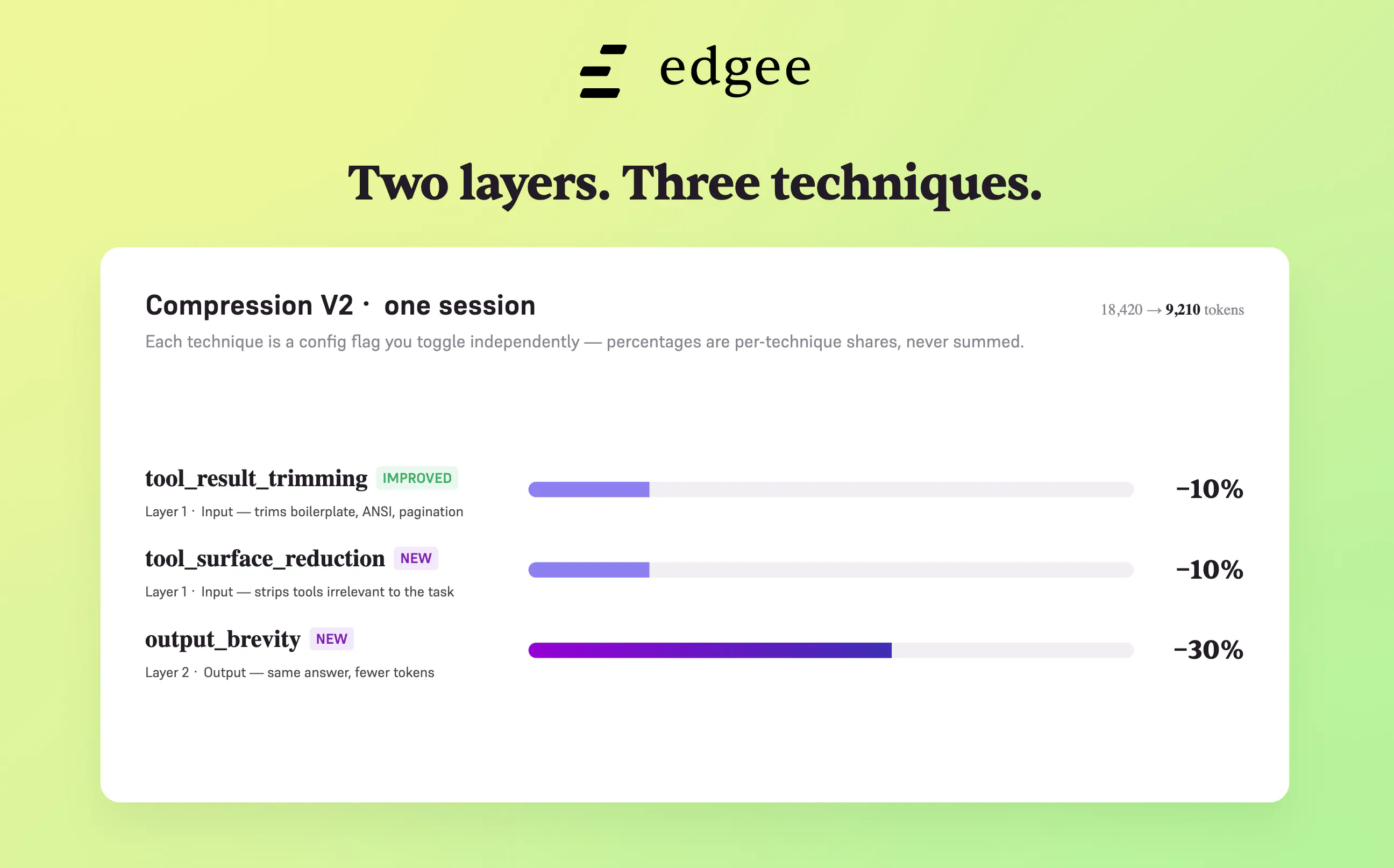
V2 stacking tool-result trimming with the other layers for real Claude Code sessions is the kind of boring infra win that actually shows up in the bill. Curious how it behaves on long MCP-heavy runs.
-
Dorcas Parker 4 months ago
Nice to see actual sign tests and confidence intervals in the writeup instead of a bare headline number. Lossless trimming? Very interesting - I need to check this out!
-
Nils Auer 4 months ago
the TSR classifier is the clever bit — scoring every MCP tool against the task and stripping irrelevant ones before they bloat the context. how much latency does the classifier itself add on each request, and does it run per-turn or only at task start?
-
Monserrate VonRueden 4 months ago
Brevity being the biggest win makes sense to me — I notice Claude Code narrating plans I never asked for. Does suppressing that narration change how easy it is for a human to follow along mid-session, or is it only trimmed on the wire?
-
Marcelo Prohaska 4 months ago
If you’re using coding agents all day, them tokens add up really fast and cutting them would save a lot of money. Does the token compression ever affect the quality of the responses?
-
Esteban Hilpert 4 months ago
Rare to see a cost claim backed by paired sign tests and per-replicate cache nonces instead of one headline number — that got me to read the full write-up. The one thing I couldn't work out: how compression interacts with prompt-cache prefix stability. On Anthropic, a cache read costs ~1/10 of uncached input, and a long Claude Code session gets most of its economics from the prefix staying byte-stable. History-layer trimming that touches an already-sent tool result mutates the prefix and invalidates everything after it — and TSR looks like it has the same tension, since the tool block sits at the very top of the prefix, so a per-task curated subset would change the first bytes of the prompt as the task evolves. Two questions: (1) Is trimming append-only — freeze what's already been sent, compress only new turns — or re-optimized per request? (2) When you say ~50%, is that net of the lost cache discounts, or measured on uncached token counts? The nonces read like caching was deliberately neutralized — the right call for isolating each technique, but it leaves the production net effect open. Asking as squarely the target user: solo dev, long-running sessions, a bill that's mostly cache reads.
-
Eino Klein 4 months ago
Looks nice. How does it compare to tools like headroom? Any benchmarks?
-
Elias Rowe 4 months ago
That's clever. Does it figure out the active task on its own, or do you need to pass in context?
-
Joshua Abshire 4 months ago
Curious how Edgee handles the “gateway” part in practice for coding agents. Is the main idea routing requests across different agent providers for cost and speed, or is it more about giving engineering teams one place to manage access and workflows? The “cheaper, faster, unstoppable” promise is clear, just wondering where the biggest control point is.
-
Rahul Goyette 4 months ago
plugged it into my Claude Code setup over the weekend and actually saw the token count drop on a refactor job. nice that it just routed around my OpenAI rate limit without me even noticing.
-
Ayden Miller 4 months ago
The 50% cost reduction claim is the kind of thing that varies a lot depending on what's actually in the context window. Conversations with heavy tool call output, long file reads, or repeated error traces compress very differently than a tidy back-and-forth session. Curious what the benchmark corpus looks like and whether that number holds on real agentic sessions rather than cleaner workloads. Also wondering whether the compression is lossy in any meaningful way, specifically whether there are cases where the model behaves differently after compression because something subtle got dropped from an earlier turn.
-
Kay Balistreri 4 months ago
Coding agents are amazing until you realize how much token waste is hidden in the background. not just the actual code changes, but repeated tool context, long outputs, noisy history, and models explaining things I didn't really need explained. The TSR idea is the most interesting part for me. with more MCP tools connected, the "tool surface" can get huge very fast, and sending irrelevant tools to the model on every request feels like exactly the kind of invisible cost that compounds. I also really respect that you published the methodology instead of just saying "up to 50% cheaper". paired tests, cache nonces, and decomposition by technique makes the claim much easier to trust. Curious how you think about the risk side of TSR. if the classifier removes a tool that would've been useful later in the task, can the agent recover, or does it need to restart with a wider tool set?