

About Eodly
Reviews 15
-
Zachariah Hudson 4 months ago
Congrats on the launch. The sourced evening page idea feels useful because it meets the team where work already happens instead of adding another standup tool. The line between helpful context and surveillance is delicate though. Do you let teams see or contest the evidence before a founder digest goes out, or is the first review always from the founder side?
-
Kyleigh Luettgen 4 months ago
The claim-versus-system-of-record check is the interesting engineering here, and the part I'd want to understand is attribution. When we cross-checked self-reported status against Git and ticket state, matching a vague claim like 'almost done with checkout' to the specific PR or ticket it refers to was where we lost accuracy. A merge that lands today can close work someone claimed three days back, so naive time-windowing reads that lag as a contradiction and fires a false flag. How does Eodly map a one-line check-in to the exact artifacts it's judging it against?
-
Johnpaul Crona 4 months ago
The "what actually shipped" framing lands, since standups usually drift into what people meant to do. Does Eodly pull signal from commits and PRs on its own, or does the team still log it manually? The moment something needs daily manual input my small team quietly stops doing it.
-
Toni Kutch 4 months ago
how does it actually figure out when someone's "slipping" vs just heads down on something that hasn't shipped yet? feels like that boundary could get noisy fast
-
Haleigh Bartoletti 4 months ago
the "not surveillance" framing is doing a lot of work here. it's still a tool that quietly scores people's activity and hands the founder a page ranking who looks slow, the team just doesn't see their own report. once people find out that page exists, and they will, I'd expect them to start performing for the sourced signals (commits, messages) rather than just doing the work, which kind of defeats the point
-
Haleigh Bartoletti 4 months ago
The "your team never logs in" line is the smartest part. Every standup/status tool dies the same way — it asks people to do extra work to report the work they already did. Reading the signal from where the work already happens (Slack, GitHub, Linear) is the only version that survives contact with a busy team. Same pattern I see in voice: the products that win meet people where they already are instead of adding a new place to go. One honest worry — how do you avoid false "slipping" flags? Someone quiet in Slack might just be heads-down shipping. Get that wrong and it reads as surveillance, right as you promise it isn't. Congrats on the launch 🚀
-
Karley Frami 4 months ago
When will you add support for JIRA ?
-
Rylan Hyatt 4 months ago
Congrats on the launch, Juwon. The 'who's quiet' flag would make me nervous to build — a designer deep in Figma or someone on client calls all day looks silent in Slack and GitHub while doing their best work of the week. How does Eodly tell that apart from actual slipping?
-
Adam West 4 months ago
That's neat. How does it distinguish actually shipped work from updates that just sound like progress?
-
Al Wolf 4 months ago
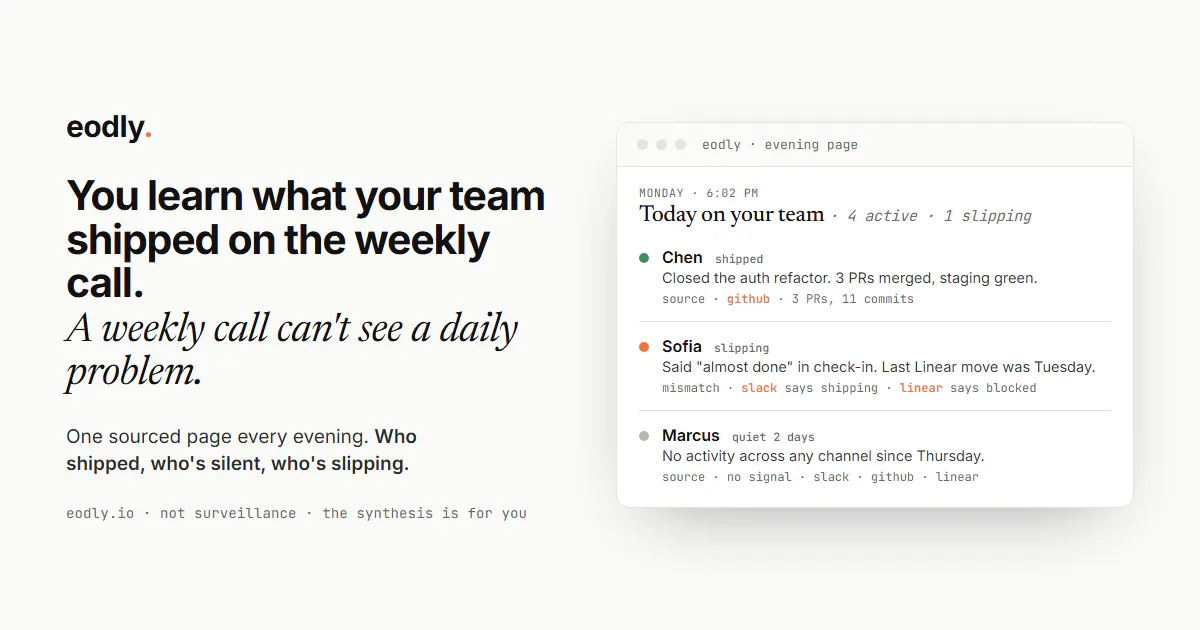
I'd love something like this but from the reverse angle, to help teams upwardly demonstrate progress and what goes into making something a reality. Something that helps aggregate a whole teams efforts for the day, while showing some of the "how the sausage gets made". As HOP I find that collecting these signals daily to share forward momentum upwards can be more time consuming than it sound on paper. As an example from your website, a positive signal as: "Closed the auth refactor. 3 PRs merged, staging green." But then translating that into something csuite will understand how that's valuable for the business and what the outcomes are/what it unlocks - then do that for 7+ in flight epics, across 30+ engineers.
-
Murray Kuhlman 4 months ago
The "what actually shipped" framing is interesting because it implies you're pulling from somewhere more reliable than self-reported updates. So I'm curious where the data actually comes from. Are you connecting to Git commits, Jira tickets, pull request merges, or is this still fundamentally a standup tool where the accuracy depends on what people remember to log? That gap between "what got done" and "what someone typed at 5pm" is where every async status tool I've seen falls apart.
-
Orrin Batz 4 months ago
This looks like something I'd like to use. How do we trigger the Eodly check from, lets say, WhatsApp? Do I have to tag it in a message and it checks whats happening, or is it only a daily overview kinda report?
-
Reilly Thiel 4 months ago
Love the evening digest concept, really cuts through the noise. One thing I'd want is a quick way to reply or comment on an entry straight from the email, like a thumbs up on a ship or a nudge to someone quiet, so I can act on it without opening another tab.
-
Makenna Eichmann 4 months ago
different angle from the team-morale question above: what about false positives on the "status doesn't match reality" flag specifically. someone could be genuinely blocked on a design review that's happening in a call, or deep in research that doesn't produce commits or messages for two days, and that would look identical to actual slipping from the outside signals you're reading. does the founder get any confidence level on those flags, or is it presented as flat fact each evening? seems like the credibility of the whole digest hinges on that ratio being low
-
Haleigh Bartoletti 4 months ago
The evening digest idea is genuinely useful, especially catching when someone's Slack optimism doesn't match their Linear tickets. Liked that it pulls from multiple sources without making the team log into yet another tool.