

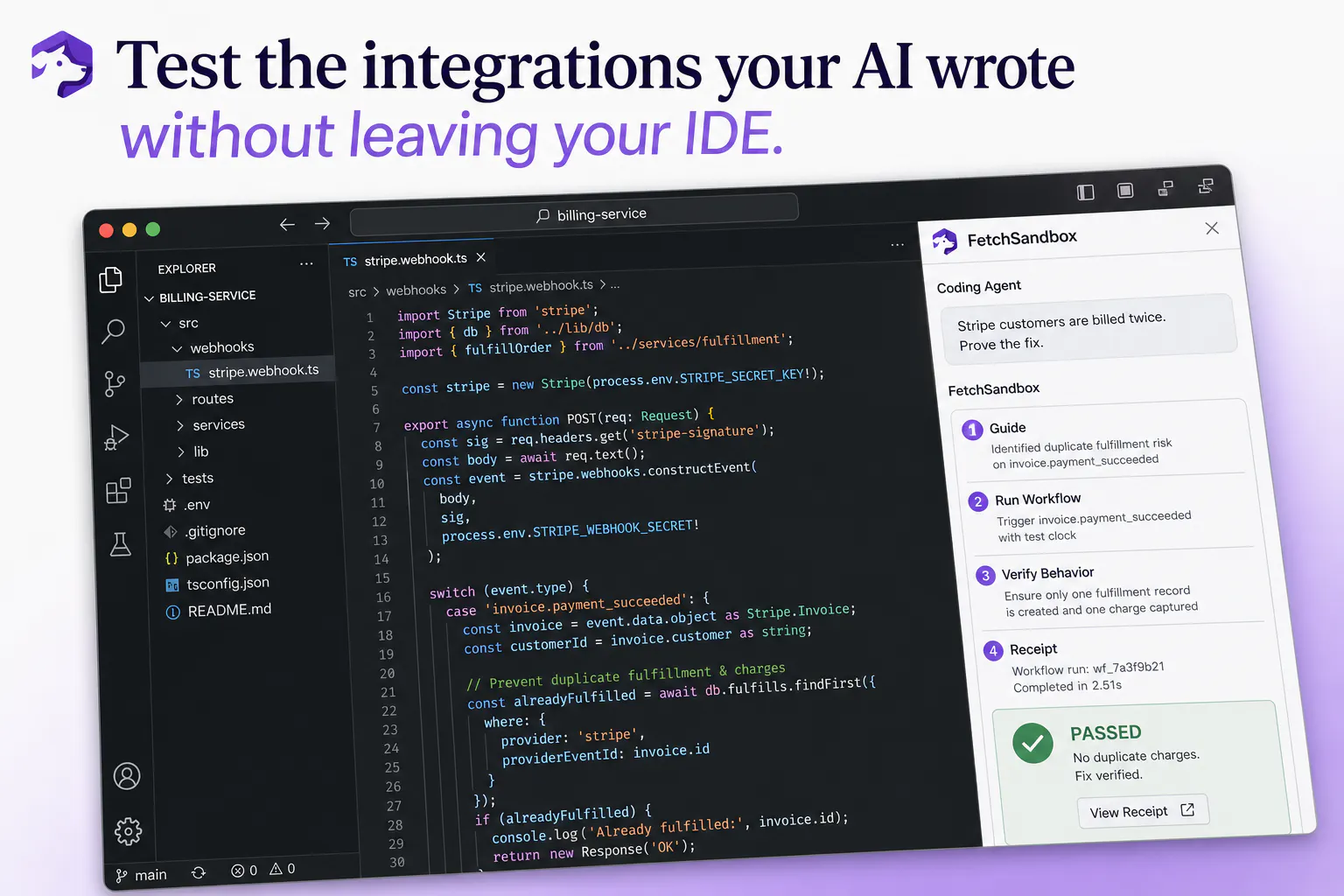
About FetchSandbox
Reviews 15
-
Hugh Borer 4 months ago
stopping at 200 OK is exactly the trap 👏 remembering what broke is the smart bit. solo devs or teams mostly?
-
Ruben McClure 4 months ago
@rnagulapalle I get the outline of what it does, but I'd love to understand this better: how can a non-coder like me who builds web-apps just by prompting with Claude Code actually make use of this? I saw it helps avoid burning through API tokens,hitting limits and fix bugs.
-
Curt Nienow 4 months ago
Not needing keys or accounts to just try it is underrated, half these tools you have to sign up for three things before you even see if it's useful. And skipping the wait on staging entirely is such a real pain point. Congrats on the launch!
-
Franz Bauch 4 months ago
The "remembers what breaks" line is interesting for API integration testing. Does FetchSandbox keep track of the exact failing request/response details, like payloads, headers, status codes, and timing, or is the memory more about patterns across previous test runs? That distinction would help teams understand where it fits beside their current CI checks.
-
Hobart Glover 4 months ago
The "beyond 200 OK" framing is exactly right, and I learned it the hard way. I shipped a Paddle integration recently and every test I had was a green 200 — the bug that actually bit me was an idempotency one: a retried/duplicate event creating an orphan customer on a rolled-back checkout. Nothing in my suite could have caught it, because I was only asserting the happy path. The way I eventually found it was by hand: ngrok pointed at localhost, replaying webhooks, poking state until something broke. A deterministic failure library that just does the duplicate-event / late-event / stale-state cases for me would have saved me an entire evening. Two questions: (1) does the failure library cover Paddle, or is Stripe the only payments provider so far? (2) for webhook lifecycle bugs specifically — can you replay events out of order (e.g. a subscription.updated landing before the checkout.completed)? That ordering case is the one that actually broke me, and it's the hardest to reproduce on purpose.
-
Haleigh Bartoletti 4 months ago
The "remembers what breaks" line is the whole reason I clicked. The APIs I integrate never fail cleanly. They pass in dev, pass in review, then throw a 500 once a week in production for reasons I can never reproduce on demand. Does FetchSandbox help with that kind of intermittent break, or is it aimed more at catching hard contract changes when a provider ships a new version? And does it cover webhook and callback flows, or just the requests I make outbound? Those inbound calls are where I get burned most and they're the hardest to test.
-
Hugh Borer 4 months ago
The worst production bugs are always the ones that look completely fine until a second system reacts. Your own code passes, the API returns 200, and then three hours later a duplicate webhook fires and someone gets charged twice. Curious what the most common failure pattern is across your 60 plus APIs, is there one class of bug that shows up regardless of which API you're testing?
-
Hobart Glover 4 months ago
the most-tests-stop-at-200 framing is exactly right. the bugs never live in the happy path, they live in the retry that fires twice and the webhook that lands out of order. good to see a tool pointed at that part specifically.
-
Curt Nienow 4 months ago
The "verify what happens after the 200 OK" framing is the actual gap for me — most of my integration bugs live in retries and webhook ordering, not the happy path. Two things I'd want to pin down before wiring it into a Claude Code loop: when I connect over MCP, does the failure library and my recorded scenarios live locally per-project or in your cloud, and can I pin a specific failure (say a Stripe webhook-out-of-order case) so a CI run replays it deterministically instead of re-deriving it each run? Determinism is what decides whether I'd gate a merge on it.
-
Malachi Armstrong 4 months ago
Congrats on the launch. I integrate several AI provider APIs in my product, and the painful breakages are never the loud ones. It's when the same endpoint quietly starts returning a slightly different shape, or a model name stops resolving one day. Does FetchSandbox catch that kind of quiet drift, or is it focused on hard failures?
-
Elmer Schoen 4 months ago
Congrats Raj! It looks amazing and I wish you all the best here
-
Buck Yundt 4 months ago
The "verify what happens next" framing is exactly the gap — 200 OK tells you nothing about the retry/webhook/state mess that actually breaks in prod. Two things I'd want to know as someone wiring these into agents: When an agent drives this over MCP, does it get to discover the failure library as callable scenarios — enumerate and pick which failure to inject — or is scenario selection still human-curated and the agent just runs what you set up? And "remembers what breaks" — is that memory per-project, and does it auto-replay the known-break scenarios as a regression gate on the next change, so a fix that regresses gets caught without me re-describing the bug? @rnagulapalle
-
Kenneth Corwin 4 months ago
the dropped-vs-mid-response-timeout distinction @omri_ben_shoham1 raised is the one I'd want too. adjacent question: do you simulate variable latency (webhook arrives 3s vs 30s late) or is timing binary right now, on-time vs late?
-
Korey Hammes 4 months ago
the dedup/idempotency scenarios are the ones I'd actually use. when two CI runs hit the same sandboxed Stripe API concurrently, is state isolated per run, or can one job's retry storm bleed into another's results?
-
Adam Zemlak 4 months ago
@Raj shipping duplicate/redelivery with the same event id is the one that matters most imo - idempotency bugs are the ones that actually cost people money in prod, way more than a webhook just being late. nice that you got that out fast. curious if dropped events also simulate a partial timeout (connection dies mid-response) vs a clean non-delivery, since those two failure modes get handled very differently in most retry logic