

About FetchSandbox MCP
Reviews 10
-
Wiley Lubowitz 3 months ago
This has good potential as with QA surface as well. Do you see FetchSandbox being used for e2e QA for dev, test, prod envs.
-
Halle Wilkinson 3 months ago
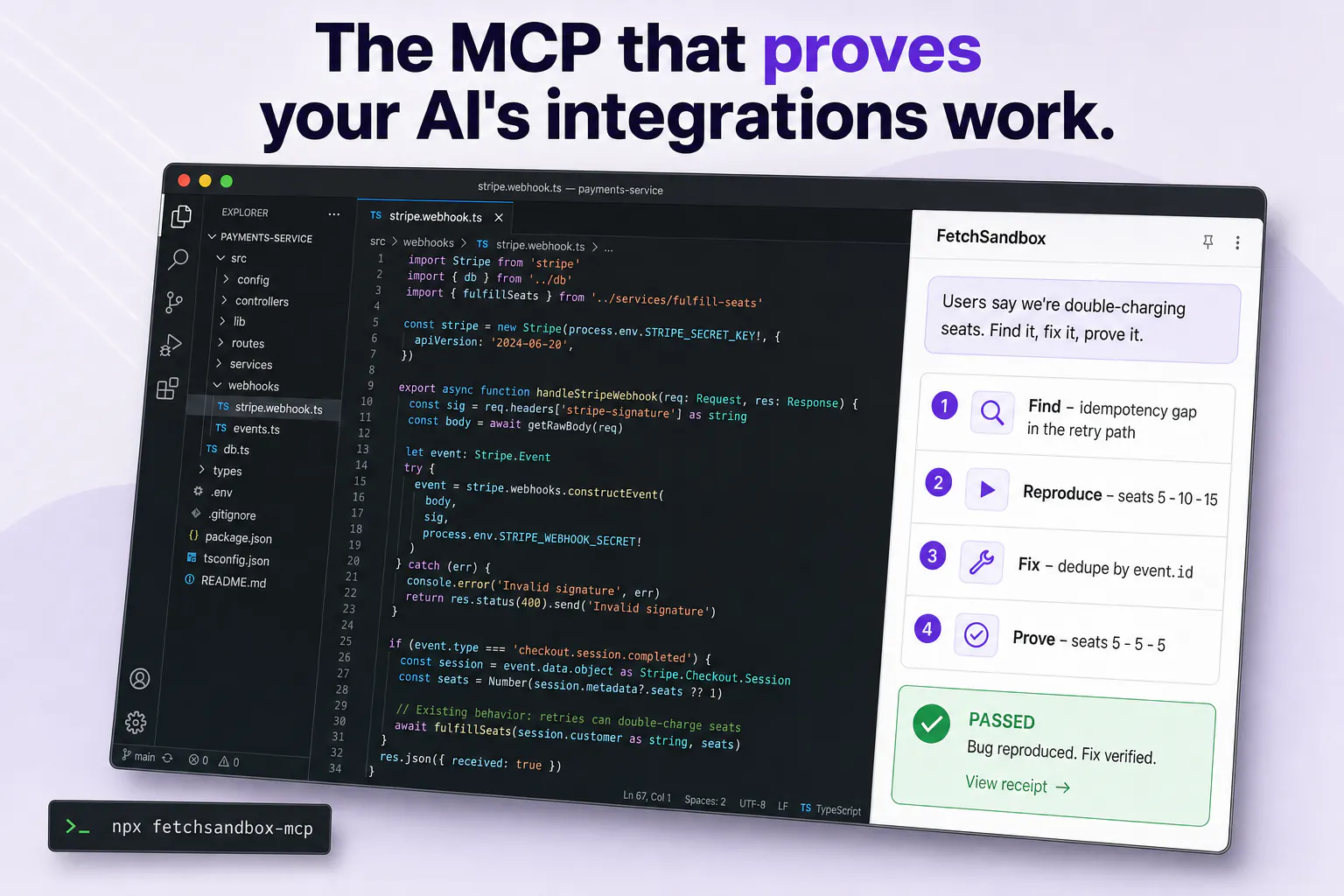
The 5 seats turning into 15 is the version of this that actually costs money. We hit the same shape at Zeplik, output that parses fine and passes every assertion we wrote, wrong in a way only the end state shows. Green CI on a bad write is worse than a red build because nobody goes back and looks. I'd want to know if the receipt catches partial failures too, 3 of 5 writes landing and the rest silently dropped.
-
Merl Orn 3 months ago
FetchSandbox addresses a real weakness in AI-generated integrations: verifying actual end states rather than merely checking for successful responses. The stateful sandboxes, failure injection, and proof receipts make this especially valuable for testing billing and authentication workflows before deployment. One optional improvement would be showing a side-by-side state diff in each receipt, highlighting the expected and actual values across the full workflow. That would make subtle failures, such as a plausible but incorrect response body, easier to detect during review. Congrats on the launch!
-
Ayden Miller 3 months ago
Testing and verifying AI integration fixes in a sandbox before deploying saves so much headache. Congrats on shipping!
-
Fidel Davis 3 months ago
what kind of integrations do you have?
-
Carter Volkman 3 months ago
"almost any fix makes the error disappear, far fewer make the data right" is the whole thing, and it is the same shape as the problem we keep running into. to answer your question: yes, and the worst one was not even an agent. we added an anthropic key and three things were wrong at once. opus rejects an explicit temperature outright, one haiku model id had been retired and returned 404, and our own code sent a temperature on every call. nothing failed in testing because nothing in testing actually called it. any customer who had selected opus would have had every single reply fail on the first try. we were offering an integration nobody had ever executed. the related one scares me more. we ran eight models against a live pricing api and two of them read the wrong row of a price ladder that was sitting in their context. one quoted 39.00 for an order that costs 9.60, the other quoted 9.00. the 39.00 gets caught by anyone glancing at it. the 9.00 does not, and that is the one that reaches a customer. so the thing i would want to know about the proof step: does it assert the response shape, or the actual values? a 200 with a plausible wrong body is the failure that survives every check we have tried.
-
Joany Hansen 3 months ago
Best of luck in the launch day!
-
Hazel Altenwerth 3 months ago
Curious how this compares to traditional contract testing tools like Pact when driven by an LLM agent? Seems much more accessible for rapid iterations.
-
Dejon Bergstrom 3 months ago
Testing webhook idempotency with AI agents is an absolute nightmare they always silently fail or fake the fix. Forcing the agent to prove it worked with an actual receipt URL before merging is brilliant. qq Are you planning to let us add custom internal enterprise APIs to the sandbox list soon? Upvoted...
-
Floyd Botsford 3 months ago
The end-state assertion is the strongest part here. In SaaS billing and automation work, preventing a duplicate event is only half the problem—the final subscription, entitlement, and audit state all need to agree. Does the sandbox also let teams test reordered events and delayed retries across the same workflow?