

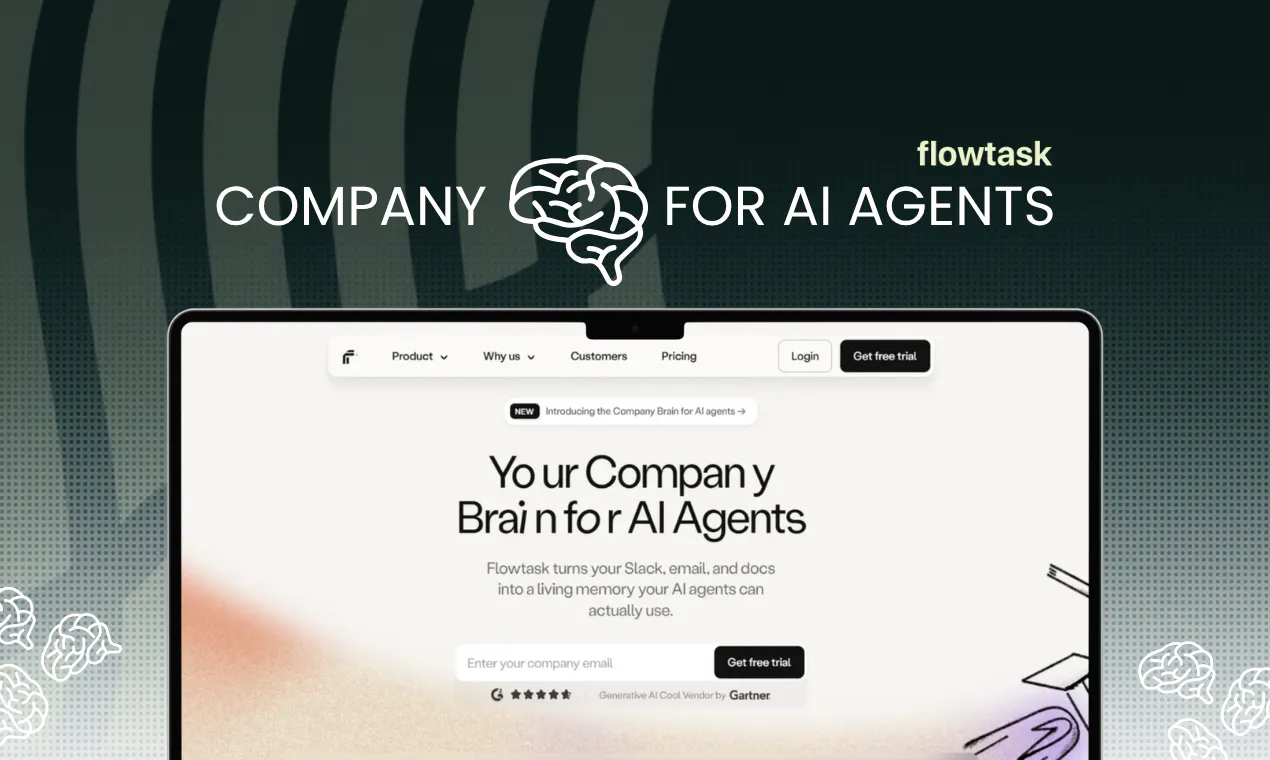
About FlowTask 2.0
Reviews 11
-
Trenton Spencer 3 months ago
Congrats on the launch; a really interesting project. I’m interested in the approval layer specifically as this is something I’ve been wrestling with in my own business. Controlling what the model gets is definitely a critical factor in success on company implementations. So, I’m curious; how does that work in practice?
-
Marcelo Prohaska 3 months ago
I've struggled with scattered knowledge across different tools, so this feels really handy and removes a lot of friction. Congrats on the launch !
-
Daren Bruen 3 months ago
This is something I say to every C-level I talk to: if a person's knowledge doesn't become the company's knowledge, the hire was meaningless. Most teams lose that expertise the moment someone's out sick or leaves. Turning scattered Slack, email, and WhatsApp threads into one living memory solves something I run into constantly. Well done.
-
Conner Jacobs 3 months ago
Congrats on the launch; a really interesting project. I’m interested in the approval layer specifically as this is something I’ve been wrestling with in my own business. Controlling what the model gets is definitely a critical factor in success on company implementations. So, I’m curious; how does that work in practice? If I’m approving what gets through, that’s a queue where I’m the gatekeeper and quite possibly the blocker. No one wants that admin role if they can help it. Is it rules based? Does it learn what you keep rejecting or is it a manual job? What happens if someone stops approving things for a fortnight? Does the agent know it’s working off a stale picture? Or does it carry on regardless, confidently working from its outdated view?
-
Curt Nienow 3 months ago
The approval layer on top of the ingestion pipeline is what makes this safe to use with real company data — without it, connecting WhatsApp and Slack is effectively giving every AI session access to every conversation that got pulled in. The thing I want to understand is the MCP server lifecycle: when an agent session connects to the FlowTask MCP, does the knowledge snapshot stay consistent for the duration of that session, or can it update mid-session as the brain ingests new messages? That matters for multi-step workflows where context drift mid-task would break the run.
-
Kay Balistreri 3 months ago
the staleness questions above are the obvious concern, but there's a related one nobody's asked yet: if Claude and ChatGPT are both reading from the same brain at the same moment via MCP, and the brain is updating minute by minute, could two agents working in parallel end up citing two different 'current' answers to the same question just because one queried a few minutes before an update landed and the other after? not a bug exactly, just a consistency question that matters more once you've got multiple agents acting on the same context instead of one person reading it.
-
Kay Balistreri 3 months ago
"No more stale CLAUDE.md files" is the right problem to name — we run agents across eight repos and those files rot faster than anyone gets around to updating them. The thing I'd worry about with an always-updated memory is a quieter kind of staleness: a fact that was true the day it was written and silently stopped being true when the code changed underneath it. Nothing in the original Slack thread ever says it expired. Does the approval layer carry any notion of a fact aging out, or is it mainly a gate on what gets in?
-
Orrin Batz 3 months ago
Very Happy to announce FlowTask on Today's Product Launch. After working for months on out SaaS we have finally launched FlowTask 2.0 which has much better Operations Management, now comes with a larger AI context for companies with large number of employees. Hope ya'll enjoy it!! Happy Coding.
-
Orrin Batz 3 months ago
both the Google Workspace and Slack connectors are broken which means there's no way to actually proceed into the app and try it out. bit disappointing and not a great experience for new potential customers
-
Jedidiah Farrell 3 months ago
I like that you're tackling the context problem instead of trying to cram more data into the model. Congrats on the launch!
-
Dorcas Parker 3 months ago
Congrats on the launch. The approval layer is the part I like most — most tools that pull from Slack and WhatsApp just take everything, so personal and work chats get mixed. Letting you decide what actually enters the brain is a smart call. One thing I keep thinking about: when the memory updates every few minutes from so many channels, how do you handle facts that go stale or contradict each other? Like a decision made in Slack last week that gets reversed today — does the brain catch that on its own, or does someone have to approve the change?