

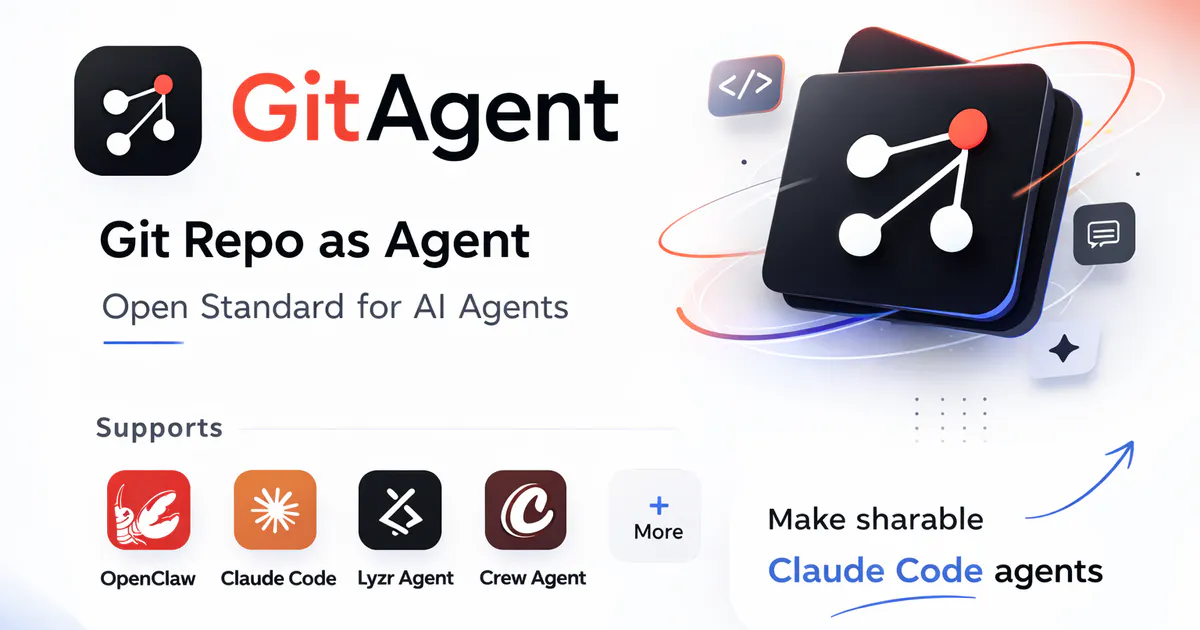
About GitAgent by Lyzr
Reviews 11
-
Halle Wilkinson 6 months ago
The Git analogy genuinely clicks here — every problem you listed (no source of truth, no versioning, no portability) is exactly what Git solved for code in the 2000s, and it's wild that agents in 2025 are still in that pre-Git chaos. The cross-runtime portability is the part I'd want to stress-test. Agents aren't just prompts — memory, tool access, and behavior can mean very different things in Claude vs CrewAI vs OpenClaw. Curious how GitAgent handles those runtime-specific differences without forcing you to lowest-common-denominator everything. Is there a layer that maps capabilities per runtime, or does the developer have to manage that themselves? Also — branching and diffing agents sounds powerful but slightly terrifying. If I branch an agent's memory, what does merging that even look like? This is the kind of infrastructure work that doesn't get enough attention because it's unglamorous. But if the standard gets adopted, everything else in the ecosystem gets easier. Worth watching closely.
-
Esteban Kilback 7 months ago
The agent space has been circling this problem without quite naming it. Most tools compete at the runtime level, which means your agents are effectively hostage to whatever platform you chose first. GitAgent moves the leverage point to ownership, and that changes things. The shift from agents as experiments to agents as assets is the real story here. Once they're versioned artifacts you can fork, audit, and evolve like code, they stop being fragile and start behaving like infrastructure. That's also a sharper positioning angle than agents in Git. The deeper narrative is portability and permanence, something teams can actually own and build on. That lands hard with engineering led buyers who are already skeptical of lock-in. I'm curious whether you see GitAgent staying a standard layer or becoming the primary interface for building and managing agents altogether.
-
Orrin Batz 8 months ago
Turning a repo into an agent is a compelling pitch. How does it handle monorepos with multiple services? And does the agent understand the git history or just the current state of the code?
-
Rahul Goyette 8 months ago
congrats on the launch! fun thing i stumbled upon while going through GitAgent : financial controls and git workflows are isomorphic, just with different names maker-checker = pull request sod (no single person can both create and approve a transaction) = branch protection audit trail = git log control documentation = rules.md. so a git-native agent doesn't need to be "made compliant", it already is, just by how git works pretty underrated consequence of this architecture for finance agents !
-
Kay Balistreri 8 months ago
This looks neat! How well does it support multiple providers at the same time, if at all? We use several models in parallel (some for different tasks, others for similar ones) and have had to port/duplicate some agents across models.
-
Franz Bauch 8 months ago
Does the agent work well with monorepos or is it better suited for single repo setups? Congrats on the launch!
-
Esteban Kilback 8 months ago
The segregation of duties aspect is interesting. Are there ways that GitAgent helps enforce that or remind me to improve SOD when any one agent begins to take on too many steps within one process?
-
Gaylord Buckridge 8 months ago
Finally - someone built the thing I've been duct-taping together with cron jobs and prayer. The idea of turning your actual repo into an agent that understands your architecture patterns feels like the natural evolution of "docs that nobody reads" to "docs that actually do something when you're not looking. How does it handle the inevitable drift between what the agent thinks your code does versus what it actually does after six months of "temporary" fixes?
-
Hazel Altenwerth 8 months ago
curious how GitAgent decides which parts of the repo are relevant context for a given task. do you embed the whole codebase or is there a smarter chunking/indexing step? I ask because I built a tool that does code security analysis on vibe-coded repos and the context selection is probably the hardest part to get right.
-
Garnet Stokes 8 months ago
Hey Product Hunt! 👋 We're thrilled to share something we've been obsessing over. @GitAgent Here's the backstory: We kept seeing the same problem over and over again. Teams would pour weeks into building AI agents, defining tool chains, decision logic, memory, persona, only to realize that all of that IP was trapped inside whatever framework they chose on day one. Want to switch frameworks? Rewrite everything. Want to version-control your agent the way you version-control your code? No clean way to do it. Want to hand off your agent to another team or deploy it somewhere else? Pain. We thought, why can't agents work like code? Store them in Git. Version them. Port them. Run them anywhere. That's GitAgent. It extracts the "soul" of your agent. The config, logic, tools, everything that makes it yours. It stores it as a portable, version-controlled definition. Then you deploy it to any framework with one command. We're calling this #OwnYourAgents because we genuinely believe that if you built the agent, you should own it. Not the framework. Not the platform. You. We'd love your feedback, your upvotes, and most importantly, your honest takes on what we can do better. This is just the beginning. Let's make agent portability the standard. 🙌
-
Lamont Strosin 8 months ago
Interesting approach. Using the repo itself as the agent's memory makes way more sense than dumping everything into a system prompt or building separate context management. How does it handle large monorepos though? Any filtering or scoping so the agent doesn't drown in irrelevant code? Also wondering about private repos, is there a self-hosted option? Congrats on the launch, gonna try this on a couple of our projects.