

About Graft AI
Reviews 11
-
Makenna Eichmann 4 months ago
Really interesting direction. As companies adopt more AI tools, do you think the biggest challenge becomes connecting knowledge, or getting teams to trust the outputs enough to change how they work?
-
Santa Cassin 4 months ago
@Yashas Gunderia thanks for the correction and the detail, that's a clearer picture than I had. the auto-repair-within-minutes plus human approval gate for business-logic changes is the part that actually addresses my original worry, will read the workflow access gap post
-
Korbin Effertz 4 months ago
The problem is definitely a very real one. But how well will your AI understand legacy systems? Have you considered adding a training mechanism? For example, you could build a browser extension where the user logs into all their systems and shows the AI where everything is located and how each system works. The AI would learn from that, remember it, and then be able to reproduce those workflows later. Something like that would be ideal in my opinion.
-
Lamont Strosin 4 months ago
the self-healing part for legacy UI drift is the piece nobody else seems to be tackling well, most RPA-style tools just break silently when a button moves. what's the actual gap between the UI changing and Graft detecting + repairing it, are we talking minutes or does it need a human to confirm the fix before it goes back into production
-
Fidel Davis 4 months ago
hello everyone, just a quick update. I've updated graft's social media, the old one was the wrong one. Thank you.
-
Neal Jacobson 4 months ago
docs go stale in a week so i like the living map idea. how does it stay updated without me babysitting it?
-
Roy Kris 4 months ago
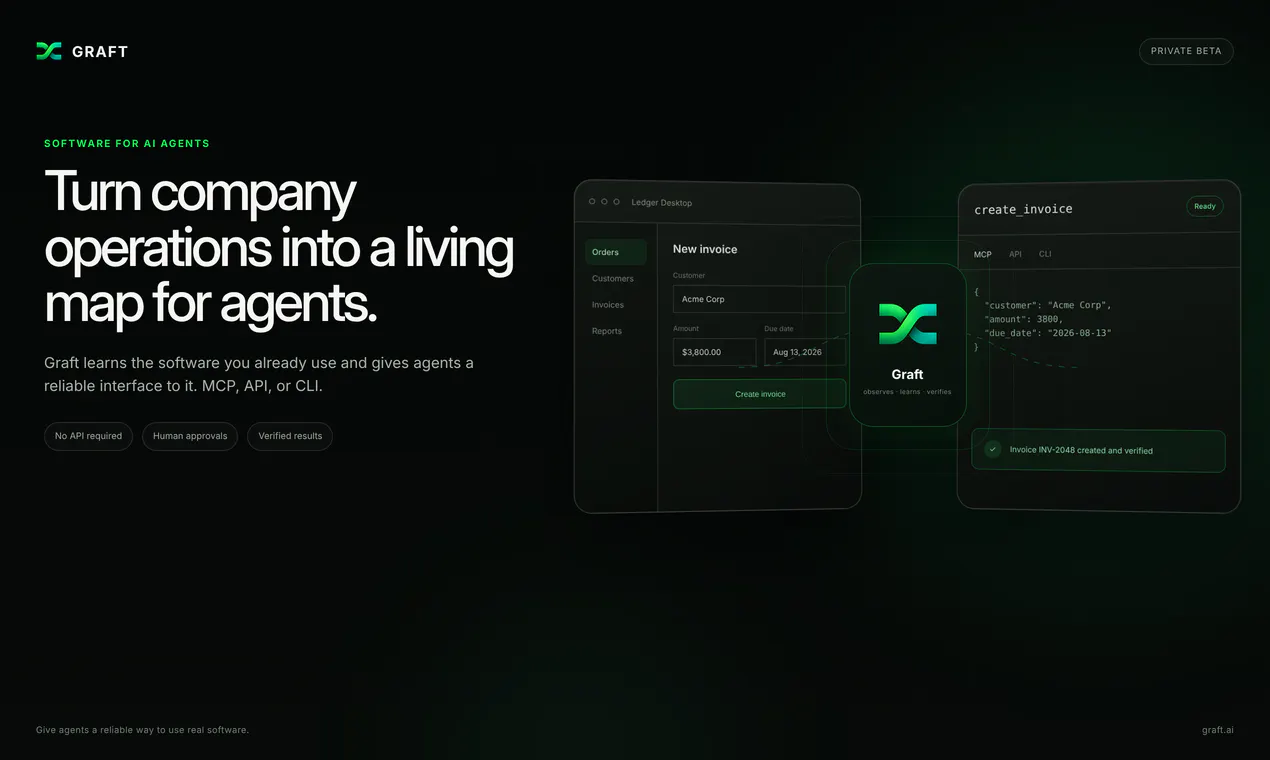
Graft will be helping f500's transform their legacy applications into operational knowledge basis for agents to use. Agents can interact with their legacy software and help them transition into agent native software, this is a shift we're seeing but companies fail because the data is in people's head as domain knowledge so we're building the infra to make it operational by agents.
-
Mortimer Powlowski 4 months ago
Building a receipt-scanning feature right now and even at my tiny scale, the "verification" part is the hard bit — I ended up schema-validating every LLM response and failing closed on anything unparseable, because silently-wrong output is worse than an error. Curious how you handle the case where the workflow succeeds mechanically but the result is semantically wrong — is verification rule-based per workflow, or learned?
-
Jake Blanda 4 months ago
Operations as a map agents can walk is close to what I do per-client, structured facts an AI can't step outside of. Mine is one brand, yours is a whole company, and I suspect the hard part scales badly. How do you keep the map current when the operations change weekly?
-
Randi Prohaska 4 months ago
One thing that would help us adopt this faster is a visual timeline view inside the operational map, so we can scrub through past workflow executions and see exactly where drift or failures happened. Right now troubleshooting at scale feels like guesswork.
-
Johnathan Homenick 4 months ago
Graft turns real company operations into a shared, continuously updated layer for agents. We've seen companies transform to the AI native era but fail in operations because of institutional knowledge, and graft solves that.