

About Intrascope 2.0
Reviews 7
-
Duncan Effertz 3 weeks ago
The Auto routing question is the one I'd want visibility into: when Auto picks a model, does it show what it classified the task as and why that model won, so a weak answer can be traced to routing rather than the model itself? And if it gets that classification wrong mid-project, can I pin a different model for the rest of that project without turning Auto off everywhere?
-
Korey Hammes 3 weeks ago
As CTO, the hardest part of building Intrascope 2.0 was making the pieces work together reliably: model routing, shared context, permissions, and connections to the tools teams already use. A demo can look great with one user and a clean setup. The real test is what happens when people bring different workflows, access levels, and messy requests. If you’re bringing AI into your team, what’s been hardest to get right? Happy to talk through how we approached it.
-
Malachi Armstrong 3 weeks ago
This looks really interesting! How does Intrascope handle shared context across different AI models? Can team members collaborate on the same projects without constantly repeating context?
-
Joany Hansen 3 weeks ago
I pick it myself, but by task type, not per message. a cheaper model for search and mechanical edits, the strong one for drafts and anything a client reads. could Auto routing take rules like that instead of guessing?
-
Gaylord Buckridge 3 weeks ago
Looks promising :) Which types of companies can get the most benefit from the app?
-
Johnpaul Crona 3 weeks ago
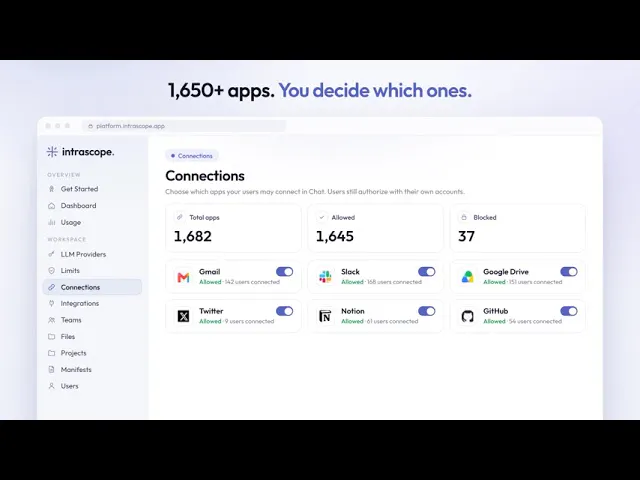
Hey Product Hunt! Stefan here, Chief of Engineering at Intrascope. Vladimir covered the “why.” I’ll add a bit of the “how.” Rebuilding 2.0 meant treating AI like real infrastructure, not a chat wrapper. The hard parts weren’t the demos - they were the edges: • Smart routing was the biggest rabbit hole. “Auto” isn’t just cheapest-model-wins. We had to model each LLM’s capabilities, strengths, and trade-offs - reasoning depth, tool use, speed, context window, multimodal support, cost - then match that profile to the intent of the request in real time • Agent + MCP that can reach into 1,650+ apps without turning every workflow into a brittle custom integration • Shared company context (Manifests, projects, permissions) so answers use your knowledge - without leaking context across teams • BYOK + usage controls so finance and security stay in the loop while the product still feels fast for everyday use A lot of nights went into making that stack boringly reliable. The goal was simple - teams should scale AI without trading control for convenience. If you run AI across a team: what’s the messiest part for you right now - picking the right model, costs, or getting agents to work with your real tools? Happy to dig into any of the engineering decisions in the thread.
-
Quincy Medhurst 3 weeks ago
Looks promising! Could Solofounders use it in their SaaS business?