

About Kastra
Reviews 15
-
Nils Auer 4 months ago
Infrastructure products often become invisible when they're doing their job well. Curious—do developers initially adopt Kastra for security, or do they end up valuing the confidence it gives them to move faster?
-
Reilly Thiel 4 months ago
@fernando_vintacourt Congratulations. And happy product launch.
-
Haleigh Bartoletti 4 months ago
runtime authz is exactly the missing peice for agents 🔥 how granular do the policies get?
-
Rylan Cremin 4 months ago
Runtime authorization for agents is a problem I didn't appreciate until I started building AI tools that take real actions (creating records, modifying data, triggering workflows). The trust boundary question is hard — how granular does Kastra get? Can you scope down to specific fields/operations, or is it more at the API-call level?
-
Demetrius Gulgowski 4 months ago
Interesting approach. I lead a data platform team and agent authorization is exactly the gap we keep running into when letting coding agents touch production-adjacent systems. Does Kastra support scoping per-tool permissions, or is it per-session? Congrats on the launch!
-
Lamont Strosin 4 months ago
The "existing controls only look at what the agent already did" line is the real gap — logging and evals are post-hoc, and the irreversible action already happened by then. Sub-1ms allow/deny I buy. The piece I'd want to understand is what routes an action to human-review vs auto-allow, because that classification is the hard part: when I give Claude Code broad access the legit action space is huge and situational. Auto-deny runs brittle and breaks a real task mid-run; escalate too much and I rubber-stamp the ~1s approvals until I'm not really reviewing. Is that routing static rules on tool + args, or does it reason about intent against the current task? And input-layer injection — how do you flag the instruction that reads as a perfectly normal one inside a 1ms budget, without an LLM in the loop?
-
Eino Klein 4 months ago
The sub-1 ms policy decision is the detail that caught me. Agent approvals usually feel bolted-on once latency shows up. Curious how teams debug a denied action — do they get a readable policy trace?
-
Jedidiah Farrell 4 months ago
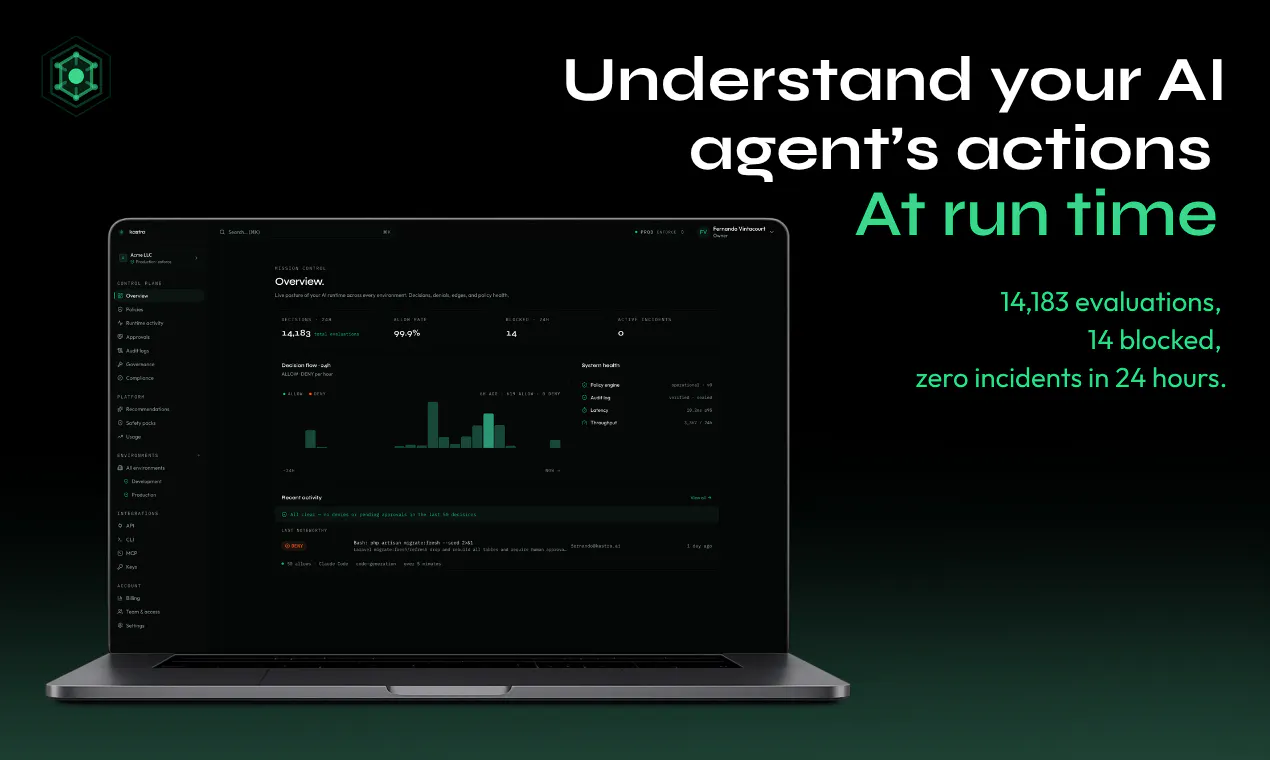
Checking shell commands and tool calls before they run is the part that clicks for me. The local policy checks and scan of past agent activity make this feel practical, not just another monitoring dashboard.
-
Reilly Thiel 4 months ago
the part that keeps me from letting my coding agents run fully unattended is exactly this. they will happily do something you didn't want and you only find out after the fact. a layer that decides no before the action runs is the piece i keep wishing i had. how granular can the policies get per tool?
-
Jackson Fisher 4 months ago
Congrats on the launch!
-
Rahul Goyette 4 months ago
Congrats on the launch. The "trust the rules, not the agents" framing is the right instinct — we've landed on the same philosophy internally. One thing I'm curious about: when a policy check fails, is deny the only outcome, or can a policy route the action to a human approval queue instead? In practice I've found agents need three outcomes, not two — allow, deny, and "a human decides this one." Sub-1ms is impressive for the allow path; wondering what the escalation path looks like.
-
Felipe Sanford 4 months ago
congrats on hitting product hunt @carlosjimenez1 keeping dev velocity high while putting hard guardrails around shell commands is pure leverage.
-
Johnpaul Crona 4 months ago
This is the unglamorous layer everyone is about to need. The moment you let Claude or Codex actually run things, "what is this agent allowed to do right now" stops being a nice-to-have. Runtime is the key word for me. Static permissions are easy, but authorizing per action while the agent works is the hard part. How do you handle an agent that needs to escalate mid-task without a human sitting there approving every step?
-
Conner Gislason 4 months ago
Congrats on the launch. Deciding before the action executes, rather than reviewing what already happened, is the right place to sit. The thing I would want as a builder is every denial landing as a structured event I can line up with the agent's own trace. When an agent quietly stops making progress, the hardest case to debug is not knowing whether it hit a policy or just reasoned itself into a dead end. If the authorization decision and the step that triggered it share an id, that is a five minute answer instead of an afternoon.
-
Felipe Sanford 4 months ago
Congrats team! 🚀 Runtime authorization before execution is the piece most agent stacks are missing, and covering Claude Code, Cursor, and both major SDKs from one control plane is a smart wedge. Quick technical question: how do you intercept actions across such different runtimes? Is it a proxy sitting between the agent and its tools, SDK-level hooks, or MCP middleware? Curious whether an agent could bypass enforcement by shelling out directly, and how Kastra closes that gap. Excited to dig into the docs!