

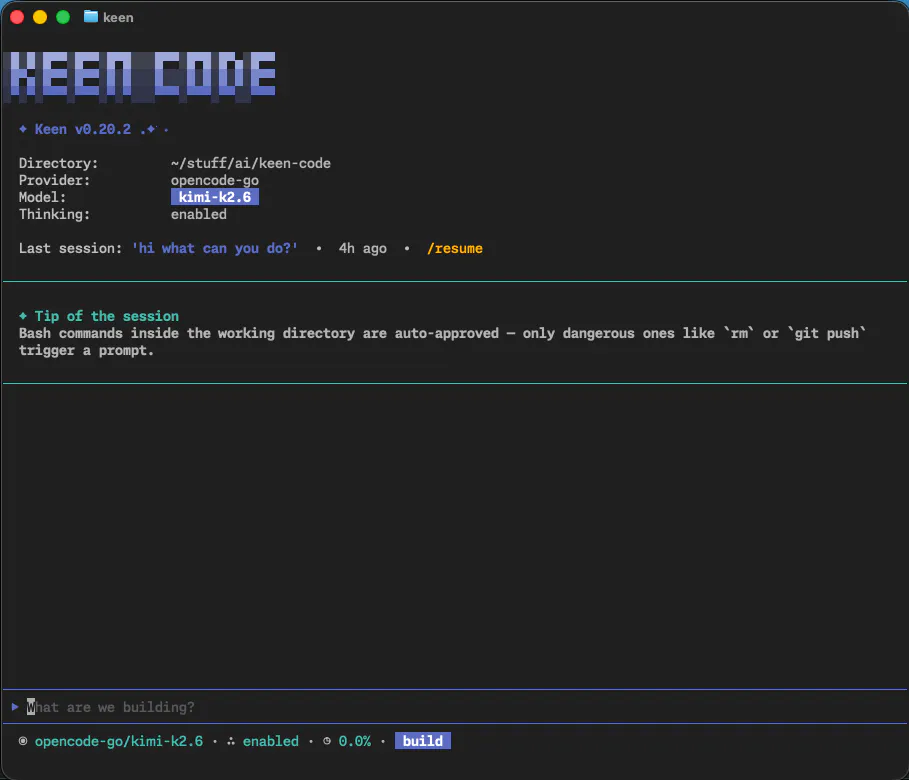
About Keen Code
Reviews 8
-
Rupert Emmerich 5 months ago
One thing we've noticed with agent workflows is that reducing context size and improving context quality are often treated as the same problem when they're actually different. Have you found Keep Code's biggest win coming from compression, retrieval, or helping agents maintain a more consistent mental model of the codebase across longer sessions?
-
Hillard Halvorson 5 months ago
Sounds interesting, but aren’t you worried about competition? There are already many AI coding tools, and new ones appear every day.
-
Kenneth Corwin 5 months ago
The context-efficiency angle is what stands out to me here — lazy-loading MCP skills instead of front-loading schemas is a genuinely smart architectural choice that most CLI agents skip. Fellow solo builder launching nearby (Sensemaker, a thinking-to-writing tool), and the "built by agents, orchestrated by human" workflow you described is almost exactly how I shipped my own MVP. Curious: how did you handle the moments where the agent went off-spec mid-session? Did you find the prompt/design trail in the repo was enough to course-correct, or did you need other guardrails?
-
Neal Jacobson 5 months ago
the skills-driven MCP approach is the part that caught my attention. every multi-tool agent setup I've seen just dumps the entire schema into context upfront and then wonders why performance drops off a cliff three turns in. lazy-loading only what the model actually needs at runtime feels obvious in hindsight but almost nobody does it. also respect for shipping the full prompt trail in the repo... that's genuinely useful for anyone trying to learn how agent-driven development actually works in practice. congrats on the launch and doing this solo is no joke
-
Rylan Hyatt 5 months ago
The "lazy-loaded Skills instead of stuffing MCP schemas into context upfront" choice is the detail that stood out to me - that's usually where multi-MCP setups quietly fall apart, the context budget gets eaten before you do any real work. As someone still figuring out how to keep agent sessions lean, I'm curious: with turn memory compacting older turns, how do you decide what's safe to drop vs keep? Do you summarize older turns or hard-truncate them? Wondering where the line is before the agent starts "forgetting" a constraint from earlier in the session. Also love that the whole prompt/design trail is in the repo - genuinely useful to learn from. Respect for building it solo. Congrats on the launch.
-
Paul Kshlerin 5 months ago
Context efficiency is the right constraint to optimize for in a coding agent. Most agents bloat the context window with irrelevant file chunks and then thrash on eviction decisions. We've hit this exact failure mode building multi-file reasoning features and it's where agent reliability falls apart. How does Keen Code handle context prioritization across a multi-step tool use chain when multiple files are relevant?
-
Johnathan Homenick 5 months ago
Building a CLI agent that manages its own context window is a genuinely hard problem. We've dealt with similar tradeoffs in long-running background jobs where keeping relevant context without blowing token budgets required careful chunking. What's your eviction strategy when the agent's working set grows mid-task: do you prioritize recency or semantic relevance?
-
Jaylon Deckow 5 months ago
Really cool, and respect for building it solo. The turn memory idea for keeping context lean is smart. How much context does it actually save in a long session?