

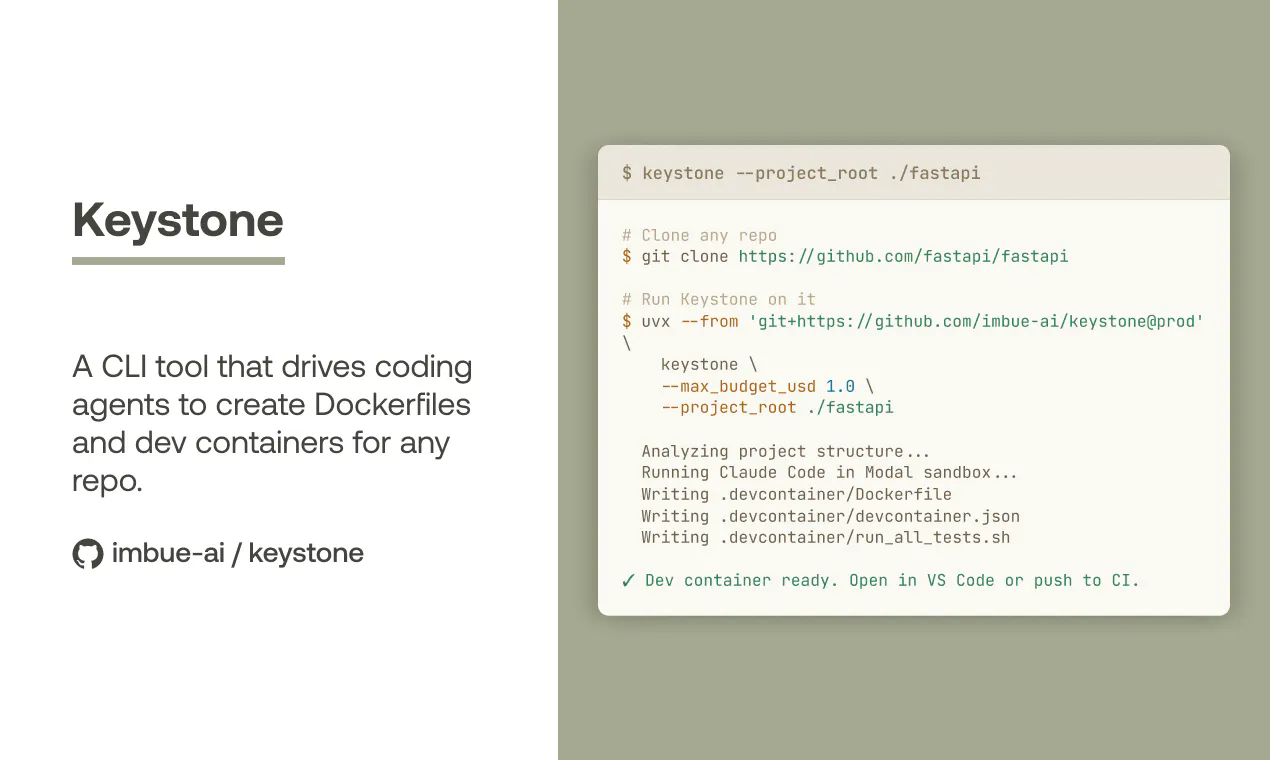
About Keystone
Reviews 5
-
Joshua Abshire 7 months ago
Can I specify my preferences before the process starts, or does it automatically choose the best option?
-
Burley Collins 7 months ago
Proud of you @thad_hughes_imbue for the work shipping this! I've learned so much from using Keystone as a benchmark to understand cost, performance, and failure modes of Claude Code vs. Codex vs. Opencode.
-
Esteban Hilpert 7 months ago
@thad_hughes_imbue it has been great to see you evolve this work on container setup over the last year from just something for us, to something anyone can use
-
Randi Prohaska 8 months ago
This is a problem I've run into running AI agents against internal repos - the setup friction is real and usually involves a lot of manual trial and error. The idea of the repo describing its own environment so agents can bootstrap correctly makes a lot of sense. Does Keystone handle cases where the environment has secrets or credentials baked into the config, or does it stay strictly in the non-secret layer?
-
Al Wolf 8 months ago
This solves a real onboarding pain — every repo has tribal knowledge that lives in someone's head, not in the docs. Question: how does it handle repos where the setup is genuinely broken and the README is wrong? Does it detect contradictions between docs and actual behavior?