

About LayerProof Bristol
Reviews 10
-
Trenton Spencer 5 months ago
@hoang_anh_cao1 once the report is live and a client asks for a change — like swapping out a metric or reordering sections — do you go back into the chat to regenerate it, or can they request edits directly on the published page?
-
Jaiden Runolfsson 5 months ago
why do you connect to those tools and run autonomously?? we might miss to provide exact context sometimes right... just my practical thought
-
Murray Kuhlman 5 months ago
Hi PH, It's Jordyn !!!!! i'm here to talk about the quiet fear nobody talks about in client work: You do great work. You have the right insights. But then you send a report thay makes you look.... average. It's not because you got anything wrong, it's because the format buries your point 😔 the structure doesn't guide the reader and the deliverable feels generic. That's where Bristol clicked for me💥. It's not "AI writes your report", but it's AI helping you build the interactive deliverable, the thing your clients actually open and explore. You can ask for changes in plain language: collapsible sections, a comparison view, a filter by channel. And the report actually behaves that way. It's real product functionality, not a design mockup! One thing i'd suggest for you to try with Bristol: start with imperfect inputs. That's the real workflow Bristol is designed for, not a clean demo with polished data 🍀 Let us know what you think!
-
Derick Koelpin 5 months ago
Congrats on the launch! The platform-native content generation looks really useful. One question: how do you balance preserving the original message while adapting the tone and style for each platform without making it feel AI-generated?
-
Rylan Hyatt 5 months ago
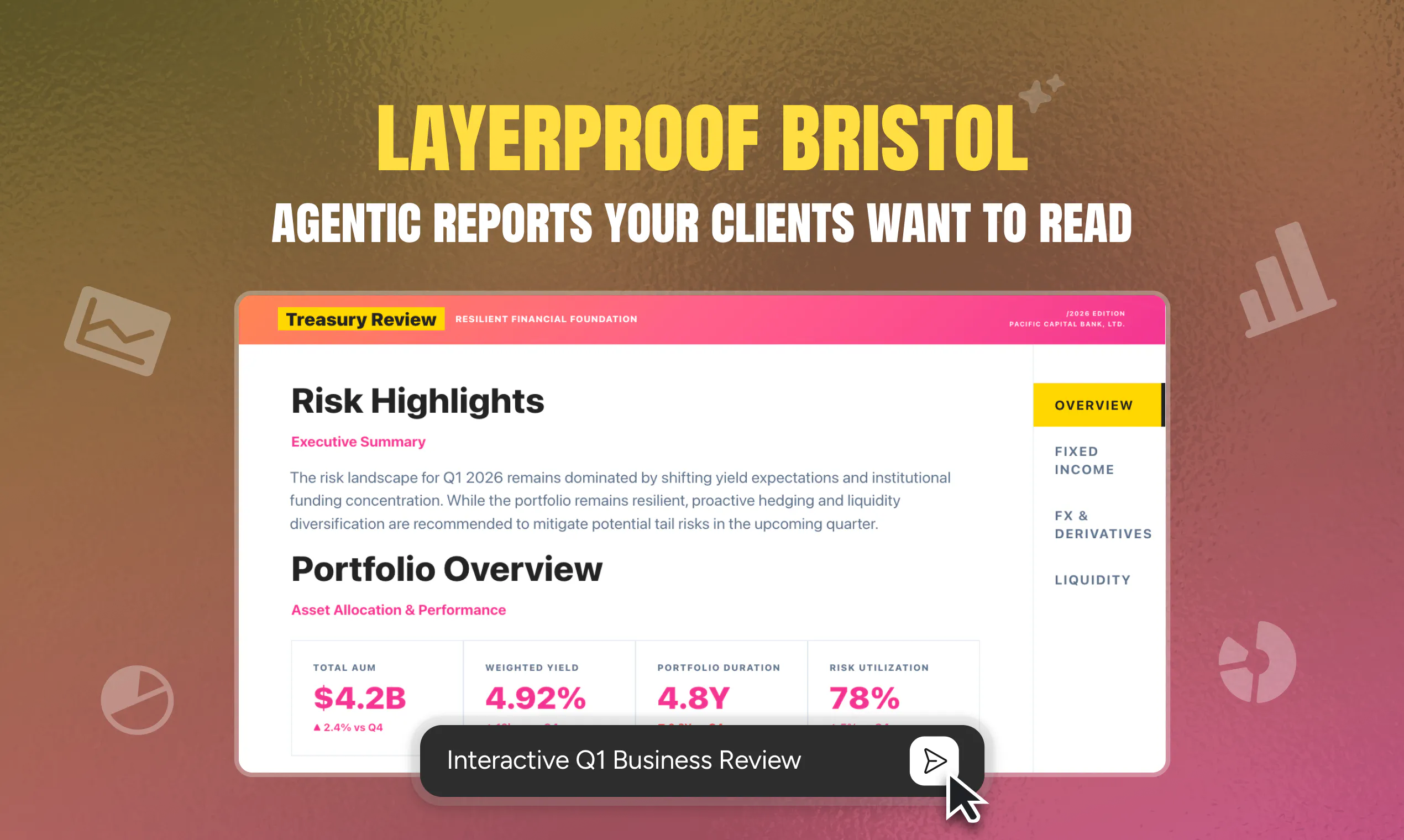
Bristol is excellent. I dropped a PDF and some data and it created an interactive agentic report my clients actually read and engage with. Publishing is instant.
-
Burley Collins 5 months ago
This looks slick. Quick question, when a number updates in the source file, does the published report refresh automatically, or do you re-run it? The "always update" line caught my eye. Either way, the traceability is the killer feature here. Congrats on shipping! 🚀
-
Dejon Bergstrom 5 months ago
hi Product hunt fam, it's Nathan (again) let's be honest about reports for a second. -you spend 3 days building that peak report. -you agonize over the executive summary. -you make the chart colors match the brand. -you export to pdf, attach it, write a thoughtful little email, hit send. it gets opened for 40s. someone scrolls to the one number they care about, screenshots it for slack, and never opens it again. and then 2 weeks later, they ask you a question that was on page 3. bold, highlighted, with a chart next to it. ( •̀ - •́ ) ╮( ˘ 、 ˘ )╭ and 90% reports don't get read. they get acknowledged. "Thanks, looks great!" is just the polite version of "I DID NOT read this." because a pdf is a terrible way to read anything. it's static, it's long, and it makes the reader do all the work of finding what matters to them. Layerproof Bristol is our attempt at the obvious fix. you build the report by chatting with an agent, then publish it as a live page the reader can actually click around in. that's it. ٩(◕‿◕)۶
-
Demetrius Gulgowski 5 months ago
Hi. I'm Ha Le from LayerProof ^^~ As a marketer, I have some recurring problems: Our team can do great work, have the right read on the data, and still lose credibility at the deliverable stage. Not because we got anything wrong. Because the report looked confusing, or generic, or like it wasn't made for that client specifically. Bristol is built around that problem. The focus isn't on generating a report. It's on generating a report someone will actually read and explore. One URL, interactive by default, and the structure can adapt to what each stakeholder cares about. If you're in marketing or client services, here's a test worth trying: take your last monthly update, drop in the messy inputs, and ask Bristol for an exec summary plus a deeper section for the team, in the same report. See if it reads like something you'd actually send without a second thought.
-
Rocio Cormier 5 months ago
Designers know something most people don't say out loud. Half the job is bringing the visual to the work look like it deserves to be trusted. Not because the insights are weak. Because a confusing layout, a buried headline, or a wall of data can quietly undo months of good thinking. We've all been there. You know the work is solid. The deliverable just isn't carrying it. Bristol is the first reporting tool that felt like it was built with that awareness. Structure you can reshape in conversation. Visual editing when you need exact control. Output that reads like something with a point of view, not a formatted export. If you try it, I'd love your honest designer take. Does it feel like a tool that respects the reader, or does it still have gaps?
-
Odell Bode 5 months ago
There's a design principle that sounds obvious until you see how many tools ignore it. If the report is hard to read, the work feels less credible. Not because the reader is wrong to feel that way. Because clarity is part of the deliverable. Structure, hierarchy, and pacing are what help someone trust what they're looking at. We heard this from a lot of teams while building Bristol. They were spending hours on layout polish and still feeling uncertain before hitting send. The data was right. The formatting just wasn't helping anyone navigate it. So Bristol is built to co-create the report with you. Chat to reshape structure fast, then do direct visual edits when you want precise control. The goal is a report that reads like a real narrative, not a formatted document. If you're a designer, I'd genuinely love your honest take. Does the output feel like something with a point of view, or does it still read like an export with better styling?