

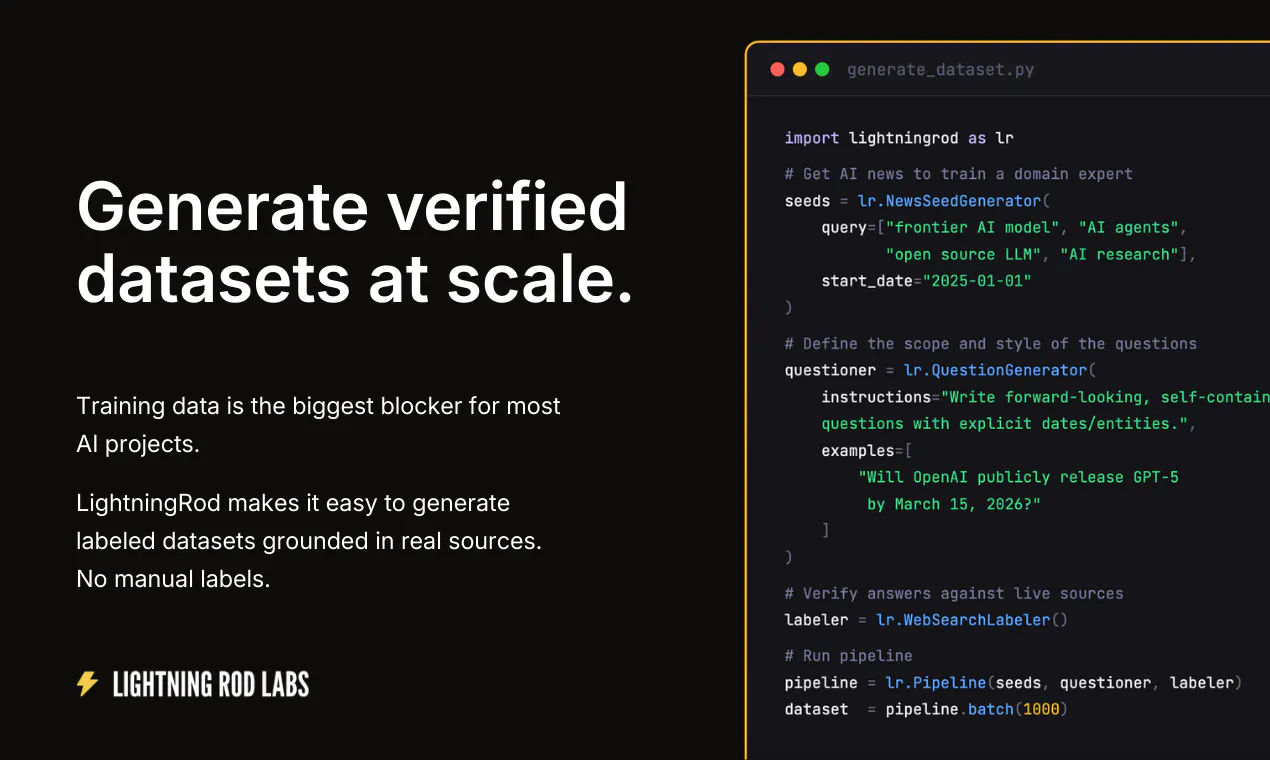
About Lightning Rod
Reviews 12
-
Makenna Eichmann 8 months ago
Very interesting! And if I have a source with outdated content, will your system be able to find and exclude all old data?
-
Kay Balistreri 8 months ago
Creating quality training data has always been one of the biggest bottlenecks in AI development — it's tedious, expensive, and often requires domain expertise that's hard to scale. A tool that can turn real-world data into structured training datasets quickly could be a game-changer, especially for smaller teams and startups that don't have the resources to build large annotation pipelines. This kind of tooling really democratizes AI development. I'm curious about data privacy and handling — when users upload real-world data to generate training sets, what safeguards are in place to ensure sensitive information isn't leaked or retained beyond the generation process?
-
Nikunj 8 months ago
What ways could I validate that the training data is actually improving downstream model performance?
-
Enrico Wiza 8 months ago
We're doing some ML work on our side for matching and recommendations so this is relevant. Can the SDK work with proprietary data like internal user behavior logs, or is it mainly designed around public sources for now?
-
Hazel Altenwerth 8 months ago
Very interesting concept. Getting training data for my AI Project 8 years ago for my capstone was a huge bottleneck. Using data that already exists and vetted to some degree democratizes training and building. I'm excited to give this a test!
-
Marcus Macejkovic 8 months ago
Congrats team! Question: How do you ensure the generated datasets are actually suitable for fine tuning, given the noise, bias, and duplication often present in public news sources? Do you apply any validation, deduplication, or labeling quality checks, and can users control how the data is structured or filtered for specific domains or tasks?
-
Kenneth Corwin 8 months ago
Congrats on the launch! Very relevant problem - everyone talks about models, but high-quality training data is still the real bottleneck. Love the emphasis on provenance and production-ready datasets. Strong positioning. Wishing you a great launch today 🙌
-
Constantin Leuschke 8 months ago
Congrats!! Any plans to a no-code interface for non-technical teams?
-
Roberto Smith 8 months ago
How does the quality scoring work... Is it model-based or rule-based filtering?
-
Reilly Thiel 8 months ago
How do you ensure the quality and diversity of the generated training data when sourcing from public news, especially given bias, duplication, and rapidly changing narratives? Do you apply any filtering, deduplication, or labeling validation steps to make the datasets suitable for fine tuning, and can users control or customize the generation process for specific domains or use cases?
-
Jarrell Homenick 8 months ago
Any benchmarks you can share?
-
Jake Blanda 8 months ago
Using real-world outcomes over time as automatic supervision instead of requiring manual labeling is a fundamentally different approach to training data generation — it means the dataset quality improves with historical depth rather than human annotation effort, which should scale much better for domain-specific fine-tuning. The claim of beating frontier models 100x larger with data generated through this platform is compelling; for teams working with internal documents like support tickets or emails, how does Lightning Rod handle PII in the source material — is there automated redaction before training data generation, or does that fall on the user?