

About Liminal
Reviews 11
-
Wiley Lubowitz 3 months ago
fair bet, and honestly a reasonable one to make right now rather than build search infra prematurely. the case that'd worry me is less "find the file with this keyword" and more "find the doc where we argued about pricing back in March" when nothing in it says the word pricing - that's a grep miss even with a smart agent doing the grepping. has that gap actually shown up for you yet at your own file count, or is it still early enough that it hasn't bitten anyone?
-
Conner Gislason 3 months ago
Love the local-first approach, feels way less wasteful than passing markdown around. One thing that would seal it for me: a small sidebar showing who is currently editing which block, so we can avoid stepping on each other during live sessions.
-
Rupert Emmerich 3 months ago
the "everyone with the link sees the same live workspace" part is the piece I'd want to understand before using this for real team work - once an agent is writing files into a shared space, it's going to write things that were meant for one person's eyes at some point (a draft perf note, a client's rough numbers, whatever). is there any per-file or per-folder permission layer, or is the model still "anyone with the link sees everything," just like the underlying markdown files would if you handed someone the folder
-
Halle Wilkinson 3 months ago
Everyone's building second brains for individuals. Almost nobody's built one for a founder plus their agents plus their people sharing the same context. That's the harder and more interesting problem. Good luck with the launch.
-
Kay Balistreri 3 months ago
You're not solving a problem only you have. I've run exactly this architecture for months — a folder of markdown that multiple agents on multiple machines read and write, synced through git because nothing better existed. It quietly became the most load-bearing thing in my stack, so the friction is real and so is the payoff. Some conventions from living it, offered as free product opinions since you said Liminal doesn't have any yet: Per-writer append-only files — each machine and agent gets its own daily log — make conflicts structurally rare instead of resolved-after-the-fact. Shared files become the exception, and the exceptional ones are the ones worth merge UI. One small always-loaded index with a hard rule that detail lives elsewhere. At 500 files the index is the search: the agent greps the index, not the corpus. Omri's question is the one that decides whether this scales. An authoritative current-state file that wins when it disagrees with older notes. Abdullah's staleness case bites hardest — my standing rule is that notes record what was true when written, and anything actionable gets re-verified before an agent acts on it. A tool that aged or flagged entries when the thing they point to disappears would be the first genuinely new feature in this category. And merging over last-write-wins is the right call — this week two of my agents wrote the same knowledge as different commits and taught me that multi-writer brains want merge semantics everywhere, not just the editor. Good launch. This one's aimed at a real hole.
-
Paul Kshlerin 3 months ago
this is one of those launches where the backstory tracks exactly with my own workflow - i ended up doing the same VS-Code-preview-then-raw-edit dance before giving up and just living in Claude Code with a folder of notes. the part i'm most curious about is scale rather than sync: once a team's second brain grows to a few hundred files across months of work, how do you actually find the right one? plain markdown in folders works great at 20 files and turns into its own kind of clutter at 500 - is there real search/structure on top, or is it still mostly relying on the agent to know where to look?
-
Joshua Abshire 3 months ago
Love the positioning. What type of teams are seeing the most value so far?
-
Elias Rowe 3 months ago
@justinonthelam The concurrent write answer above covers editing at the same time, but I'm curious about the offline case: if you're working locally with the sync CLI not running, say on a flight, does everything just work as plain markdown with nothing lost?
-
Trenton Spencer 3 months ago
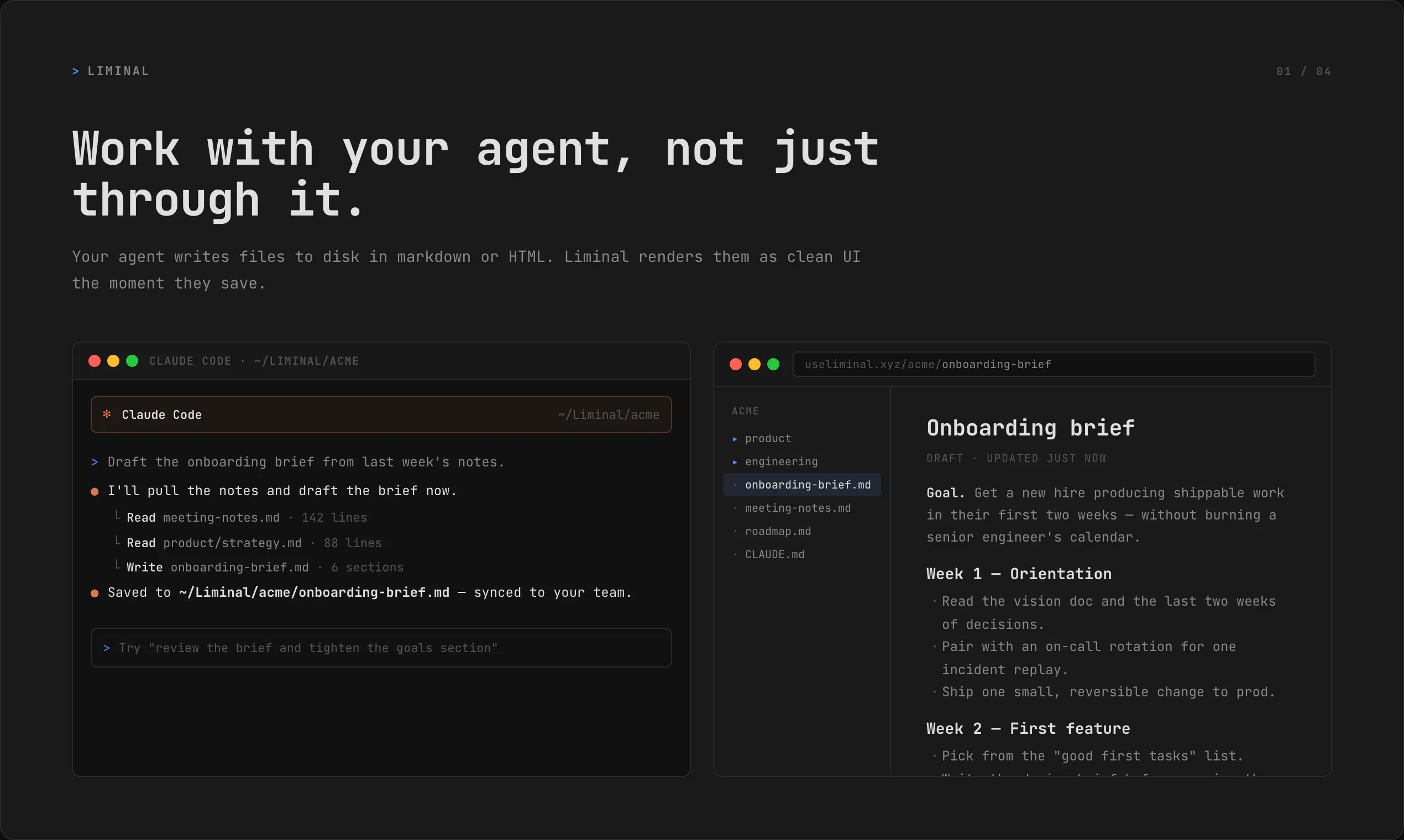
finally something that doesn't make me wrangle markdown back and forth. plugged in an agent output and it just showed up as a clean page my coworker could edit, which honestly felt kind of magical
-
Dorcas Parker 3 months ago
'work with your agent, not just through it' is the real reframe. when two agents write the same file at once, does it merge or last-write-win?
-
Nikunj 3 months ago
You asked whether this maps to people living in Claude Code all day, and from my desk the answer is yes, the friction is real. My whole setup runs on a folder of markdown memory files with an index loaded each session, and it quietly became the most durable part of my workflow because notes survive every context reset. The failure mode I keep hitting is staleness, a note written three weeks ago names a file or a flag that no longer exists and the agent recommends it confidently anyway. Does Liminal do anything to age or flag entries when the thing a note points to changes, or is pruning still on the human?