

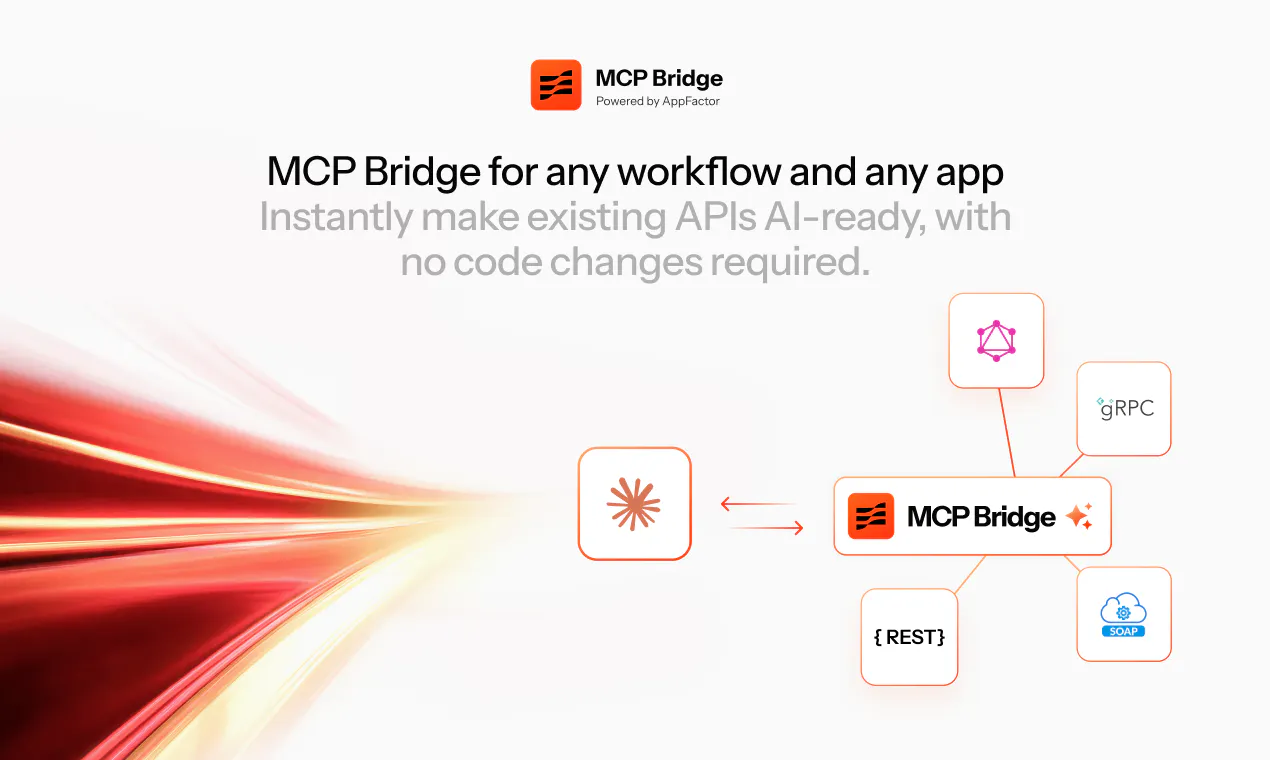
About MCP Bridge by Appfactor
Reviews 15
-
Korbin Effertz 5 months ago
"Any API" is the key claim does it handle APIs that require OAuth or custom auth flows, or mostly simple API key setups? That's usually where these tools hit a wall.
-
Trenton Spencer 5 months ago
We've run into this problem a few times while connecting different agent workflows. The integration itself is usually easy, but keeping everything reliable once multiple tools start talking to each other is where things get messy. Are most teams using MCP Bridge as a central layer between agents, or more as a quick way to expose existing APIs to AI tools?
-
Jedidiah Farrell 5 months ago
Finally, a product to help you create a MCP server, fast and reliable. It's about time! If you don't use @MCP Bridge by Appfactor, you're ngmi. S/O for the launch, ?makers
-
Derick Koelpin 5 months ago
Auto-generating typed MCP schemas from SOAP and gRPC alongside REST is the hard part others skip. We've spent cycles manually wrapping customer-side APIs with inconsistent auth patterns just to get an agent to call them reliably. How does schema inference hold up for APIs without an OpenAPI spec, or ones where the response shape varies by query?
-
Kay Balistreri 5 months ago
How does auth work when the target API needs OAuth? that's the part that always kills these tools for me
-
Ulises Ankunding 5 months ago
Using MCP as the standard transport is a smart call. Agents get structured tool definitions without any custom adapter code. We've hit the N+1 connector problem repeatedly building AI agents that need to talk to CRMs and ticketing systems. How do you handle auth token lifecycle when agents discover and invoke new endpoints dynamically?
-
Ruben McClure 5 months ago
the security breakdown in the comments is the most honest thing I've read on a PH launch. most tools in this space skip the 'what happens when your agent gets prompt injected' conversation entirely. the 3-level sensitivity guardrails and credential encryption is how this should be built
-
Santa Cassin 5 months ago
the auto-generated schema approach is smart. biggest pain point with MCP right now is writing tool definitions by hand for every API you want to connect. curious how it handles APIs with inconsistent response formats across endpoints?
-
Mortimer Powlowski 5 months ago
Most "connect any API" tools mean "connect any API that already has an OpenAPI spec and clean auth." What does MCP Bridge actually do when you're dealing with something messier, like a legacy REST endpoint with inconsistent error codes or an API that requires a multi-step auth handshake before you can do anything useful? Congrats for the launch!
-
Elias Rowe 5 months ago
This could save developers a lot of integration time.
-
Conner Jacobs 5 months ago
that 'code mode' metadata trick is clever. standard openapi schemas completely blow out the context window with hundreds of lines of redundant definitions that make models hallucinate instantly. replacing hundreds of tool definitions with just 3 meta-tools to handle dynamic runtime dispatching under the hood is a massive optimization breakthrough for context reduction. building wrappers for legacy soap and grpc services just to make them talk to cursor or claude code is a huge pain. having a local open source rust engine to handle this via container is a massive lifesaver. stellar job on the launch @keith_neilson
-
Buck Yundt 5 months ago
How do you handle user permissions without leaking secrets to the agent?
-
Joshua Abshire 5 months ago
So happy to launch MCP Bridge! 🚀
-
Wiley Lubowitz 5 months ago
What kind of security risks and bad actors threats do you anticipate with a tool like that? And how should users monitor and prepare for that?
-
Godfrey Donnelly 6 months ago
Hi builders! Keith here, CEO and co-founder of AppFactor. Really excited to ship this one. The story We built MCP Bridge for our own need, not an idea. At AppFactor we've spent years building deterministic tools for an orchestration system of agents that deliver autonomous software maintenance. Infra and software discovery, scanning orchestration, build engines, deployment automation. As we layered our upcoming agentic platform (ForgeCatalyst) on top to harness these tools, we hit the wall every team building production agents eventually hits. Security, governance, cost/token usage, observability... The AppFactor system requires meaningful validations, in environments where governance, security and controls are paramount when acting on customer code. With large complex API's with many tools, comes the next challenge - context constraints and efficiencies and multiple protocols to support. The standard fix is to hand-build a dedicated MCP server for every API. This doesn't scale. We know we are not alone with our requirements and given the domain we operate in which is all about software maintenance, legacy transformation and the eternal battle of trying to bridge the past to the future. We recognised that not all systems have clean, well presented OpenAPI spec API's. There are many API protocols, and almost all API's were indeed built before agents and LLM's became an exciting real world proposition. That poses challenges in how these tools are invoked and consumed. So we built MCP Bridge to address all of these challenges. You know the rest of the story. What it does Point it at any REST, GraphQL, SOAP, or gRPC API. It auto-generates fully-typed MCP tools with behavioral annotations and smart response processing. Self-hosted. Open source. Credentials never leave your environment. What's shipped 4 API types, end-to-end 6 auth methods (Bearer, Basic, API key, OAuth2, Cognito SRP) Human-in-the-loop approval for destructive ops Code Mode: 3 meta-tools replace 100+ definitions, ~98% less context Analytics: latency, token cost, errors per tool Built in Rust (Dioxus + Axum), PostgreSQL, in a container We're in the comments all day. What APIs would you connect first? And how should we improve? Happy building! Keith → MCP Bridge: https://mcp-bridge.ai/ → Docs: https://docs.mcp-bridge.ai/ Thanks @fmerian for hunting us!