

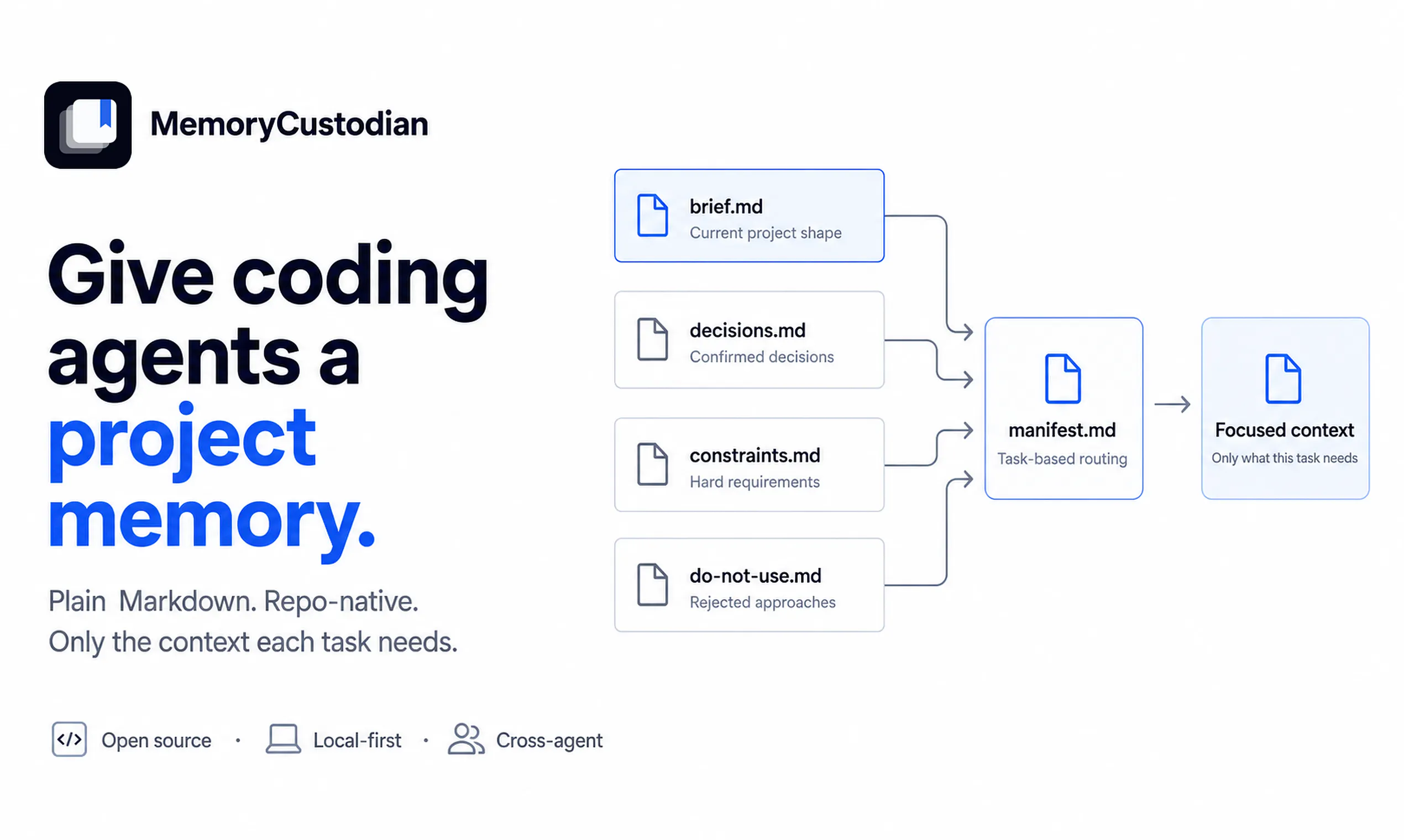
About MemoryCustodian
Reviews 12
-
Hillard Halvorson 3 months ago
Repo-native plain Markdown is the right call, I hand-maintain something similar and versioning memory alongside the code is exactly what keeps it from rotting. The part I keep hitting isn't retrieval, it's write discipline: what actually triggers a new entry? If the agent decides when a decision is "worth remembering," how do you stop constraints.md from filling up with conversation-local noise that was never really a durable decision?
-
Joany Hansen 3 months ago
Is there a review step before something becomes durable, or does it persist the moment the agent decides it's worth keeping?
-
Hillard Halvorson 3 months ago
Love the repo native approach. How do you handle memory that is stale or contradicts another note? Does the agent get warned before it trusts that context, or does someone have to catch it during review?
-
Korey Hammes 3 months ago
the deleted like code phrasing is doing more work than it looks. deleting a memory file takes it out of the working tree, but if it was ever committed it stays in history, in every clone, and in every fork. so forgetting is reversible for anyone holding the repo. matters because rejected-approach notes are exactly where the sensitive material collects. we cannot use X because of the contract with Y, or this is throttled because vendor Z caps us at N. fine in a private repo among employees, less fine once a contractor clones it or the project goes open source. not an argument against repo-native, I still think the tradeoff lands your way. just that safe forgetting probably wants a line in the docs about what it does and does not cover...
-
Joshua Abshire 3 months ago
Congrats on the launch. Recording rejected approaches is the part most memory systems skip entirely, and it might be the highest value item on your list, because without it an agent will cheerfully re-propose the thing you already ruled out last month. The manifest is the interesting design call. How do you handle relevance drifting, where a file was genuinely relevant when written but is not for the task at hand, and the agent cannot tell the difference until it has already loaded it? Plain Markdown in the repo is the right default either way, since it means a human can actually audit what the agent believes about the project.
-
Malachi Armstrong 3 months ago
Repo-native is the right call, and the branch question above is the obvious follow-up — so I'll ask the one underneath it. What happens when the project isn't one repo? Mine is three: the app, the infrastructure, and the marketing site. The decisions that bite me are almost always made in one and violated in another — a constraint I set while working on infra that the agent working in the app repo has never seen. Repo-native is exactly right for "why is this code shaped this way." It also makes the repo the trust boundary, and my project boundary is wider than that. Is sharing a memory module across repos something you'd support — a submodule, a symlink, a shared manifest entry — or is one-repo-one-memory a deliberate scope call?
-
Blaze Koepp 3 months ago
Plain Markdown in the repo means agent memory goes through code review like everything else, which is the whole reason teams will adopt it. I run two developer-facing products and the pattern repeats, nobody trusts memory they cannot audit. A hosted memory service is one more vendor in the compliance review, a Markdown file ships with the PR. And the manifest that loads only task-relevant memory deserves top billing, context bloat is what kills long-running agents.
-
Wiley Lubowitz 3 months ago
Different failure mode than the branch/rebase question above: two agent sessions on separate branches each append a note to constraints.md, no line-level conflict so git merges both cleanly, but the notes contradict each other (one says 'never use library X', the other says 'X is now required for Y'). Nothing breaks at merge time, the file just quietly holds two decisions that can't both be true. Is there any detection for that, or does it rely on someone eventually reading the file top to bottom and noticing?
-
Conner Gislason 3 months ago
Memory is key for agents! Glad to see you helping on this Zekun! Wish you all the best
-
Murray Kuhlman 3 months ago
Repo-native is the right instinct — memory that lives outside the repo drifts away from the code it describes almost immediately, and then you're maintaining two sources of truth about the same system. The question that follows is what happens on a branch. If memory is committed alongside code, then a note written on a feature branch is invisible on main until merge, which is arguably correct but might surprise people. And a rebase or a squash would rewrite the memory's history along with everything else. Is memory versioned with the code by design, or does it sit in the repo but outside normal git flow?
-
Rupert Emmerich 3 months ago
Plain Markdown in the repo instead of a hosted service is the right call for me. My worry is upkeep, and I saw you support correcting and forgetting memory, so the tooling is there. It is the habit I am unsure about. The file is only worth anything as long as someone keeps it honest, and when you work alone that someone is you. Not a criticism of the approach, I think the approach is sound. Nice launch!
-
Sedrick Hirthe 3 months ago
the "manifest loads only the memory relevant to each task" line is the part I'd poke at. relevance selection is its own hard problem - if it's simple keyword or path matching against the task description that's predictable, but if the agent itself is judging which memory files matter for the current task, you can end up with the same failure mode you're trying to avoid: it just won't load the one constraint file it doesn't realize is relevant, and you get no error, just quietly wrong behavior. how does the manifest decide relevance today, and is there any way to see what got left out for a given task