

About /mission for Claude Code
Reviews 15
-
Nils Auer 3 months ago
We've been testing using an orchestrator persona to handle fleets of agents. How does your system stay aligned with the overall mission, especially whenever it's long horizon and open-ended?
-
Marcelo Prohaska 3 months ago
The failure mode that scales worst in a team-of-agents setup is that every agent trusts the completion signal of the one below it. A concrete one from this week: my own agent posted five comments, reported success five times, and posted nothing. The submit handler never fired. Every check it ran said done, because every check was reading its own report of what it had done. One agent doing that is a wasted task. A team doing it is a chain: the reviewer reviews work that was never written, the integrator integrates a branch that does not exist, and each step passes because the step before it said so. The error does not surface where it happened, it surfaces several hops later as something inexplicable. The only fix that has held for us is to verify at the destination rather than at the source, and specifically in the render the consumer sees, because the actor's view of its own output agrees with reality most of the time, which is exactly what makes it a bad check. Does a mission's completion get checked against anything outside the agent that claims it?
-
Kenneth Corwin 3 months ago
Hey! Which Claude Code Plan would you recommend for your project? And how fast does it burn tokens?
-
Mckenzie Mosciski 3 months ago
To summarise this launch: project management built directly into AI-assisted software development
-
Franz Bauch 3 months ago
Congrats on shipping. It'd be interesting if missions could automatically estimate cost, runtime, and complexity before execution. Is this feature already available?
-
Daren Bruen 3 months ago
How Medley handles conflicting outputs when two agents solve the same problem differently?
-
Korey Hammes 3 months ago
The BYOK approach is a nice bonus for teams already invested in different model providers. 😊
-
Marcus Macejkovic 3 months ago
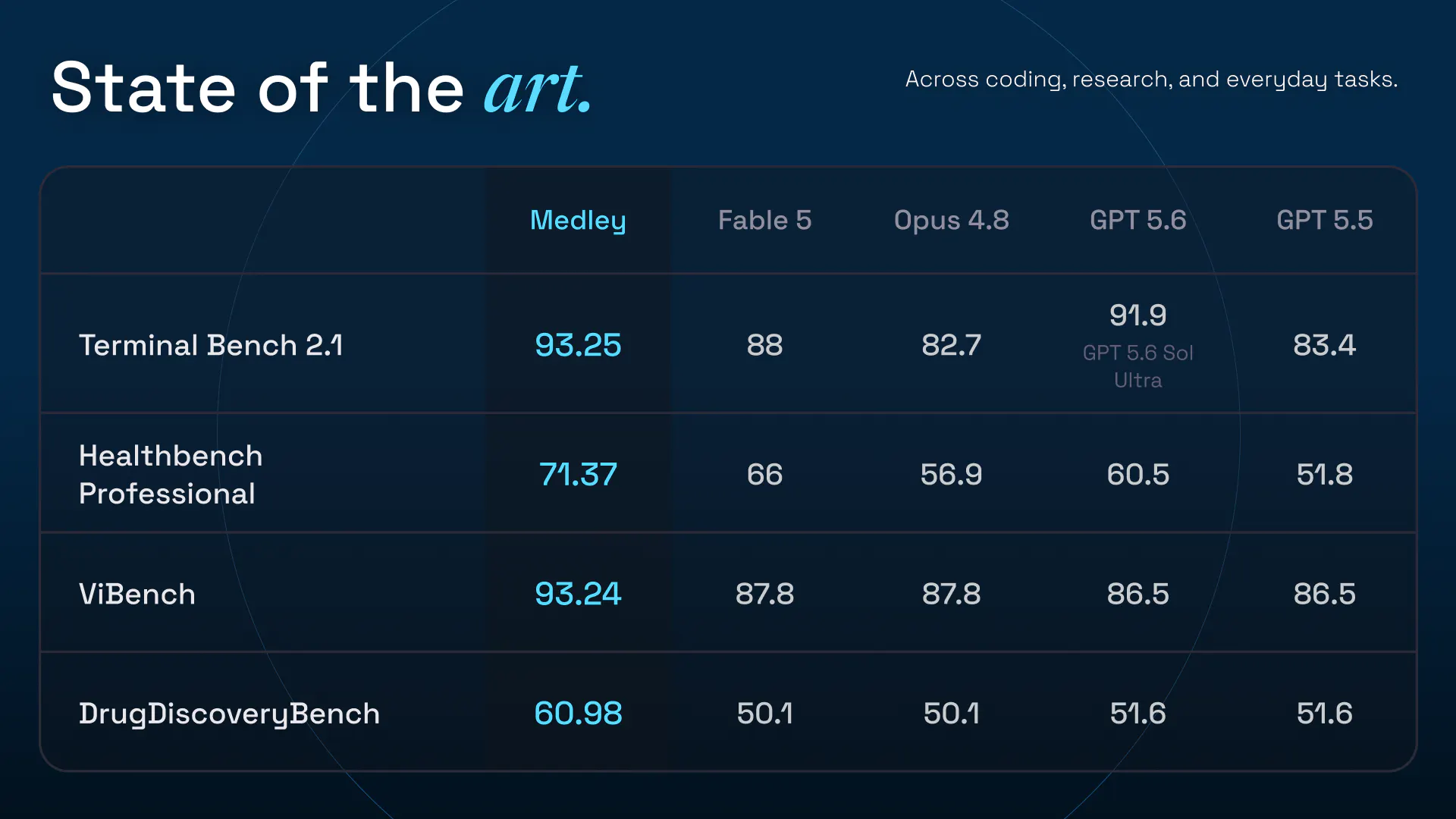
Wow! It's really interesting that the benchmark improvements came from orchestration rather than a new foundation model.
-
Carter Volkman 3 months ago
How would Medley figure which agent comes next versus continuing with the current one?
-
Randi Prohaska 3 months ago
Fantastic! This solves a pain every Claude Code user eventually runs into projects rarely fit inside a single session anymore. :D
-
Garland Grady 3 months ago
Very cool, congrats on the launch. Is this tool usable / feasible for Pro / Max users who aren't primarily interfacing via the API?
-
Garnet Stokes 3 months ago
I feel I was too late starting to use Claude Code. But immediately in a week I realised the Claude Code doesn't get the context properly especially if it's a long running task. Hence, I love the idea of orchestrating multiple coding agents instead of manually passing context between them through Medley. I will give it a try.
-
Gaylord Buckridge 3 months ago
Spawning a team of agents is the easy part. The hard part is they step on each other and you end up reviewing merge conflicts instead of features. How does /mission handle scope boundaries between agents? That's usually where multi-agent setups fall apart.
-
Johnathan Homenick 3 months ago
Really like that this meets developers inside Claude Code instead of pulling them into yet another app. I can see it helping with those messy refactors that are secretly five tasks pretending to be one. How do you keep a team of spawned agents from stepping on each other's changes in the same repo?
-
Quincy Medhurst 3 months ago
The benchmark numbers are the headline, but the line I keep re-reading is "it uses your existing subscriptions or API access." If a mission coordinates several Claude Code and Codex workers at once, the binding constraint for most solo people isn't dollars — it's the plan's rate limit. Parallel workers on a subscription hit a wall that a per-token budget doesn't describe. So: what is "budget" denominated in when the workers are running on a subscription rather than an API key? And does the orchestrator know the difference — does it throttle its own fan-out when it's running against a plan limit, or does it plan the graph as if capacity were unbounded and find out on the way?