

About Mooon
Reviews 8
-
Jaiden Runolfsson 8 months ago
Really cool niche product. The automatic furigana annotation alone would save so much time for anyone reading Japanese content above their level. Being able to go from a raw PDF to an audiobook in one step is a killer feature for commuters studying Japanese. Do you plan to expand this to other CJK languages like Chinese or Korean in the future?
-
Trenton Spencer 8 months ago
The claim that Mooon does OCR, layout analysis and semantic extraction in a single step is intriguing – does the engine run the whole pipeline on‑device or does it fall back to a cloud service for the heavy lifting? I could see it slotting nicely into a CI job that validates Japanese contracts before they hit a legal‑review board.
-
Reilly Thiel 8 months ago
Love the idea of bringing Japanese document processing to the modern stack. The attention to workflow detail shows. Congrats on shipping! 🎉
-
Marcelo Prohaska 8 months ago
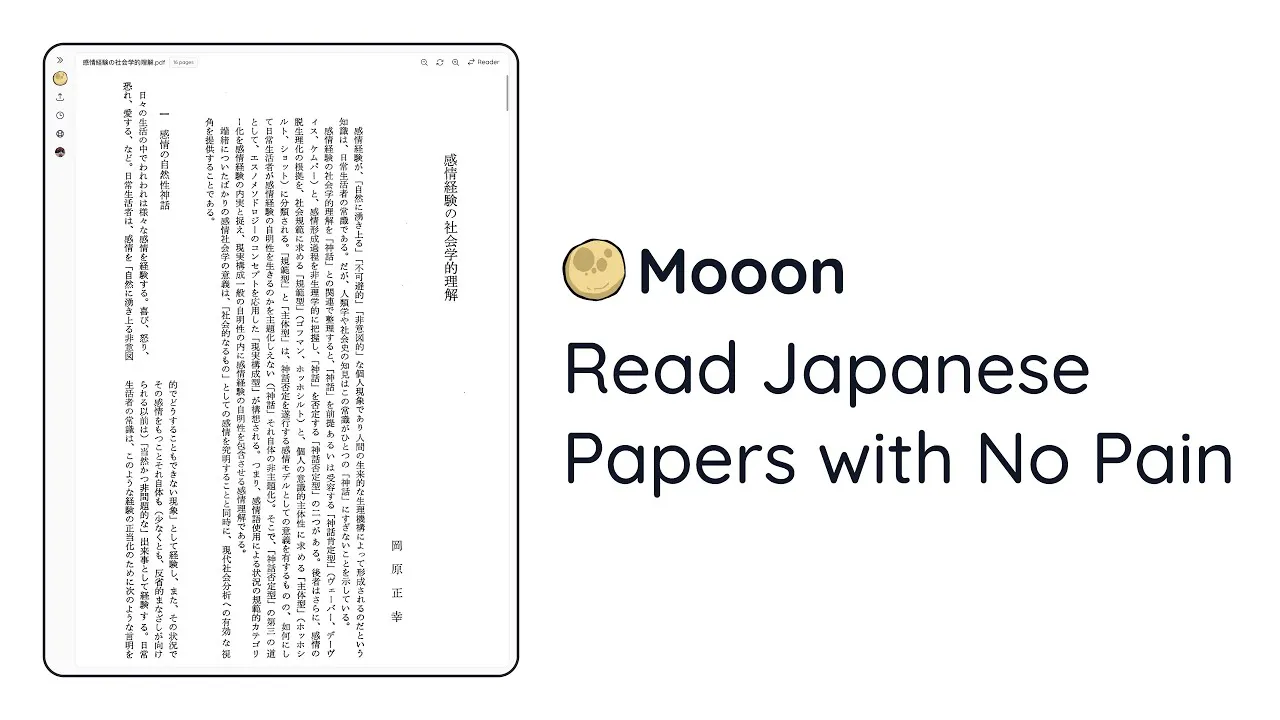
Great, this engine handles Japanese files in one step and even adds furigana and audio. Scrolling through, I can see it works for papers and manga. Feels like someone thought of everything. Good luck!
-
Rupert Emmerich 8 months ago
This is actually pretty handy for digitizing a lot of Japanese paperwork as well. Nicely done!
-
Fidel Davis 8 months ago
Congrats. Does it support conversion to Kindle version as well?
-
Neal Jacobson 8 months ago
Automating furigana annotation for kanji solves one of the biggest friction points for intermediate Japanese learners — constantly looking up readings breaks the reading flow and kills motivation. The vertical-to-horizontal layout conversion combined with side-by-side translation output is particularly useful for academic papers where you need both the original and translated text for citation purposes. Does the audiobook generation handle the pitch accent differences across Japanese dialects?
-
Ruben McClure 8 months ago
congratulations on the launch 🎉