

About Nada
Reviews 15
-
Jaylon Deckow 4 months ago
Humming a melody and getting MIDI out is a problem that's been partially solved a bunch of times but never well. The mobile-first approach makes sense - that's where the spontaneous musical ideas actually happen. Does it preserve the rhythm/timing accurately, or does it quantize to a grid automatically?
-
Joaquin Wisozk 4 months ago
Amazing work Bregas.. hopefully you get a lot of funding that you build Nada AI assistant that guides you to work along to make a song while you just record your sung voice version into it..
-
Conner Gislason 4 months ago
Congrats on the launch ! How the link voice-music is made? is it by frequency similarity matching?
-
Godfrey Donnelly 4 months ago
How well does it handle timing and pitch when you’re just humming casually, especially with background noise?
-
Santa Cassin 4 months ago
For the voice-to-midi translation engine, how are you separating expressive articulation (like pitch bends, vibrato, or dynamics) from the raw musical notes? Are you mapping those vocal nuances directly to standard MIDI CC data in real time, or handling them post-processing through a secondary latent-space conditioning layer?
-
Rylan Hyatt 4 months ago
Love that this is "capture your own idea" and not "AI makes a song for you." Great work!
-
Paul Kshlerin 4 months ago
@bregas This would honestly save so many random voice notes on my phone. The idea of humming something quickly and turning it into MIDI before the melody disappears feels super useful.
-
Derick Koelpin 4 months ago
I really like the philosophy of helping people capture ideas instead of generating them!!! I'm curious though... have you seen more adoption from experienced musicians looking for a faster workflow, or from complete beginners who don't play an instrument?
-
Hillard Halvorson 4 months ago
Hi product hunt! 👋 I’m one of the designers behind Nada. It’s been really fun watching this app grow from early designs into something people can actually use. I’ve mostly been involved in making the product and visuals feel easier to understand and more enjoyable to use. Seeing people turn a simple hum into something they can build on has been one of the coolest parts of working on this project. Excited to finally share it here, and I’d genuinely love to hear what you think. Thanks for checking out Nada! 🫶
-
Hugh Borer 4 months ago
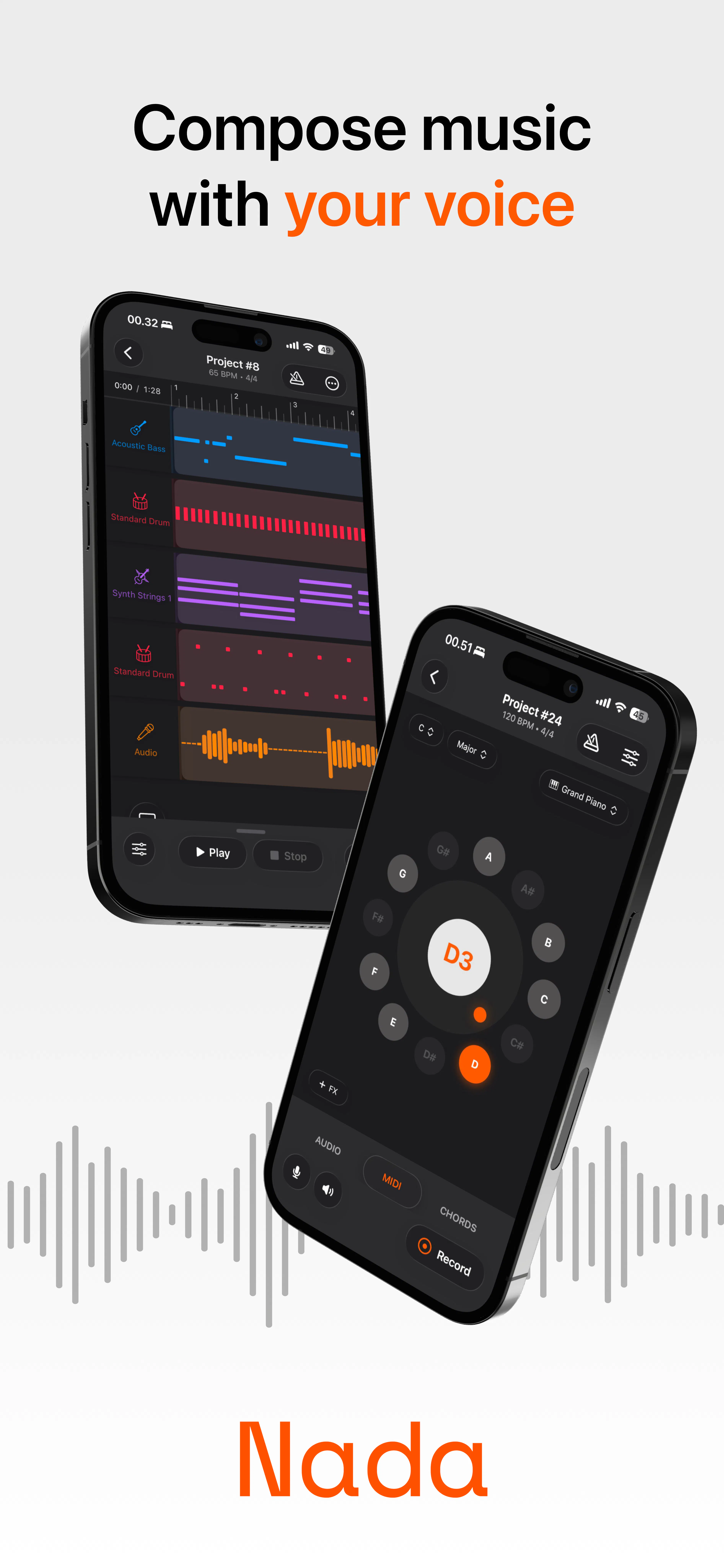
If you haven't tried the Chord Pads yet, please give it a spin! It's one of our standout features, designed to help you generate chord progressions and kickstart your music ideas. Cheers!
-
Roy Kris 4 months ago
Wow Bregas! This is really impressive. Music creators gonna love you. Wish you all the best
-
Korey Hammes 4 months ago
It’s amazing to finally see Nada live on Product Hunt! 🎉 been watching this idea grow from a simple thought into a tool that helps people turn melodies into music has been such a journey. Really proud of what Tunelab team built. Hope Nada helps more creators bring their musical ideas to life.
-
Curt Nienow 4 months ago
The "no AI generation" framing is actually the right call here - the value is capturing your musical idea, not generating a new one. Musicians who can hear melodies but can't play piano have been stuck with voice memos + manual transcription forever. Cutting that to hum-to-MIDI directly removes 3-4 steps from a genuinely painful workflow. Curious how it handles rhythm accuracy - is the MIDI timing quantized automatically or does it preserve your exact phrasing? That's usually where voice-to-MIDI tools live or die for people who care about their groove.
-
Rylan Cremin 4 months ago
Hi everyone! I’m Tika, part of the design team behind Nada. 👋 From the very beginning, we knew we wanted to create something that lived at the intersection of creativity and productivity. Since we all share a love for music, it naturally became the heart of what we wanted to build together. Designing this app has been both incredibly fun and challenging, and I feel privileged to have been part of it since day one. I’ve watched Nada grow from messy whiteboard sketches into an intricate app that continues to evolve with innovative features we never even imagined at the start. It has become a product we’re all genuinely passionate about. What makes this journey especially meaningful isn’t just the product itself, but the team behind it. I’m deeply grateful to be part of this amazing group of people and excited for what lies ahead for Nada. We believe there’s still so much to explore in refining the creative process for musicians, and perhaps even embracing AI to unlock new ways of creating, capturing, and shaping musical ideas. This launch feels less like the finish line and more like the first note of a much longer song. 🎵🚀
-
Charley Swift 4 months ago
Nada Coder here. I really enjoyed building this product and felt excited throughout the entire development process. From the very beginning, during the ideation phase, our goal was to create a product that is not only enjoyable for us to build as developers, but also enjoyable and valuable for users to use in their daily experience. We continuously focused on understanding user needs, collecting feedback, and improving the product based on the experiences and insights we received along the way. Throughout this journey, I learned a lot because this product was something completely new to me and pushed me to explore many areas that I had never worked on before. During the development process, I encountered various technical challenges, unexpected issues, and many moments where I needed to learn quickly in order to solve problems effectively. Those experiences helped me improve not only my technical skills, but also the way I think about problem solving, product development, and collaboration within a team. What made this experience especially valuable for me was seeing how an idea can slowly evolve into a real product through continuous iteration and learning. Building this product taught me that creating good software is not only about writing code, but also about understanding users, adapting to feedback, making improvements consistently, and being willing to learn from mistakes. Overall, this journey gave me a lot of new knowledge and became an experience that helped me grow significantly as a developer.