

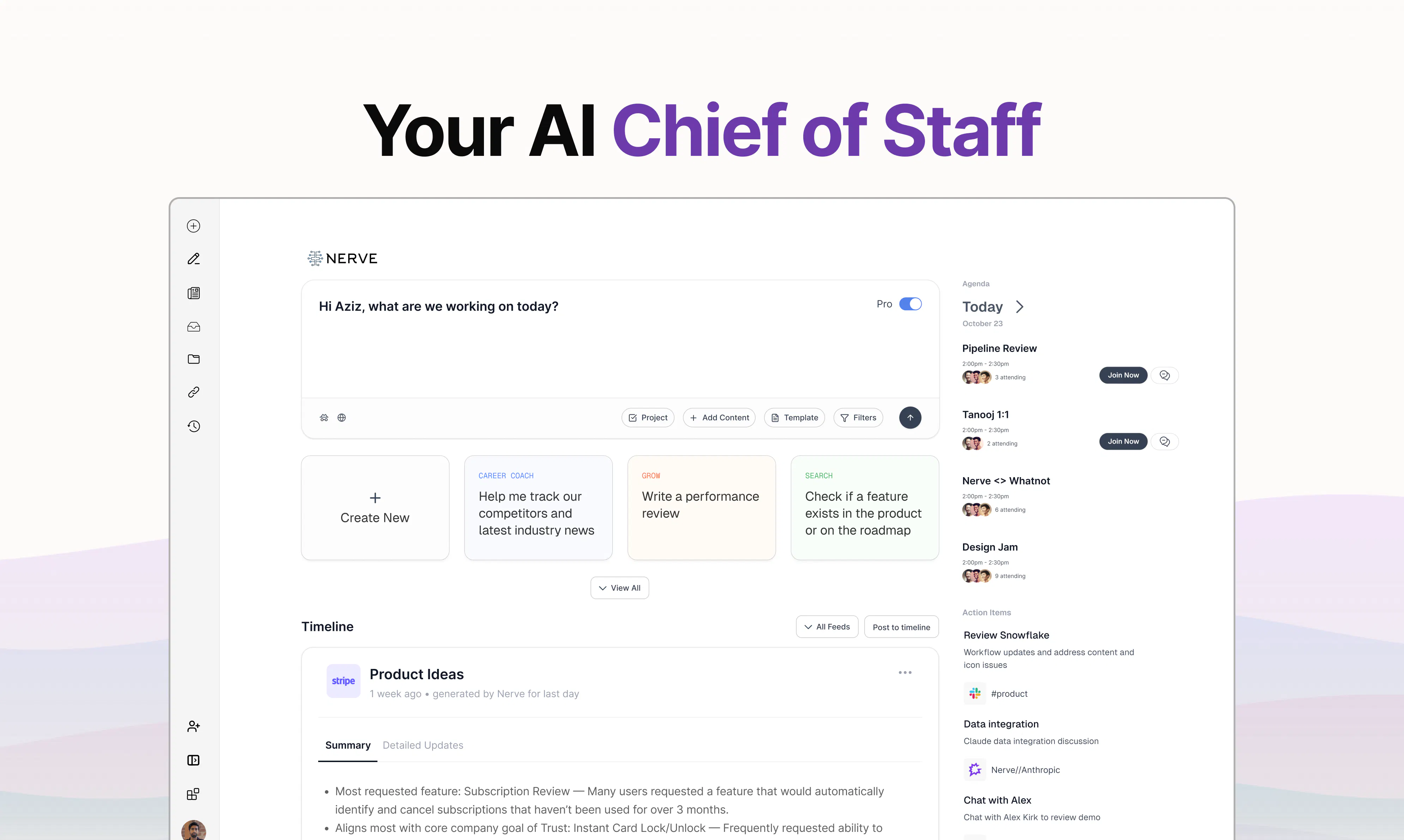
About Nerve
Reviews 8
-
Sedrick Hirthe 11 months ago
Congrats on this; I can see this being extremely beneficial. How has this improved time management and overall success?? Personally my time is mainly eaten up by admin tasks and outreach-lead generation. If I can have those off my plate, it would be a huge help
-
Lamont Strosin 11 months ago
Great idea! It would be very useful for me if AI could give recommendations on improving certain processes. For example, I write a task in Jira: "Connect Mailchimp for newsletters." The AI analyzes the task and understands that this is a personalized B2B newsletter, then gives a recommendation: "For personalized B2B newsletters it’s better to use Reply, where emails land in the primary inbox rather than the Promotions tab." Is it easy to build this with AI? Of course! Is it useful? It would be an absolute game-changer ;)
-
Korey Hammes 11 months ago
Love that Nerve is proactive instead of waiting for us to start a chat, especially for surfacing follow-ups and things that need attention. Which signal or trigger has turned out to be the most useful for those proactive alerts?
-
Tyrique Lind 11 months ago
Congrats!! I have used Nerve as a PM and it has been instrumental in finding and sharing knowledge with stakeholders. Rather than sifting through multitude of documents, engineers, designers, marketers now ask questions to Nerve and get answers quickly. It led to a greater engagement and stronger shared context across our team.
-
Kay Balistreri 11 months ago
I lead product at OpenSpace, and over the last few months Nerve has quietly become one of the most important tools in my day. It started as “yet another AI thing to try” and ended up feeling a lot closer to an extra person on the team. A lot of AI products are basically “ChatGPT with a different skin.” Nerve is different in two important ways for us: It actually knows our company. Nerve sits on top of the tools we live in every day—Gmail, Slack, Google Drive, Gong, Jira, Salesforce, etc.—and indexes them in a way that respects permissions. It can only see what I can see, but it brings all of that context into a single conversation. That means I can ask things like: “Show me everything customers have said about [competitor] in the last 2 weeks across Gong and Slack and summarize the themes.” “Remind me what we committed to in my last call with [customer] and draft a follow-up email.” “Pull in the latest PRDs, specs, and Slack threads related to this epic and help me write an updated product brief.” It’s built for actual work, not just answers. The place where Nerve really shines for me is long-form, messy work—the stuff that usually takes real time: product specs, strategy docs, customer updates, competitive reviews, internal memos. My typical workflow now looks like: Start with a messy brain dump: “Here’s a wall of Slack, Gong, and doc links. Help me turn this into a draft PRD in this template.” Apply our own templates: we’ve set up PRD and internal comms templates, so Nerve can mirror our exact structure, tone, and headings. It doesn’t just write “a document” – it writes an OpenSpace-style document. Iterate in place: I highlight a section and say “tighten this,” “make this more executive-friendly,” or “add risks and open questions based on the source material” and it edits just that portion instead of rewriting the whole thing. For me personally, Nerve has replaced a lot of painful context gathering and blank-page time. A few concrete examples of how I actually use it: Prepping for important calls: Before a customer or partner meeting, I’ll ask Nerve to summarize the last call, pull in any relevant emails and Slack threads, and list open questions or action items. I no longer dig through 5 different tools 10 minutes before a call. Competitive intelligence timelines: We created a “competitive feed” timeline that watches Gong, Slack, and a few key docs for mentions of competitors. Nerve compiles this into a digest so I can see what customers are saying, how deals are shifting, and where pricing or messaging is coming up. Weekly “what did I actually do?” summaries: I’m experimenting with using Nerve to answer “What did I work on this week?” It pulls from meetings, email, Slack, and docs to draft a Good/Bad/Neutral style update that I can quickly review and be critical about where I'm spending my time, my most critical resource. Turn calls into real outputs: When we run internal product or project huddles, we often end with obvious next steps: “Let’s write a PRD,” “Let’s create Jira tickets,” “Let’s draft a note for sales.” Once that call is recorded and shows up in our systems, Nerve is where I go to turn that raw conversation into structured tickets or documents. What’s made this all stick is that the team behind Nerve actually listens and ships. We’ve given them pretty opinionated feedback (sometimes bluntly), and we’ve watched them: Fix UX paper cuts within days. Rework action items so they auto-resolve when I actually reply in email or Slack, instead of turning into an endless, noisy backlog. Improve timelines from overly long, source-by-source dumps to concise summaries with details available if you want them. Is everything perfect? No product is. I’d love to see even more “agentic” workflows where it listens to my meetings or reviews notes (Granola-esque!) and proactively proposes tasks, tickets, or docs for me to confirm. But at this point, for the way we work in product at OpenSpace, Nerve has crossed an important line: it’s not a toy, it’s infrastructure. If they turned it off tomorrow, my week would get noticeably worse. If you’re in product (or lead a cross‑functional team) and your work lives across Slack, email, docs, Gong, and Jira, Nerve is one of the few AI tools I’ve tried that actually earns a permanent spot in that stack. Happy to answer questions about how we’ve wired it into our workflows.
-
Elias Rowe 11 months ago
I've been using Nerve for over six months as a PM at OpenSpace.ai. Last week I dropped a call transcript in and asked it to draft a PRD and tickets for a quick, scrappy project we wanted to ship fast. It came back with a full draft—and flagged issues we'd raised six months ago when we first discussed this project. Context pulled from old team notes, calls, and docs that nobody on the current call had mentioned. That alone saved us a ton of headaches. The beauty is now the Nerve agent takes it one step further and actually creates the Jira tickets. No other AI tool I've used comes close to this level of context understanding. Nerve actually knows my company. It's accurately incorporated bits of information from years ago and somehow can avoid getting lost in irrelevant context. Honestly, mind-blowing. Very impressive work from the Nerve team.
-
Tyrique Lind 11 months ago
A next-level productivity tool. Does Nerve support customizing workflows or is it limited to built-in integrations only?
-
Marcelo Prohaska 11 months ago
Hey PH! Cofounder/CTO here at Nerve. We solved a ton of technical challenges while building Nerve -- everything from indexing huge amounts of data while maintaining a strict permission layer, to building more advanced agents that are able to handle more complicated workflows like pipeline reviews or performance evaluations, and even dealing with writing data back to dozens of apps. Happy to chat about any of those if you’re curious, and always open to feedback!