

About NeuralAgent 3.0
Reviews 7
-
Johnpaul Crona 5 months ago
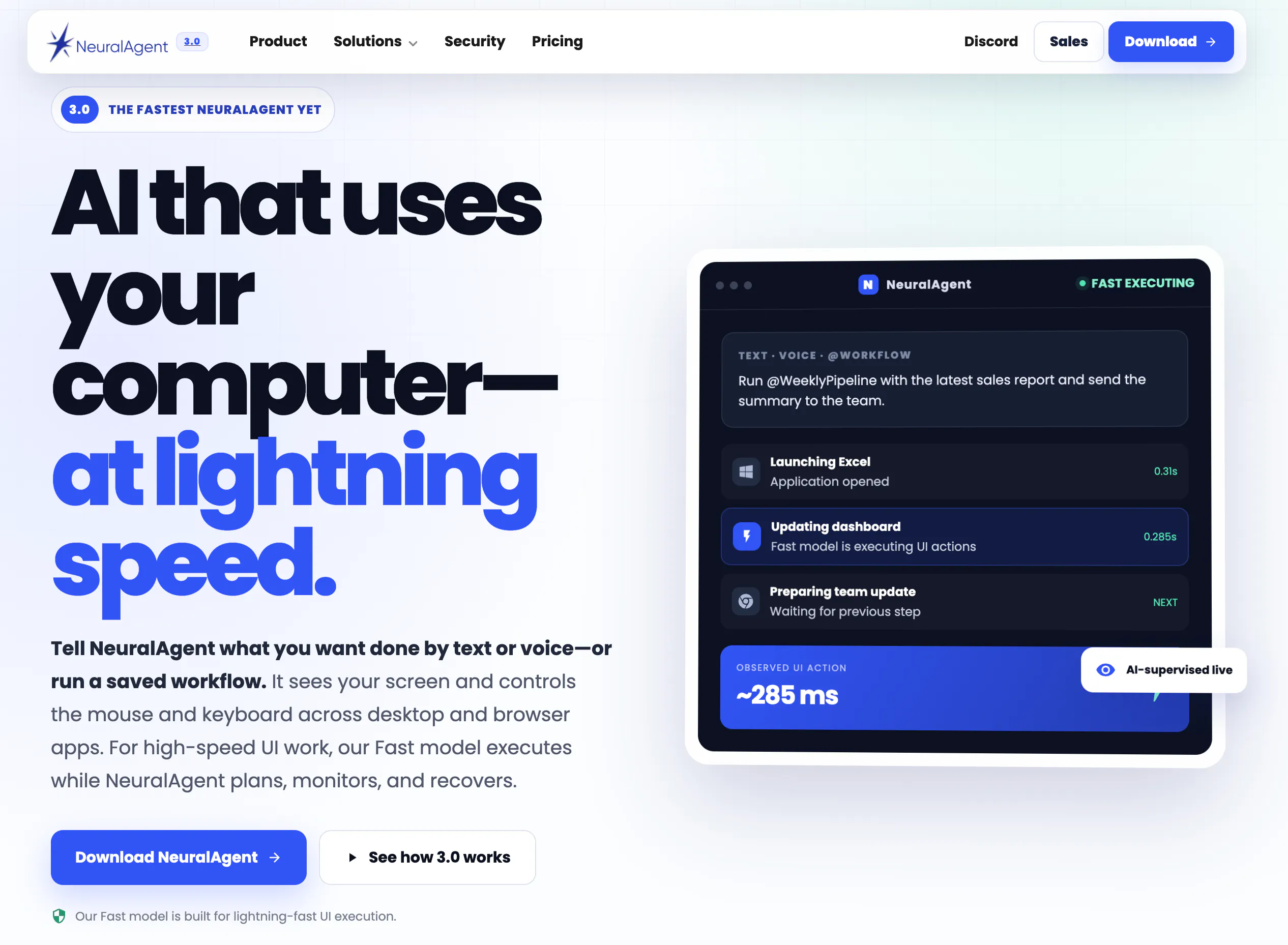
Because screenshot → model → action chaining causes most agent stacks I've attempted to sit closer to multi-second loops, ~285ms for UI action execution is a meaningful benchmark if it's end-to-end from intent to click. What is the usual action granularity (single click vs. multi-step procedure) and is that figure based on local inference? I'd also like to know how you handle partial failures when a native app doesn't expose standard accessibility trees or when the DOM changes. Is the action layer proprietary or is it open-sourced? Women's Leather Jackets
-
Jackson Fisher 5 months ago
~285ms for UI action execution is a meaningful benchmark if it's end-to-end from intent to click — most agent stacks I've tried sit closer to multi-second loops because of screenshot → model → action chaining. Is that number measured on local inference, and what's the typical action granularity (single click vs. multi-step workflow)? Would also love to know how you recover from partial failures when the DOM shifts or a native app doesn't expose standard accessibility trees. Are you open-sourcing any of the action layer, or keeping that proprietary?
-
Jake Blanda 5 months ago
Can we combine it with a frontier agent, like Claude or Codex, to handle computer-use tasks?
-
Daren Bruen 5 months ago
The replay feature feels practical. Computer-use agents are useful, but saving a task and rerunning it quickly is what could make them part of a real workflow instead of a one-off demo.
-
Rylan Cremin 5 months ago
Love the Fast model plus reasoning model architecture, I am a little curious about, when the supervisor steps in to re-plan after an error, how much latency does that recovery typically add to the flow?
-
Al Wolf 5 months ago
A lot of computer-use demos still feel like watching a slow remote desktop session. The Fast model + supervisor split is the bit that makes NeuralAgent feel practical, not just impressive in a demo.
-
Reilly Thiel 5 months ago
The replay architecture is the most interesting thing here. Not-a-macro is doing a lot of work in that claim though. If the Fast model re-analyses the live screen on every replay run, what's the latency cost versus a recorded macro when the interface hasn't changed? And when it does adapt to an interface change, how does it signal to the user that it deviated from the original task path rather than silently doing something adjacent? The brittle script problem is real. Curious how you surface the cases where "adapted" actually meant "got it wrong."