

About OLLM.COM
Reviews 10
-
Rylan Hyatt 11 months ago
Very useful. Many people worry about how private their data and code really are when sent over the network, since protection at every step can’t be guaranteed. This seems to address that concern.However, the document button on the website doesn’t work. It would be good to know how users can verify that the data is truly encrypted, rather than just trusting what’s reported.
-
Dorcas Parker 11 months ago
This is actually refreshing to see. Privacy is usually just a buzzword in AI, but running LLMs on confidential hardware and proving it cryptographically is a big deal. The fact that data stays encrypted even during processing is something most people still ignore. Curious to see how this scales.
-
Reilly Thiel 11 months ago
This hits a real nerve. That “blind trust” feeling around AI tooling is something a lot of us quietly worry about, but rarely see addressed this directly. I really respect how you turned that fear into something concrete and verifiable — cryptographic proof > promises. 👏 Curious: for teams just starting with OLLM, what’s the easiest first workflow to move over without slowing dev velocity?
-
Korbin Effertz 11 months ago
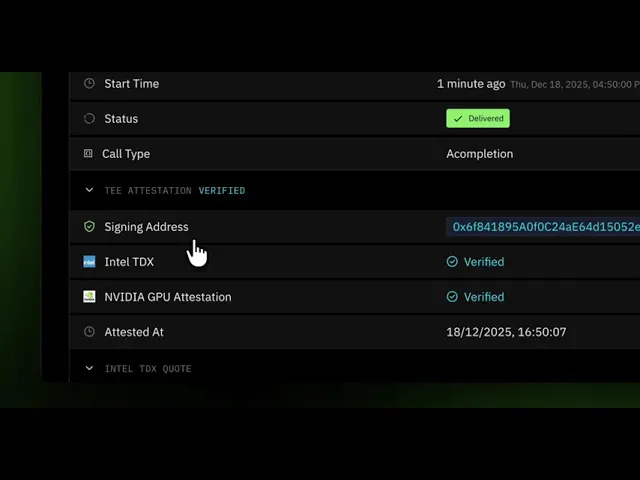
I gave OLLM a real try for coding with Zed, routing requests to DeepSeek-V3.1 on NEAR, and wanted to share honest feedback. First: this is not just a landing-page idea, it actually works. I ran fairly large coding contexts (20/25k input tokens per request), and inference was stable. Latency varied (a few seconds for short completions, ~20s+ for heavier ones), which is expected with confidential compute + large contexts. Costs were transparent and predictable, which I appreciated. What really stands out is the request-level transparency. Being able to inspect individual requests with: TEE attestation Intel TDX + NVIDIA GPU verification cryptographic signatures …is something I haven’t seen in any mainstream coding assistant. This feels like a fundamentally different trust model than “just believe our privacy policy.” That said, wearing an enterprise / security hat, I’m curious about what’s coming next beyond the tech (which is impressive): Will there be contractual assurances suitable for enterprises? DPA / SCCs / indemnities? Audit rights? SLAs and incident response commitments? Add option for SSO login for corporate clients Would be nice to see some success story eg: actual app using this gateway or how founder is using it etc. Those are usually the last blockers for adoption in regulated orgs, even when the tech is strong. One small UX note from actual usage: When you have many past requests, it’s hard to find a specific historical request. Having the request ID visible in the dashboard + a search-by-ID in the explorer/scanner would make debugging and audits much smoother. Overall: this feels like a serious attempt to move AI from “trust us” to “verify it yourself”. Curious to see how it evolves beyond MVP.
-
Hillard Halvorson 11 months ago
Confidentially is always the most important factor for me when I look at LLMs. Is the code audited? Do you have any data on how much latency there is due to it running in an TEE?
-
Michel Heathcote 11 months ago
I think your approach is promising. However, would love to see some benchmarks on latency, throughput and cost compared to standard GPU inference or other Gateway providers
-
Gilbert Lind 11 months ago
Great initiative and a much-needed direction. At a time when trust in AI is mostly based on promises, an approach grounded in verifiable, cryptographic proof is a real game changer. Wishing OLLM strong momentum and looking forward to seeing how the product evolves. Which open-source models are you planning to support next, and are you considering any code-focused LLMs specifically?
-
Floyd Botsford 11 months ago
OLLM is one of the first AI platforms that actually closes the trust gap instead of just asking you to “believe the privacy policy.” It lets you run open‑source LLMs inside confidential computing environments (TEEs) and gives you cryptographic attestation for every call, so you can prove where and how your data was processed. This makes it a genuinely usable option for teams handling sensitive code, financial data, or patient records who want modern AI workflows without sacrificing compliance or peace of mind.
-
Ruben McClure 11 months ago
Hey team, first of all super cool concept! I do have to say that, even though the UI is pretty sleek, I think the login flow and how you generate your API is not very intuitive. I could suggest maybe a very clear "login" button as you enter the console that maybe re-directs you directly to the dashboard.
-
Michel Heathcote 11 months ago
Very nice and needed. Many are wondering the same thing about how truly private is their data and code once it goes through the network and the result comes back. We can't be sure every step our data is protected. This apparently would solve that issue. The document button is not working on the website. Would love to understand how to actually verify the data is really encrypted. Because at this moment you report that is, but why we should trust what you report? How users can actually verify everything?