

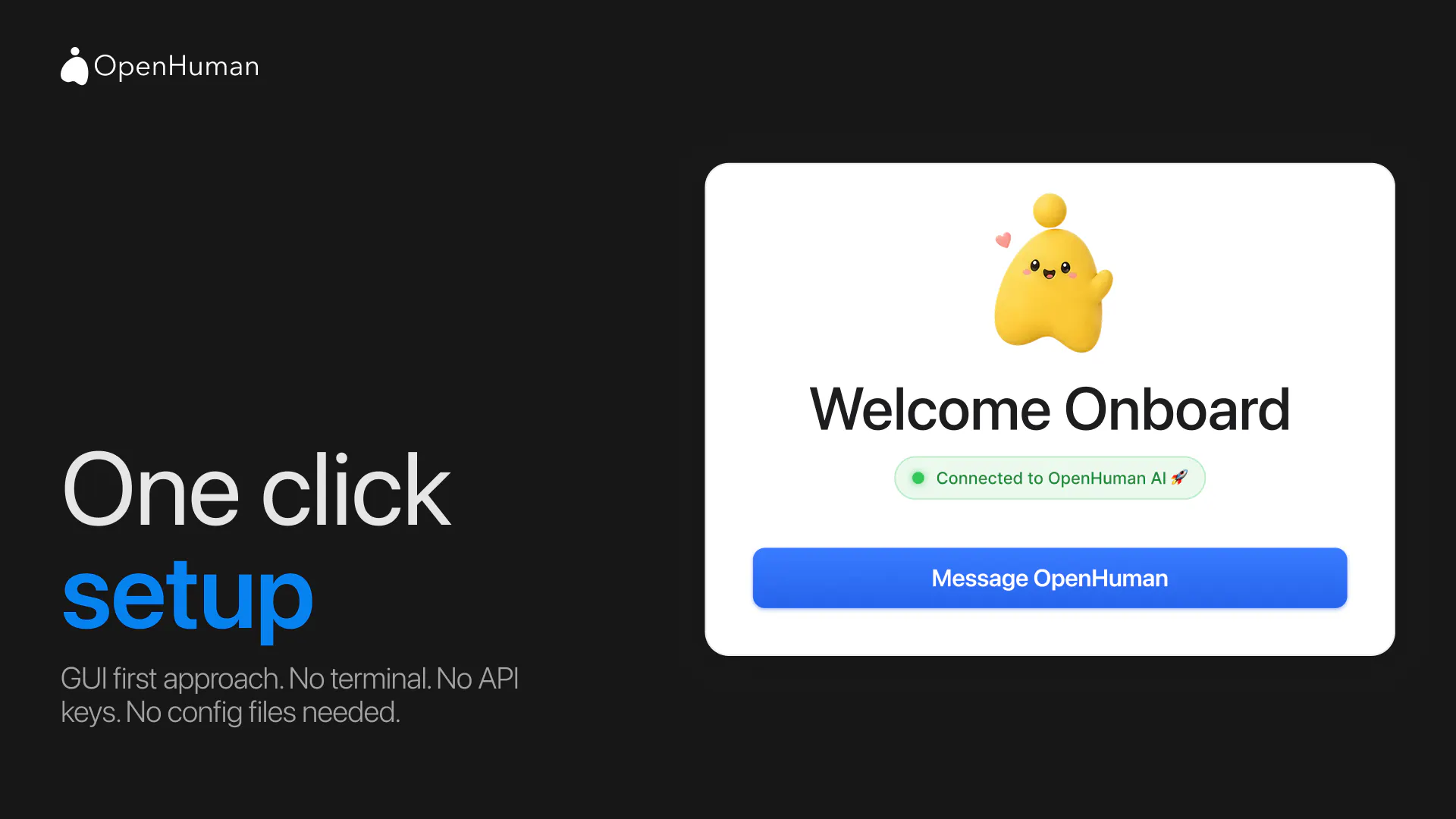
About OpenHuman
Reviews 15
-
Nikunj 5 months ago
The dad test is a good framing and a real problem. The 90% dropout stat is doing a lot of work though. Where does that come from? The memory claim is the one I'd want to stress-tested. "Remembers everything about you and gets smarter" is a strong promise. What's the actual architecture: vector store, fine-tuning on local data, something else? And what happens to that memory when the app updates or the local storage gets corrupted? 8000 GitHub stars in early days is a real signal. What's the retention curve look like past day 7? That's where local-first tools usually fall apart.
-
Fidel Davis 5 months ago
Hey, congrats on the launch! Really like what you're building here - the fact that it's open source makes it even better) A couple of questions: First, are you open to community contributions of apps/integrations into the harness? We're building an integration that lets agents delegate tasks to human experts (freelancers) when they hit the limits of what they can do solo. Feels like there could be a nice fit here - would love to explore collaborating. Second, how deep does your MCP support go right now? We've noticed most harnesses don't yet support MCP tasks, which turn out to be crucial for long-running work. Curious whether broad MCP coverage is something you're actively targeting, or more of a "we'll get there when we get there" kind of thing.
-
Gaylord Buckridge 5 months ago
The mascot threw me at first, seemed gimmicky. Then I realised it's probably doing a lot of work to make the whole thing feel approachable to people who've never run an agent before. The local-first angle is the right call for a general audience; most people won't hand over Gmail access to a server they've never heard of. My question is about the long tail: what does the experience look like after 6 months of daily use, when the memory is dense and potentially contradictory? Is there a way to audit or clean what it's learned about you?
-
Korey Hammes 6 months ago
probably one of the most interesting launches here for me. open-source AI tools just feel more trustworthy when you can actually understand what’s happening behind the scenes and also tinker with it to add new flavor(features).
-
Santa Cassin 6 months ago
The persistent memory angle is what makes this actually agentic rather than just a pretty chatbot wrapper. Session resets are one of the biggest reasons agents feel useless in practice. The dad story resonates too- accessibility is an underrated problem in this space. Curious how the memory layer handles conflicts or outdated context...if I told it something about my workflow six months ago that's no longer true, does it overwrite, append, or does the user have to manually prune? Also wondering how the local Gemma3 orchestration holds up when you're chaining several tool calls together? Does it struggle with longer reasoning chains compared to a hosted model?
-
Hugh Borer 6 months ago
Hi al! I am curious how the team thinks about the storage trade-off underneath the 【TokenJuice】. The raw feed from Gmail, Slack, and Notion is preserved in SQLite, and then a separate Markdown memory tree is generated for Obsidian. So the same corpus lives twice on a local disk. I ran a similar local-first RAG setup last year, and at around 20,000 chunked documents the query latency climbed from under 200ms to multiple seconds. The double index (database plus filesystem) was the bottleneck. OpenHuman markets "automatic growth" as a feature. Has the team tested the local index at tens of thousands of memory nodes? And is there a path for users to prune the raw OAuth feed after compression without losing the distilled memory entirely? I would love to hear how the makers are thinking about retention policies or compaction. Local storage is not a free resource after all.
-
Mike VonRueden 6 months ago
can it integrate with WhatsApp, Facebook and YouTube? Edit: I found in the documentation that yes for WhatsaApp and YouTube, but I couldn't find Facebook! good luke!
-
Blaze Koepp 6 months ago
okay the "90% of people give up on AI agents" stat hit different because it's completely true. every agent tool I've tried either loses memory after 5 minutes or needs a PhD to set up. the local-first + persistent memory combo is genuinely the right approach. my only concern — "one-click setup" has been promised by 50 tools this year and exactly 3 delivered. going in cautiously optimistic but watching this one closely. congrats on 8k stars in a week though, that's not luck.
-
Roberto Smith 6 months ago
90% dropoff on AI agents is believable and the three reasons listed are accurate. the terminal barrier alone kills adoption with anyone who isn't already technical. one-click setup is doing a lot of work in this pitch and i hope it actually means one click
-
Joany Hansen 6 months ago
BIG QUESTION. How abut security? Does he run insider a sanbox like nemoclaw? Or in a vm ?
-
Roberto Smith 6 months ago
Interesting project, unfortunately couldn't find any pricing plan for the OpenHuman One Subscription.
-
Rylan Hyatt 6 months ago
Hey, I loved the idea and would love to try it. I do want to know the cost for it, as I don't see the pricing page for this tool on the website, Is there a free trial or something? and how are you guys optimizing the costs from the llms tokens?
-
Carter Volkman 6 months ago
Is it free to use? Can we use local models from ollama.. is it good at coding tasks?
-
Blaze Koepp 6 months ago
Could you change from OpenHuman to TinyHuman? We already registered name OpenHuman from 2023. Which make it mismatch for anyone @enamakel . https://www.crunchbase.com/organization/openhuman https://www.linkedin.com/company/openhuman https://x.com/OpenHuman
-
Lance Morar 6 months ago
What does OpenHuman feel like as a desktop app, specifically? Does it feel polished and intentional, like a native tool you’d keep open all day, or more like a very capable web app wearing a desktop costume and hoping nobody asks too many questions?