

Perplexity Computer Skills
Extend Computer’s capabilities with repeatable instructions
About Perplexity Computer Skills
Reviews 15
-
Johnathan Homenick 8 months ago
So basically macros, but actually intelligent? How does it handle steps that change based on context?
-
Haleigh Bartoletti 8 months ago
The portability angle is what gets me. Rebuilding the same workflow logic every time you switch models is one of those invisible costs that adds up fast. Curious how it handles context switching when the same skill file gets interpreted differently across models. Does it normalize behavior or just pass through as-is?
-
Santa Cassin 8 months ago
The SKILL.md portability angle is what makes this genuinely interesting. We're seeing the same pattern across the ecosystem — Claude Code, Codex, and now Perplexity all converging on markdown-based skill definitions. It's like Dockerfiles for AI workflows. What I find exciting is the 19-model execution part. Right now most of us are locked into one model per skill. Being able to run the same workflow across different models means you can actually benchmark which model handles your specific task best — not just generic benchmarks, but YOUR actual workflow. For context, I build native macOS apps and use Claude Code with custom skills daily. The pain point has always been: if I invest time crafting a perfect workflow in one tool, I'm locked in. Making skills portable changes the economics of investing in workflow engineering. Curious: does it handle skills that rely on tool-specific features like Claude Code hooks or MCP servers? That's where portability usually breaks down.
-
Dorcas Parker 8 months ago
The portable workflow concept here is brilliant - having skills that understand context and fire automatically rather than needing explicit invocation is a game-changer for builder productivity. Curious how the 19-model routing works - is it deterministic based on skill type or more dynamic? Also interested in how team collaboration on shared skill libraries would work.
-
Wiley Lubowitz 8 months ago
Having portable workflow formats across different AI coding tools is exactly what the developer ecosystem needed. The context-aware triggering approach is clever - letting the tool infer intent rather than requiring explicit commands reduces friction significantly. Excited to test how this works with complex multi-step automations.
-
Ruben McClure 8 months ago
Congrats on the launch! As a heavy user of Gemini, Claude Opus, and Manus, reading through this immediately gave me strong Manus vibes—and I mean that in the best way possible. Moving from "answering questions" to "executing multi-step workflows" is exactly what makes agentic tools like Manus so powerful. Seeing Perplexity adopt this "Computer" orchestration approach, especially with SKILL.md portability, is a massiveee step forward. I'm just worried about the costs a bit. Subscription-based is great, as it allows us power users to outpace standard API costs. But since this routes tasks through various sub-models under the hood, I wonder if it might end up being as pricy or even pricier than Manus. I have my largest non-api costs there right now. Looking forward to tryint it out. Really exciting
-
Esteban Kilback 8 months ago
Love the portability angle here - having consistent workflow definitions across different AI tools is a big productivity win. The 19-model support is impressive. How do you handle version conflicts when skill files get updated?
-
Joaquin Wisozk 8 months ago
This solves a real pain point. Love seeing workflow portability across AI tools.
-
Sedrick Hirthe 8 months ago
The portability angle is the real unlock here. Most of us have invested significant time building workflows in one environment - the idea that these become transferable assets across 19 models changes the economics of AI workflow investment entirely. No more vendor lock-in on your institutional knowledge. Curious about the context activation mechanism - how granular is the trigger detection for choosing between similar workflows?
-
Garland Grady 8 months ago
The SKILL.md integration is a game-changer for agent workflow standardization. What I find most compelling is the 19-model execution - this solves the vendor lock-in problem that's plagued AI tooling. Being able to import existing Claude Code or Codex setups without rewriting means teams can actually compound their workflow investments rather than starting fresh with each new tool. Curious about the activation logic: does the context-based workflow triggering use semantic matching or keyword patterns? And for teams with large skill libraries, how does it handle priority conflicts when multiple workflows could match?
-
Lamont Strosin 8 months ago
Computer use is the big next step. Going from "answer my question" to "do this task on my computer" changes everything. I've been waiting for this since Anthropic demoed computer use last year. The repeatable instructions part is what I care about most. I have about 15 things I do every morning that could probably be automated if the AI could just watch me do it once. How reliable is it with apps that change their UI frequently? That's usually where automation breaks.
-
Charley Swift 8 months ago
The SKILL.md portability across Claude Code, Codex, and now Perplexity is a smart move — making workflows tool-agnostic rather than locking them into one ecosystem solves a real pain point for power users. Curious whether there's a versioning or diff system planned for skills, since iterating on a workflow across 19 models likely produces very different outputs than the original single-model setup.
-
Nils Auer 8 months ago
Amazing am gonna try this out
-
Hobart Glover 8 months ago
The SKILL.md portability angle is the real story here. I maintain a library of 100+ skills for Claude Code and the biggest friction has always been vendor lock-in. Being able to reuse those workflows across tools without rewriting is a genuine time saver. Curious how it handles complex multi-step skills with tool-specific syntax.
-
Maxwell Blanda 8 months ago
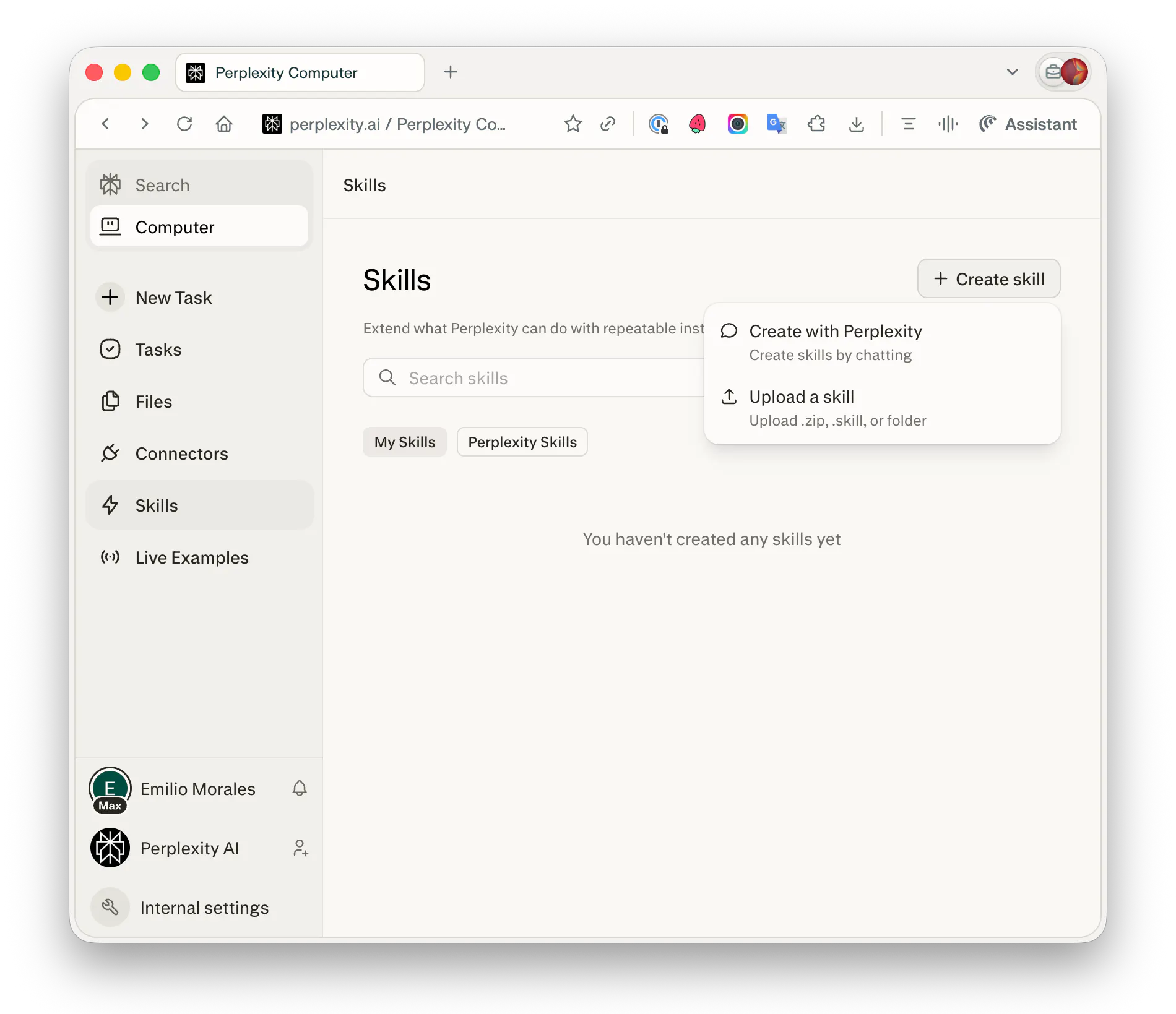
@rohanrecommends @aravindsrinivas @Perplexity Computer Skills As a heavy user of AI workflows, this "Computer Skills" module is really quite different. Upgrade "prompt" to "reusable workflow template Previously, long prompts were piled up in various chat interfaces, which were difficult to reuse and could not guarantee stable output. Perplexity's Skills transform these frequently used patterns into "naming and manageable skills", and they can be triggered automatically based on descriptions, providing a more experience similar to "requesting a fixed style AI employee" rather than randomly generating a prompt. The two creation methods cover users ranging from beginners to advanced users. If you can't write the SKILL.md file, you can directly generate it in the Computer using the "Create with Perplexity" dialog box. This is very suitable for product, operation, and analysis students. For teams with their own knowledge base and standards, you can manage it using a .zip + SKILL.md format. Combined with the YAML frontmatter's name and description, it can achieve precise triggering and is already very close to the feeling of "lightweight workflow orchestration". The automatic activation driven by the description + combined use is the highlight. The series of relay tasks mentioned in the document, such as Research, Research Report, and Slides, are very crucial: Users only provide requirements, and Computer selects and arranges the skills based on the descriptions. In the same task, one can first conduct research, then write a report, and finally generate a presentation. This minimizes the need for manual copy-pasting. This is closer to the real knowledge work scenario than a "super universal chat box". It is very friendly to team collaboration and standardized output. The "weekly report template", "competitive product research paradigm", and "data analysis report structure" are all made into Skills. New team members can directly reuse the SKILL.md accumulated by experienced members, which not only saves training costs but also ensures a more unified output style. The following are the several points that I will pay attention to. Permissions and Sharing: How to manage within a team or enterprise who can create, who can modify, and who can share skills Version Control: SKILL.md, as a text, is actually very suitable for working with Git for version management Observability: When complex tasks involve multiple Skills and the result is unsatisfactory, can one see the "call chain" to facilitate optimization