

About Pilot5 Legal
Reviews 3
-
Demetrius Gulgowski 1 month ago
One point because it comes up in every conversation. Pilot5 Legal is built first for US practice: the five workflows of the console check against US federal and state law. The deliberation and the source base are not limited to the US. Statutes, regulations and case law come from official publishers: Congress.gov, CourtListener, the Federal Register and twenty-plus state legislatures in the US; legislation.gov.uk and BAILII; CanLII; EUR-Lex, the Court of Justice of the EU and HUDOC; Légifrance, Normattiva, gesetze-im-internet, the BOE; Fedlex, Rechtspraak, Legilux; ADGM, DIFC and the Saudi Ministry of Commerce; ICC, LCIA, ICSID and UNCITRAL for arbitration. Over 400 verified institutional sources across 21 domains, and the list keeps growing, with Europe, India and the Middle East next. The full list is public on pilot5.ai, under Sources. https://pilot5.ai/sources
-
Trenton Spencer 1 month ago
Thomas, the saved counterargument is what I keep coming back to. I've trusted one confident answer before and regretted it, so leaving myself something to push back against feels right to me.
-
Blaze Koepp 1 month ago
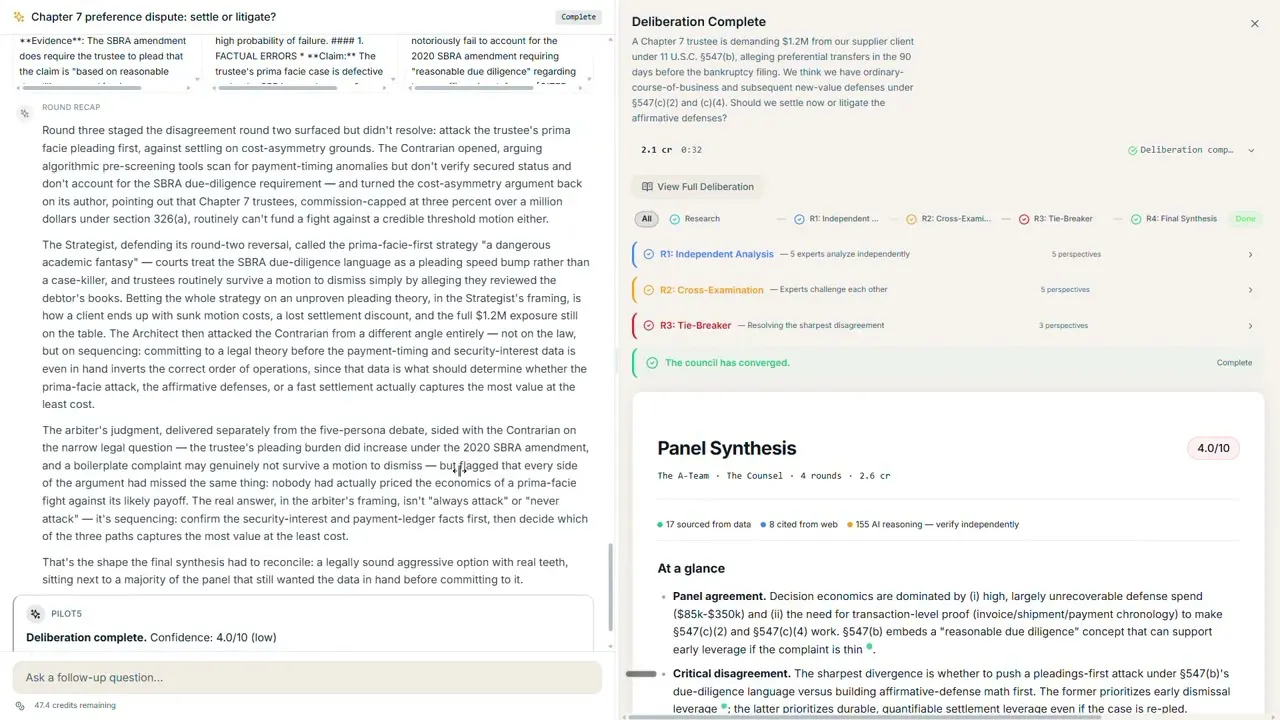
the part I'd push on is "independent" - five frontier models are mostly trained on overlapping web/legal corpora and share a lot of the same blind spots, so disagreement between them isn't the same as disagreement between five lawyers from different schools of thought. if all five miss the same obscure circuit split because none of them saw it in training, the convergence looks reassuring but means nothing. do you weight or flag the cases where all five agree but the agreement might just be a shared gap, or is consensus always treated as a positive signal