

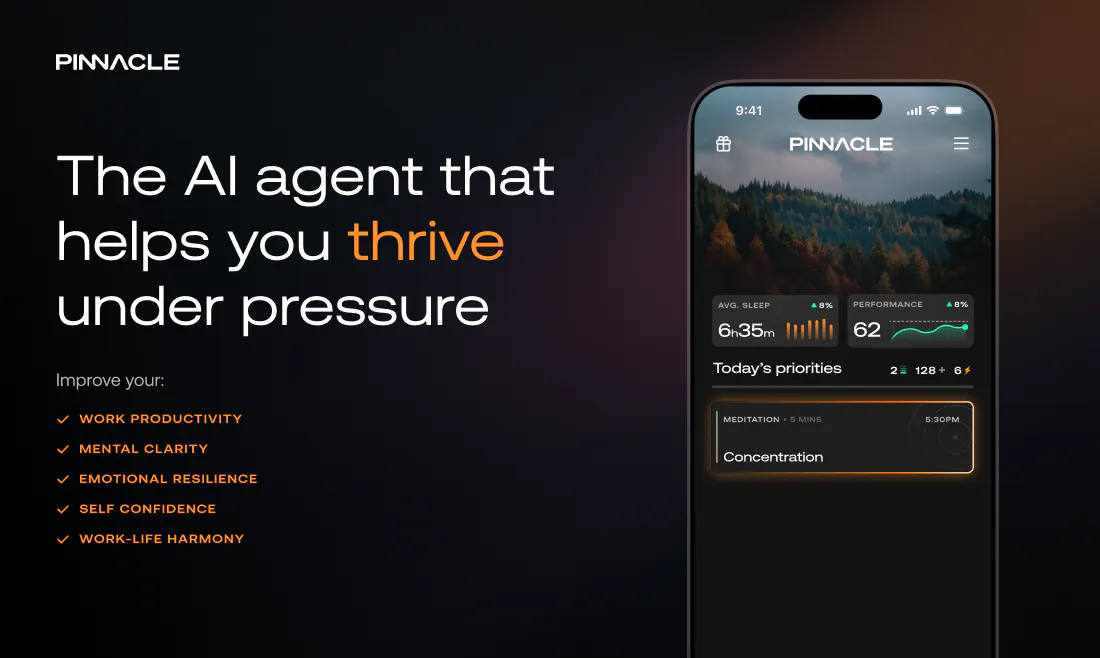
About Pinnacle
Reviews 15
-
Nils Auer 8 months ago
Nice feature@joel_jackson1 , but which iPhone sensors are you actually using to infer HRV and stress?
-
Esteban Hilpert 8 months ago
the 'performance coach' framing is interesting vs the usual wellness/health angle. feels less guilty more ambitious. does it adapt based on what you actually do or is it mostly static recommendations
-
Elias Rowe 8 months ago
This was what I wanted to build for my openclaw as a skill from Apple Health input. The flow and step by step instruction is very detailed. 1 problem I encountered is that the LLM change language during conversation for no reason. Add ifttt or more language.md for user preference
-
Kay Balistreri 8 months ago
I really like the idea! But how accurately does it currently detect my current state?
-
Hobart Glover 8 months ago
Looking really interesting, I’d love to try it but I’ve just noticed the app is not available in the App Store outside of the US? Is there a link to a webapp?
-
Lamont Strosin 8 months ago
Used pinnacle for a few months as a beta tester - and it was really great! Good synthesis of different signals, really nice goal tracking, all backed up with accountability via coaching. Still sustaining habits we worked on months ago!
-
Quincy Medhurst 8 months ago
Hey @joel_jackson1 first of congratulations on the launch, I just check Pinnacle and it seems solid but I was wondering what's different in it that others don't have? I mean that solution are you guys providing that existing platforms are not solving? Would love to hear your feedback and best of luck!
-
Elmer Schoen 8 months ago
I am slowly getting over the hump of thinking of AI as companions, but still often uncomfortable. Do you think AI needs to mimic humans for it to feel natural? Or something else?
-
Godfrey Donnelly 8 months ago
Interesting concept. Turning a phone into a tool that helps people understand their mental state throughout the day sounds powerful. I like the idea of combining biometrics with simple, actionable insights instead of just raw data. Which iPhone sensors does Pinnacle rely on to interpret emotional state and focus levels?
-
Duncan Effertz 8 months ago
I've been tracking HRV with a chest strap for a while and the data is genuinely useful, but iPhone sensor accuracy for HRV is... mixed at best. Is the "performance score" heavily weighted on HRV, or is it more of a composite that uses conversational inputs + biometrics together so that noisy sensor data doesn't throw off the whole picture?
-
Haleigh Bartoletti 8 months ago
Calibrating to a personal baseline is a good design decision. I've used apps that tell me my focus score is "72" with no context for whether that's good or bad for me specifically. Relative improvement from my own starting point is a much more useful signal. How are you using the iPhone sensors for brain measurement? I'm curious whether it's HRV-based (which correlates with cognitive readiness) or something else. And do the breathwork exercises adapt based on what the sensors detect, or is the exercise library more of a fixed menu that you recommend from?
-
Esteban Hilpert 8 months ago
Using iPhone sensors for cognitive state detection is clever - leveraging existing hardware rather than requiring wearables. The positioning between therapy (expensive, backward-looking) and meditation apps (impersonal, static) hits a real gap. Curious about the sensor fusion approach - are you correlating touch patterns, typing cadence, voice analysis during conversation? The real-time adaptation based on measured state could be powerful for in-the-moment coaching.
-
Gaylord Buckridge 8 months ago
This fills a real gap in the market. Current tools either focus on processing the past (therapy) or are too static and impersonal (meditation apps). Using the iPhone sensors you already have for real-time biometric reads is clever - no new hardware purchase barrier. The intersection of emotional state interpretation + practical training could create a feedback loop thats actually actionable. Question: how does the system adapt recommendations when someone is going through an unusually stressful period vs their baseline?
-
Mortimer Powlowski 8 months ago
The iPhone sensor approach is clever - leveraging hardware people already carry for biometric insights without extra wearables. Curious about the natural conversation training - does it adapt recommendations based on patterns it detects over time? Also wondering about privacy handling for the sensor data.
-
Karley Frami 8 months ago
The positioning here is smart - you've identified a real gap between therapy (backward-looking), coaching (expensive and unquantified), and wearables (body-only). Bridging psychological insights with sensor data could create a feedback loop that none of these categories can deliver alone. The iPhone sensor approach is clever since users already have the hardware. What's the baseline calibration like - do you need an initial period to establish someone's personal norms before the coaching becomes personalized?