

About Prelint
Reviews 15
-
Hugh Borer 3 months ago
Interesting product
-
Haleigh Bartoletti 3 months ago
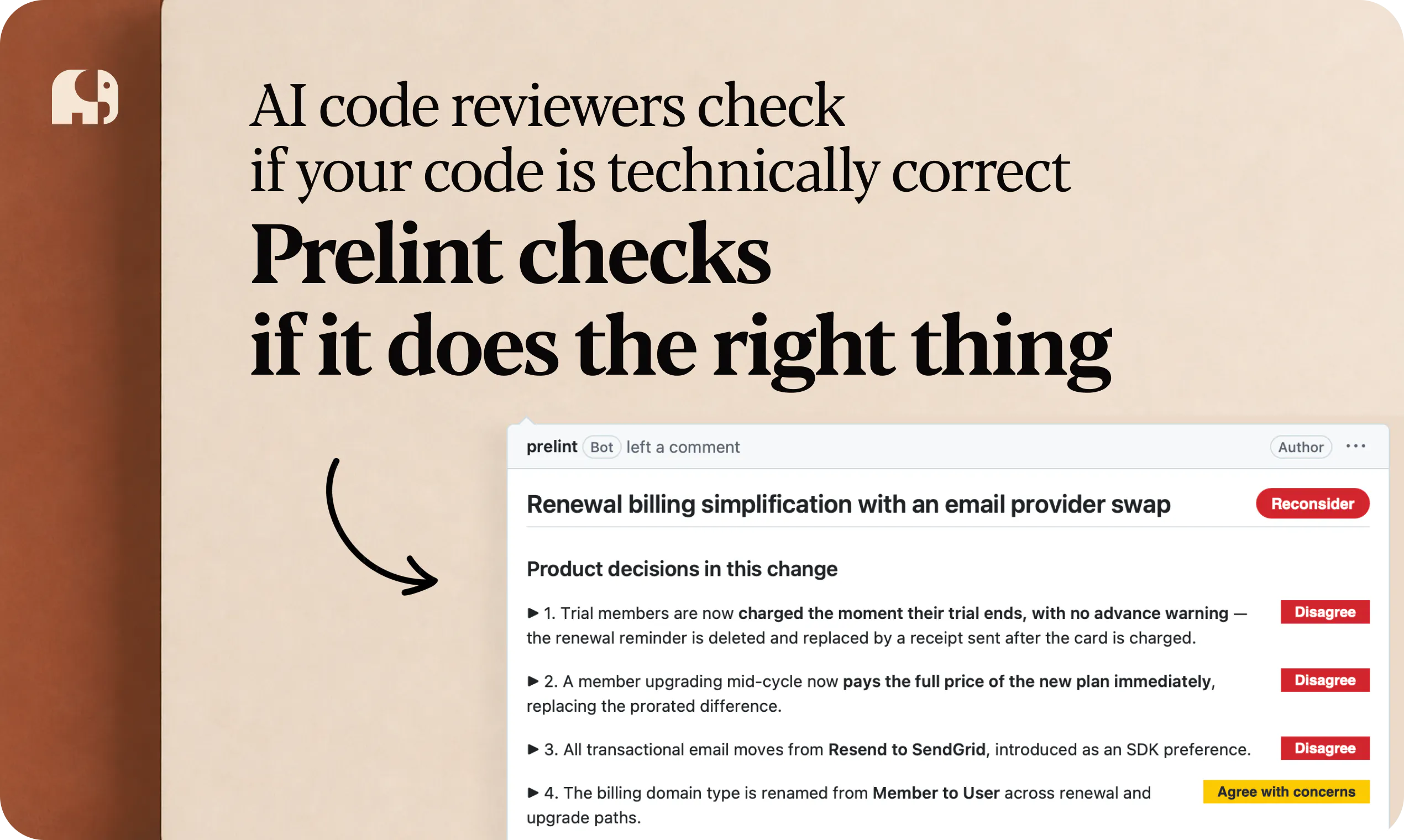
Congrats on the launch! 🚀 I really like the distinction between reviewing whether code is correct and whether it's the right thing to build. As AI becomes part of the development workflow, I think that second question will become just as important as traditional code review.
-
Santa Cassin 3 months ago
I'm on a trip through Poland and I found your QR code poster next to Kraków Zabłocie station. This seems like a product I actually want. Thanks for the free credits.
-
Makenna Eichmann 3 months ago
Congrats on a successful launch!
-
Hugh Borer 3 months ago
product drift is the real silent killer with ai code 👀 how do you keep false positves low?
-
Ayden Miller 3 months ago
The decision ledger is the right object, and it inherits the failure mode of every artifact that becomes authoritative: the entries nobody re-checks are the ones everybody trusts most. We hit the small version of this. A comment in our planner said the model was gpt-4o long after it had been switched to Haiku. Nothing broke, tests passed, the code was correct, and every human and every agent that read that file afterwards inherited a decision no one had made. The wrongness was invisible precisely because the artifact was doing its job. Weighting by authority makes this sharper rather than softer. The entries that most need an expiry are exactly the ones the weighting protects, and an agent reading your ledger will trust it more than it trusts the code, which is the correct behaviour right up until the entry is stale. So: does an entry ever get demoted, and what evidence demotes it? Ours are append-only, never deleted, because deleting a rule reopens the bug class it was written to prevent, so a retired entry leaves a tombstone pointing at the audit that killed it. The ledger records the deaths, not just the decisions.
-
Eino Klein 3 months ago
"Good code that quietly builds the wrong product" is uncomfortably specific to something I have sitting in my own guidelines file right now: a component that fetches data directly instead of going through a hook, flagged months ago as a known violation, still not fixed because it passed review and works fine. That's the exact gap you're describing: nothing was broken, so nothing forced the conversation. Question: when Prelint flags a decision, does it also catch pre-existing drift already merged, or only new changes in the current PR?
-
Daren Bruen 3 months ago
Super interesting. I'm one person shipping with Claude Code daily. I had wrongly assumed drift was a coordination problem: several people, nobody reading each other's decisions. But what i found is that my own documented decisions go stale against my own code, and then they propagate. Two from this month. A task in my tracker carried an explicit "do not do X without first verifying Y" warning. I wrote the checklist for that exact task without reading its notes, and caught it only when I went to close the task afterward. Separately, my canonical brand doc described a logo treatment that the actual shipped asset files contradicted. The doc was wrong for weeks and seeded the wrong version into an outgoing email template before I noticed. Neither was an agent going rogue. Both were correct-looking work built on a confidently stated stale premise. So my question: your supersession detection sounds aimed at documents contradicting each other. Does it handle a document contradicting the artifact it describes? The rotten context that actually cost me was doc versus reality, not doc versus doc, and the docs were the ones asserting loudest.
-
Kyleigh Luettgen 3 months ago
AI-generated code will only become more common, so governance tools like Prelint are going to be must-have!
-
Esteban Hilpert 3 months ago
Congrats on shipping. Whats the roadmap looking like?
-
Blaze Koepp 3 months ago
Congrats Wojtek. Did you build this out of your own frustration or what inspired to think of solving this problem?
-
Randi Prohaska 3 months ago
Are you primarily targeting product and dev teams?
-
Adam West 3 months ago
Congratulations. Does Prelint suggest the closest approved design pattern when it detects a violation?
-
Hillard Halvorson 3 months ago
When you build with AI, product consistency tends to erode gradually. Tools like Prelint can help stop that before it becomes expensive. Congrats on the launch.
-
Maxwell Blanda 3 months ago
the "decision ledger vs check code against docs" framing is what actually clicks for me. i keep a section in my own CLAUDE.md that's a manual, extremely low-tech version of this, not architecture notes, just "already tried this, here's why it didn't work" so the agent doesn't quietly rebuild the same mistake three months later. what i can't do by hand is catch the drift in real time instead of noticing the pattern repeating after the fact. question on an existing repo: does the ledger backfill decisions from git history, or does it only start learning from the point you connect it?