

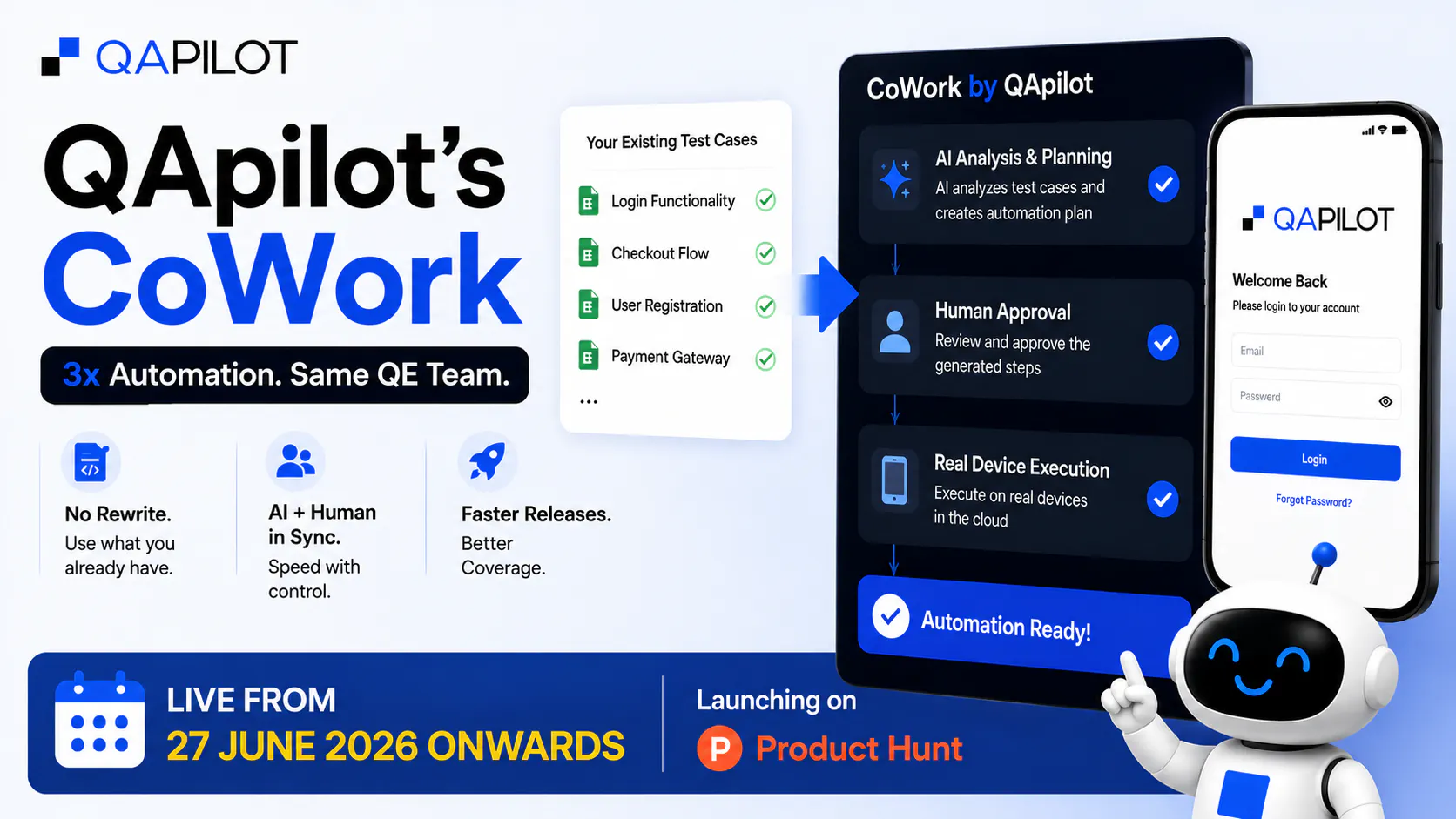
About QApilot's CoWork
Reviews 15
-
Gaylord Buckridge 4 months ago
Congrats on the launch! I really like the idea of turning existing test cases into something that can actually be executed without rebuilding everything from scratch. The balance between AI automation and human approval is a smart approach. Pausing when input is needed instead of making assumptions feels much more reliable for real-world testing.
-
Sedrick Hirthe 4 months ago
How does CoWork handle changes in app UI or user flows over time while keeping generated mobile automation tests reliable and minimizing maintenance?
-
Esteban Hilpert 4 months ago
Looks so useful!
-
Marcelo Prohaska 4 months ago
I really like that this project still treats humans as a fundamental part of the QA process. QA is extremely delicate. AI can be useful for speed and execution, but it still tends to get confused, assume things, or hallucinate its way through uncertainty. So the human-approved replanning part makes a lot of sense to me. I’d much rather have the system pause and ask when something changes than confidently continue with a broken or misleading test. Curious how you think about trust over time: how do QA teams review what the AI changed, and how do they decide when an approved adaptation should become part of the test suite?
-
Dejon Bergstrom 4 months ago
The honest-fail behaviour looks great. I'm curious about human-in-loop at scale though, if a nightly run throws 12 approvals at 2am, you're babysitting again. Does CoWork remember an approved change so it stops re-asking on every run after that?
-
Zachariah Hudson 4 months ago
Charan, the honest-fail and intent-anchoring already won me over (saw your answer to David), so let me push on the part that decides whether this scales: the human approval itself. A single replan-with-approval is clearly the right call. But a regression suite is hundreds of tests, and a UI change rarely hits just one, a renamed "Checkout" button can ripple across 40 flows. So my real question: when a human approves a replan once, does that decision propagate, does CoWork remember it for the rest of the run and the next one, or does the same change get re-surfaced 40 times? If every approval is a one-off, the human control that makes it trustworthy quietly becomes the bottleneck that kills the 3x. The magic version is one approval teaching the whole suite. Put simply: does an approved replan become a durable update to the test, or just a per-run decision? That's the line between "AI with a human checkpoint" and "a human clicking approve 200 times." Congrats on the launch, genuinely strong positioning :)
-
Joshua Abshire 4 months ago
The thing that kills most AI test-gen tools in practice is maintenance: the agent writes a suite, the UI changes next sprint, and now you're drowning in false failures. Does CoWork self-heal selectors when the DOM shifts, and can it tell a real regression from a benign markup change? That signal-to-noise ratio is what decides whether teams keep the suite or quietly delete it.
-
Joany Hansen 4 months ago
Congratulations
-
Wiley Lubowitz 4 months ago
mobile QA is so underserved, 3x is a bold claim 👀 which platform u nail first?
-
Felipe Sanford 4 months ago
This feels especially useful for teams that already have test cases written down, but still end up doing too much manual release checking because automation takes too long to maintain. The human-approved replanning part is the most important detail to me. For QA, I’d rather have the system pause and ask when something changes than confidently fake its way through a broken flow :) Curious how CoWork handles UI changes over time. does it learn from approved replans so the same changed label or popup does not need approval every time?
-
Joshua Abshire 4 months ago
real device testing is the part everyone skips and then regrets. nice to see the human approval step for unexpected states, that's usually where automation quietly lies to you. congrats on the launch.
-
Ayden Miller 4 months ago
The human-approved replanning part feels like the important bit. I’ve seen mobile test agents get scary when they quietly guess through OTPs or changed labels. Curious if teams can set different approval rules for smoke tests vs release-blocking flows?
-
Duncan Effertz 4 months ago
When scale testing mobile applications, how does CoWork handle deep state synchronization or state flakiness across parallel test instances? Is it actively maintaining a synchronized virtual state tree across the instances, or relying on aggressive DOM/view re-verification loops to prevent false negatives?
-
Duncan Effertz 4 months ago
The replanning loop is what gets me here — most AI test tools fail silently when the UI changes, and you end up with flaky tests nobody trusts. Human-approved replanning before re-execution is the right call. Curious how CoWork handles cases where the AI's planned steps diverge significantly from the original test intent — does the human reviewer see a diff of the original vs proposed plan, or just the new steps in isolation? Congrats on the launch 🚀
-
Malachi Armstrong 4 months ago
It’s a great idea. I apologize for my limited understanding. Considering the increasing cost-effectiveness and reliability of code production, why should we rely on agentic testing? I understand that specifications can fail due to changes like button renames, but (at least in our suite), it’s expected that tests will fail, and specifications need to be updated accordingly. Wouldn’t it be more efficient to use deterministic testing combined with a non-deterministic report generator?