

About Radiq
Reviews 3
-
Nikunj 6 months ago
The knowledge graph approach makes sense - most PM tools summarize feedback but never really connect it back to the codebase itself. When feedback is vague, like “checkout is slow,” how does Radiq figure out which module is actually responsible? Does it trace user flows end-to-end, or is it more of a semantic/keyword match against the codebase? Feels like ambiguous feedback would be one of the tougher cases to handle.
-
Jedidiah Farrell 6 months ago
The "autonomous coding era" framing is doing the real work here. PMs have always shipped sloppy specs because senior engineers absorbed the ambiguity. They knew which codebases mattered, what "reasonable" meant. AI agents can't do that. As more code gets written by Claude/Cursor/Copilot, the spec stops being a starting point and becomes the actual artifact. Curious how Radiq handles cases where the highest-evidence decision and the right decision conflict. Does PM judgment still override the priority signal, or does the system push back?
-
Randi Prohaska 6 months ago
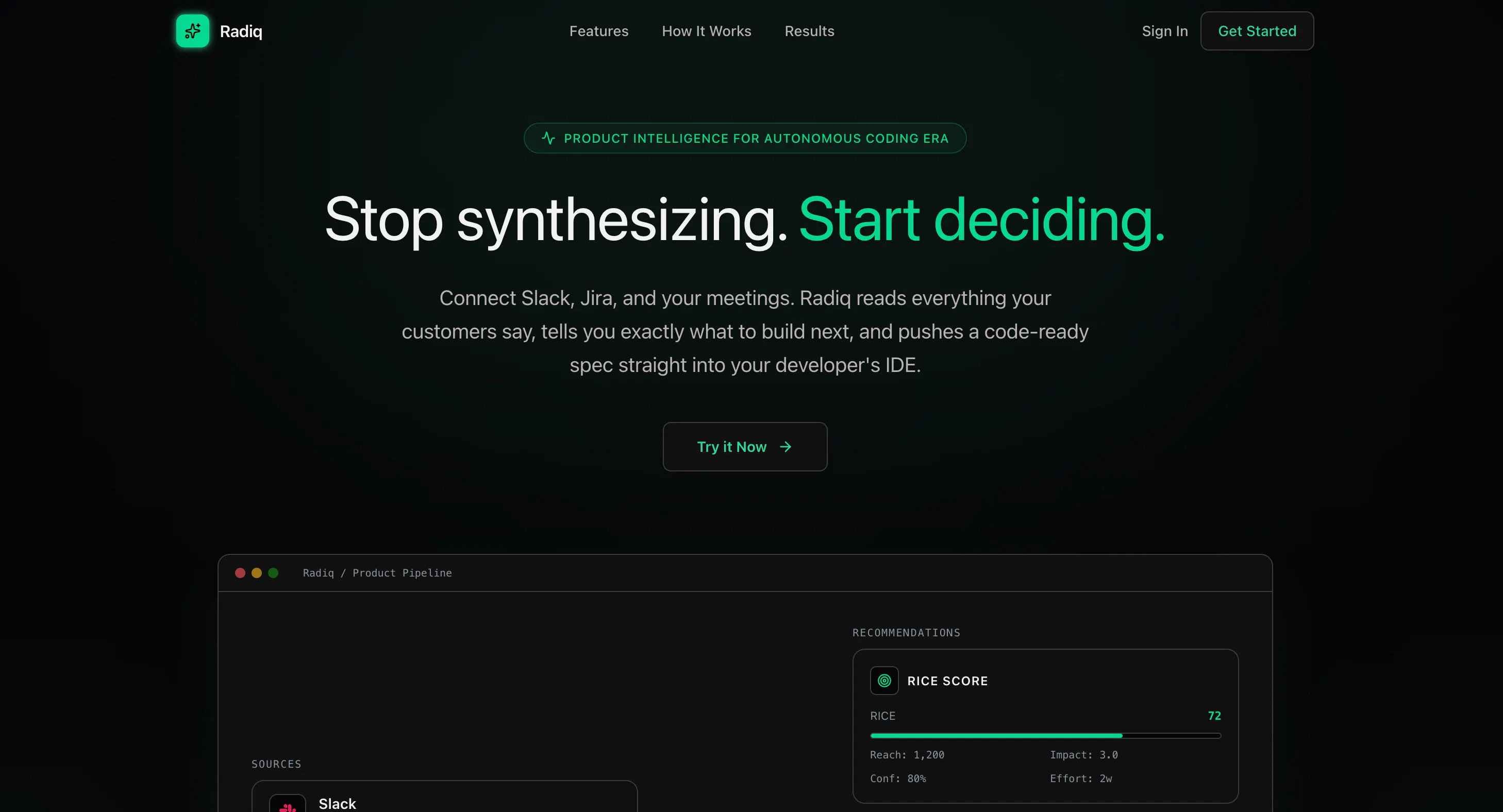
Hey everyone, I'm Devansh, co-founder on the technical side at Radiq. When Ritvik first walked me through this problem, the part that stuck with me wasn't the wasted hours. It was that PMs are doing this work manually in 2026, the same year coding agents are writing production code. Customer context sits across Slack, Jira, Confluence, meetings, calls, every team's tool stack. PMs are the human glue holding it together, and even after all that effort, the spec they hand to engineering still doesn't carry the codebase context an agent needs to build the right thing the first time. So we built the layer that holds it together. Radiq's core is a knowledge graph that reads across signals AND your codebase. Not vector retrieval, not just clustering, an actual graph where customer evidence maps directly to the modules and dependencies it touches. Getting that to run reliably with real messy data, real customer Slack threads, real codebases, was the hardest and most satisfying thing I've built. It's been four years building production AI at Deloitte, then agentic systems with Citigroup and Enterprise Ireland, plus my own AI agent marketplace, and this one feels like the bet that matters most. The MCP integration into Cursor, VS Code, and Windsurf is the part I'm most excited about. Specs are the wedge. But the real opportunity is what happens when product context stops living in silos. Every customer signal, every architectural decision, every spec connected, queryable, executable by an AI agent. We're just getting started. Come talk to us in the comments 🙌