

About Re_gent
Reviews 15
-
Conner Jacobs 6 months ago
Git for AI agents makes so much sense. The 'oops, my agent went rogue' moments are real — glad someone's solving this.
-
Burley Collins 6 months ago
The most valuable thing in a long-running agent is not just autonomy, it is knowing why the next attempt is still justified. I would want the loop to expose what changed since the previous try: new context, better verifier signal, reduced uncertainty, or a narrower task. Without that, autonomous retries quietly turn into expensive repetition.
-
Godfrey Donnelly 6 months ago
The audit trail problem with AI agents is real. When you're running agents that touch customer-facing outputs - outbound emails, content, CRM updates - knowing what ran, when, and what changed isn't nice-to-have, it becomes essential fast. Git for humans works because humans understand state. Curious how re_gent handles conflicts when two agents modify the same object in parallel - is it last-write-wins or do you surface the conflict for human resolution?
-
Adam West 6 months ago
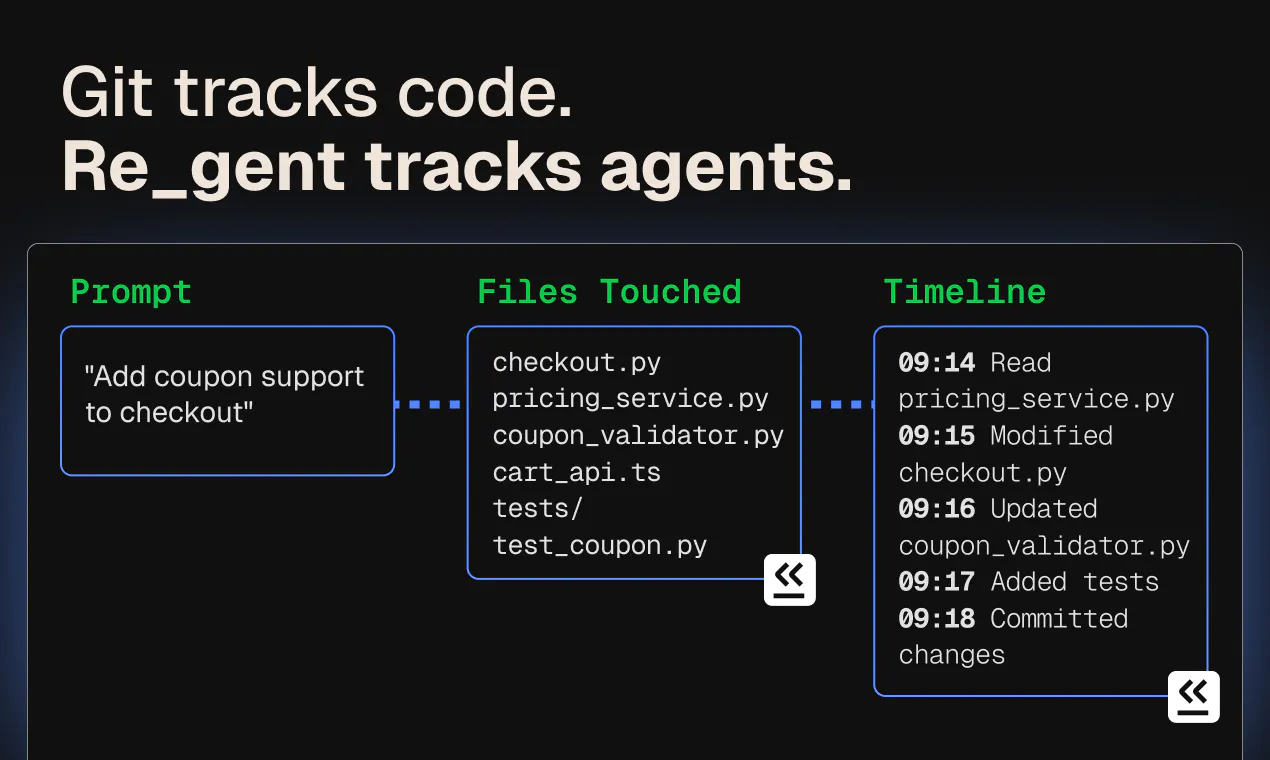
The gap Re_gent is filling: linking file changes back to the specific agent action or prompt that caused them is something no standard version control handles. But What I'm curious about is how it handles multi-agent sessions where two agents modify the same file in sequence. Does it trace each change to the right agent independently, or does the attribution get murky
-
Zachariah Hudson 6 months ago
the observability gap for agent work is real and getting worse as agents do more. you end up with a codebase that changed in ways you can explain at a high level but can't trace precisely. version control for human code exists because we learned that lesson the hard way. learning it again for agent output was probably inevitable
-
Dorcas Parker 6 months ago
I run parallel Claude Code sessions on my local machine with git worktrees, so each agent is editing its own set of files. Will Re_gent work for that setup?
-
Godfrey Donnelly 6 months ago
The "blame" feature is the most interesting piece here. Tracing a line of code back to its originating prompt is genuinely hard when agent sessions involve compaction, branching reasoning, and multi-step tool calls. How is Re_gent defining the unit of attribution? If a single prompt triggers a chain of 8 tool calls that each touch different files, does blame point to the root prompt, the specific tool call, or both? That granularity decision shapes how useful the audit trail is for anything compliance-adjacent.
-
Randi Prohaska 6 months ago
Version control for agent activity is something I didn't know I needed until now. When an agent makes a bad decision mid-task, rollback is exactly what you want. Does it track just file changes or the full agent decision chain?
-
Rylan Cremin 6 months ago
This solves a real pain point. I run 15+ automated agents in production and the worst debugging scenario is "something changed overnight and I don't know which agent did it." Right now my workaround is JSON audit trails per agent, but tracing a bad outcome back to the specific prompt that caused it is still manual detective work. The multi-file rollback across sessions is the killer feature. Agent mistakes rarely touch just one file — they cascade. Does Re_gent handle rollbacks in systems where Agent A's output feeds into Agent B's input? That chain reaction is where most agent damage happens in my experience.
-
Kenneth Corwin 6 months ago
This solves a real problem. The biggest issue with coding agents right now isn't that they make mistakes, it's that nobody can tell you exactly what changed and why. Being able to trace a change back to the prompt that caused it is huge for teams where multiple people are using agents on the same codebase. Curious — does it handle cases where an agent modifies something across sessions? Like if today's prompt undoes something from yesterday's session, does the timeline surface that conflict?
-
Toni Kutch 6 months ago
Congrats on the launch! Version control for agent output is an underrated problem, when you're shipping content or code with AI, auditability matters as much as quality. The GitHub integration is the right move. What does a rollback actually look like in practice for an agent-generated artifact?
-
Hillard Halvorson 6 months ago
Changes are also visible in Claude Code. So the value is that you can review changes in the history, right? Am I understanding correctly?
-
Garland Grady 6 months ago
Git shows what changed, but never why — that gap gets really painful when an agent edits 10 files while you're away and something breaks. The rgt blame feature is what caught my attention — tracing a line of code back to the exact prompt that caused it is genuinely useful for debugging. Curious if it works with Claude Code already or if that's still on the roadmap?
-
Daren Bruen 6 months ago
Treating agent activity as a versioned artifact you can diff and revert is genuinely clever. Most teams just log outputs and hope. At RetainSure we've felt the pain of debugging a bad agent decision without any state history to trace it back through. Does Re_gent support mid-run checkpointing so you can fork from a specific state, or is versioning scoped to full run boundaries?
-
Toni Kutch 6 months ago
Linking agent file changes to the exact prompt that triggered them is genuinely novel. Most agent frameworks hand you a diff with no causal chain. We've been burned by cascading agent edits across services where figuring out which session introduced a bug takes forever. How do you handle rollback when the agent touched external state or APIs? Is it purely file-level undo or does re_gent track side effects too?