

About Render Sandboxes
Reviews 8
-
Gilbert Lind 2 weeks ago
The isolation angle is the part that feels useful. Running several coding agents on one laptop is fine until memory dies and every session goes with it. Curious how suspend and wake behave after a heavy install. If one sandbox hits a memory limit, do the others keep running cleanly, and does wake restore the working tree without a full reinstall?
-
Demetrius Gulgowski 2 weeks ago
Congrats on the launch. Maybe a stupid question, but can I run subscription based agents (e.g. claude code) in the sandboxes? Or would it be API only?
-
Mckenzie Mosciski 2 weeks ago
All our scheduled agents run on one laptop, and one evening the 6pm run just died because the lid was closed. Can a sandbox wake itself on a schedule, say every day at 6pm, or does something outside have to send it the first command?
-
Franz Bauch 3 weeks ago
Can I spin up a bunch of sandboxes from the same snapshot, or do I need a copy for each one?
-
Jackson Fisher 3 weeks ago
I've run a dozen or more coding agents at once on one 48GB Mac. In September that took the whole machine down from memory exhaustion and every session died together, so the isolation is the part I care about here. What happens when one sandbox hits its memory limit: does only that agent die while the others keep going? And how well does suspend and wake hold up with a big install? Our node_modules is 18GB.
-
Jarrell Homenick 3 weeks ago
Congrats on the launch! How would you recommend running long AI jobs alongside a web API on Render? I'd be especially interested in what happens to jobs already in progress during a deployment.
-
Kyleigh Luettgen 3 weeks ago
Keeping memory and files through a pause is useful for longer tasks. When debugging a retry, I'd also want to see clearly which work resumed and which work ran again.
-
Jarrell Homenick 3 weeks ago
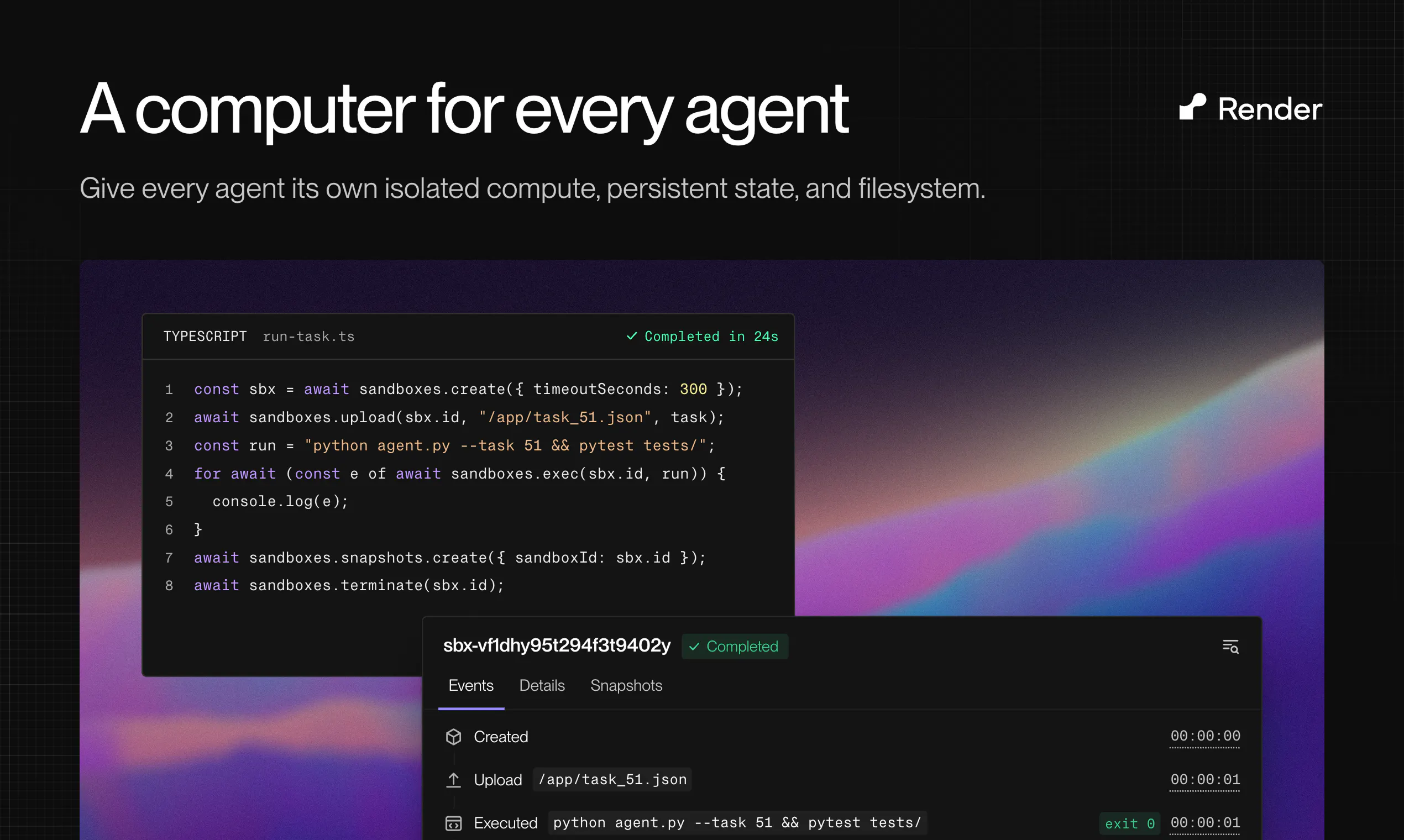
Hey Product Hunt 👋 I'm Slav, PM for Render Sandboxes. The work agents are given is becoming increasingly complex. Like people, agents need machines on which to do this work, so they can write and run code, install dependencies, manipulate files, and more. But not just any machine will do! To work safely, agents need a separate machine for each task or user, isolated from your app and from each other. And since agent work comes in bursts, those machines need to start and stop with demand. Render Sandboxes give each user or task its own machine the moment it’s needed. Each sandbox runs in its own Firecracker microVM. Speed: a sandbox is ready for its first command in under a second. Scale: you can run thousands of sandboxes at once, reliably. Security: you can set each sandbox to allow all outbound traffic, allow only the domains you list, or block outbound traffic entirely. Credential brokering (now in early access; let us know if you're interested) adds your API keys to outgoing requests, so the keys never sit inside the sandbox. Pricing: you pay for the CPU a sandbox actually uses and the memory it allocates. A suspended sandbox stops both charges and billing, except for snapshot storage. Long-running work: A sandbox can run with no time limit. When it goes idle, Render suspends it and wakes it on the next command with its files and memory intact. One platform: your sandboxes live in the same workspace as your web services, background workers, and Render Postgres databases, with one API key, one SDK, and one bill. Teams use Render Sandboxes to run an agent harness like Claude Code or Codex inside a sandbox, to start a full copy of an app so a coding agent can test its changes, and to run code and files they didn't write. Render Sandboxes are in public beta - tell us if anything feels missing or doesn't work as expected. We'll be here throughout the day answering questions!